How to Strengthen a Weak Horse? Guide 2023
If you want to improve the strength of your weak horse, you can do a few different exercises. First of all, you can try exercises that will engage the deep muscles in the hind end. Second, you can try exercises that will improve your weak horse's topline. Third, you can also work on jumping at the step and in-hand groundwork.
Exercises to strengthen a weak horse's topline
The topline is a complex and difficult area of muscle development for horses. Proper exercise and diet can help a weak horse develop a stronger topline. Some common symptoms of a weak topline include lack of impulsion and straightness. If you've noticed any of these symptoms, you may want to start with diet and exercise modifications.
One of the best ways to improve a weak horse's topline is by stretching. You can encourage a horse to stand square by giving it a carrot, or you can do a stretch from the ground. Another great exercise for building a topline is backing up, which requires the horse to take a few steps backward. The reason for this exercise is to engage the horse's core, and therefore strengthen the topline.
Exercises to engage the deep muscles of the hind end
A horse with weak hind end muscles can benefit from an exercise program that engages the deep muscles of the hind end. This type of exercise will strengthen the Iliopsoas muscle, which acts as an adductor by pulling the femur forward. It can also strengthen the hindquarters by training the psoas-iliac and gluteus medius muscles. Use fast muscle recovery supplements after Horse workouts.
To determine if a horse's hindquarters are weak, watch for wringing hocks, loose stifles, and swinging hocks. If you notice these symptoms, it may be time for a veterinarian to check your horse's hind end. Having a vet look at your horse's hind end will help your exercise program work more effectively.
Jumps at the step
Jumps at the step help a horse to decelerate at takeoff and store energy for a push-off. These exercises use the tendons, ligaments, and muscles of a horse to help the horse decelerate. The legs and forehand work together to pull the horse forward and the hind legs bend inward.
When you work with your horse, pay close attention to its hips and hocks. If you notice soreness in the stifles and hocks, it's time to see a veterinarian. With proper medical care, your horse will respond to exercises much better.
In-hand groundwork
Groundwork exercises are an important part of horse training. It helps a horse to understand his position in relation to you. A horse that doesn't know how to stay in one spot will try to rush past you and crowd you. In order to make your horse aware of where he's supposed to stand in relation to other people, you need to train him to respect his space.
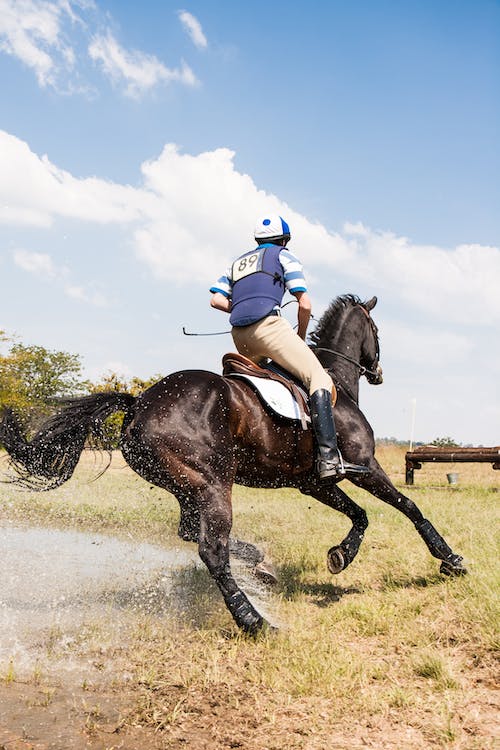
In-hand groundwork is extremely valuable for strengthening the back and hindquarters of a horse. It can also help a horse prepare for self-carriage with a rider. Clayton, H.M. (2009) reviewed equine back pain from the motor control perspective. Comparative Exercise Physiology, 8(3), 145-152
Longlining
Longlining a horse is a great way to build strength. It can be used to overcome fear and apprehension. In longlining a horse, the rider lies on the ground. The horse must remain relaxed and accepting of the position. The rider should always maintain good positioning around the horse, as it may react unpredictably if it feels uncomfortable.
Longlining helps develop the fitness of a horse, making it easier to learn basic commands like forward movement, steering, and straightness. It also enables the rider to observe and learn from the horse. It is also beneficial when starting a young horse under saddle.
Reinback
Rein back is an excellent way to help a weak horse gain strength. Rein back requires a horse to reverse backward and its legs move in diagonal pairs (left front leg moves with left back leg, and vice versa). As the horse moves backward, his hindquarters move more underneath the body. This movement is important for developing a horse's lightness and collection.
This exercise stretches the muscles of the hindquarters and the stifle. It also encourages the horse to engage its topline and abdomen. Reinback can be performed in hand or under saddle. Most horses prefer the latter.
Stretching the hind limbs
Stretching the hind limbs can help a weak horse improve its gait. To do this, hold the back leg by the fetlock or hock, and gently lead the hind leg forward. While the hind leg is extended, make sure to keep the foot low to the ground so that it doesn't stress the soft tissues.
The hind end is the horse's biggest "spring box" and the source of propulsion. In addition to strengthening the hind limbs, a weak hind end can also cause the horse to limp and be unbalanced. Some horses may have wasted muscles that require more nutritional attention and strengthening exercises.
Appreciate the creator