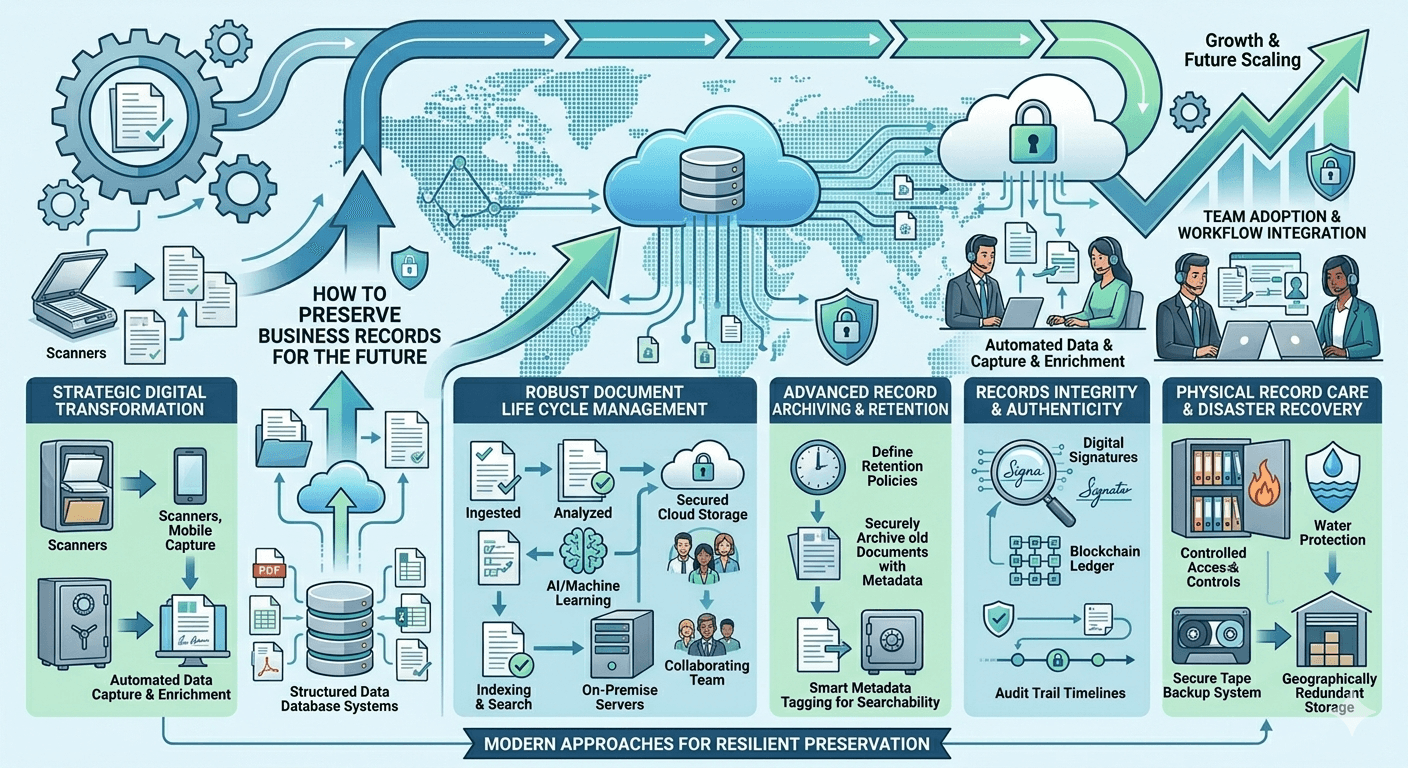
How to Preserve Business Records for the Future
Every business creates records every day. Contracts, invoices, payroll files, tax documents, client agreements, compliance reports, emails, and internal policies all become part of a company’s history. The problem is that many companies do not think seriously about Long-Term Archiving until a file goes missing, an audit begins, or a legal issue appears. By then, the damage is already knocking at the door.
Preserving business records is not just about saving old documents. It is about protecting proof, memory, decisions, and accountability. A company’s records show what was agreed, what was paid, what was approved, and how key decisions were made. Without a proper system, those records can become scattered across inboxes, shared drives, laptops, cloud folders, and outdated software.
That sounds harmless at first. It is not. Poor record preservation can slow teams down, create compliance risks, increase storage costs, and expose sensitive data. In a world where business information keeps growing, companies need a clear plan for keeping records safe, searchable, and useful for years.
Why Business Records Need a Real Preservation Strategy
Business data is growing at a massive rate. IDC projected that the global datasphere would grow from 33 zettabytes in 2018 to 175 zettabytes by 2025. That means companies are creating, storing, and managing more information than ever before. More data can be useful, but only when it is controlled. Otherwise, it becomes digital clutter.
This is where many businesses struggle. A company may have the final version of a contract in one folder, an older draft in another, and a scanned copy attached to an email. Finance may store records differently from HR. Sales may keep client documents in a CRM, while operations keeps project files in a shared drive. Everyone thinks the records are “somewhere.” Somewhere is not a strategy.
A poor archive creates three main problems.
First, it makes records hard to find. If employees waste time searching for documents, productivity drops. A missing file can delay a client response, slow down an audit, or create confusion during a dispute.
Second, it creates security risks. Archived records often contain sensitive financial, legal, employee, and customer information. IBM’s 2025 Cost of a Data Breach Report found that the global average cost of a data breach was USD 4.4 million. That is not a small mistake. That is a boardroom-level problem.
Third, it leads to unnecessary storage. Veritas reported that 52% of stored organizational data was dark data, meaning its value was unknown, while another 33% was redundant, obsolete, or trivial. In simple words, many companies are paying to store data they do not understand or need.
This is why Long-Term Archiving matters. It gives businesses a structured way to preserve important records while reducing noise, cost, and risk.
What Business Records Should Be Preserved?
Not every document needs to live forever. Keeping everything may feel safe, but it often creates bigger problems. The more unnecessary data a company stores, the harder it becomes to find what truly matters.
A better approach starts with classification. Businesses should group records by type, purpose, and importance. Common categories include financial records, tax files, contracts, employee records, insurance documents, legal correspondence, compliance reports, vendor agreements, customer records, intellectual property documents, and operational policies.
After classification, the next step is setting retention periods. Some records may need to be kept for only a few years. Others may need to be preserved much longer because of legal, tax, regulatory, or business requirements. For example, a signed client agreement may remain useful long after a project ends. A routine internal update may lose value quickly.
This is where a retention schedule becomes important. A retention schedule explains what should be kept, where it should be stored, how long it should be retained, and when it can be deleted. Without this, employees make their own rules. That usually leads to chaos wearing a neat folder name.
Businesses should also assign ownership. Records management cannot float between departments with no clear responsibility. Finance, legal, HR, operations, and IT should all understand their roles. IT may manage systems, but that does not mean IT alone should decide which records are legally or commercially important.
Good record preservation is not just a technical task. It is a business discipline.
How to Build a Future-Ready Archive
A future-ready archive needs more than storage space. It needs structure, security, consistency, and regular review.
Start with stable file formats. Important records should be saved in formats that remain accessible over time. PDF and PDF/A are commonly used for long-term document preservation because they are designed to maintain document appearance and readability. The goal is simple: a file saved today should still open correctly years from now.
Next, use metadata. Metadata is information about the document, such as title, date, department, author, client name, record type, retention category, and access level. Without metadata, an archive becomes a digital basement. Everything may be there, but finding anything feels like punishment.
Security should also be built into the archive from the beginning. Businesses should use role-based access, encryption, audit trails, strong passwords, and multi-factor authentication. Sensitive records should not be available to everyone. Access should follow business need, not convenience.
Backups are another critical part of preservation. A single archive location is risky. Files can be deleted by accident, damaged by system failure, locked by ransomware, or lost during migration. Backups should be stored securely and tested regularly. An untested backup is just optimism with a file path.
Finally, review the archive at least once a year. Regulations change. Teams change. Software changes. Business priorities change. A system that worked five years ago may not be enough today. Regular reviews help ensure that records remain accurate, secure, and aligned with company needs.
This is the real value of Long-Term Archiving. It keeps business records useful, not just stored. It turns old files into reliable evidence, accessible knowledge, and protected company memory.
Conclusion
Business records are not just paperwork. They are proof of decisions, transactions, responsibilities, and history. When records are poorly managed, companies lose time, increase risk, and weaken their ability to respond during audits, disputes or major business changes.
A strong preservation strategy should classify records, set retention rules, use stable formats, add metadata, protect access, maintain backups, and review the archive regularly. This approach keeps important information organized without drowning the business in unnecessary data.
Long-Term Archiving is not about living in the past. It is about making sure the business can trust its records in the future. And for any serious company, that trust is worth protecting.
Appreciate the creator