How to Choose the Right Soap for Your Skin Type
Your skin's been tight after every shower for weeks, or breaking out along the jaw, and you've started eyeing the soap in your bathroom as the culprit. You've probably seen "castile soap" and "organic soap" pushed as the fix, next to warnings about sodium lauryl sulfate. Most of that advice skips a step. Before buying anything new, you need to know what your skin is doing right now, and what soap actually does to it, chemically. That's the part most guides turn into a shopping list instead of an answer.
What your skin is actually doing right now
Skip the "oily, dry, combination" quiz for a second and try something simpler. Wash your face with plain water only, no cleanser, and wait thirty minutes without touching it. If your skin feels tight or flaky by the end, it's leaning dry. If your T-zone (forehead, nose, chin) has visible shine but your cheeks stayed matte, that's combination. All-over shine within the half hour points to oily. No real change either way is normal skin, and you have more room to experiment than the other categories do.
Sensitivity is a separate axis, not a skin type. If new products regularly sting, redden, or itch within minutes of contact, or you've been told you have eczema or rosacea, sensitivity overrides whatever the water test says. That's the group most likely to react to a soap switch, and the group most guides give the least specific advice to.
Write down what you find. It's the baseline you'll compare against once you've actually switched, because two weeks from now you'll want to know whether your skin is adjusting or reacting. Everything after this, the soap type, the pH, the ingredient list, only matters in relation to what you just found.
What sodium lauryl sulfate actually does to your skin barrier
Sodium lauryl sulfate, SLS, is the surfactant behind most commercial bar and liquid soap's foam. It's cheap. It lathers fast. It also strips lipids out of your skin's outer layer along with the dirt.
A 2021 study published in the journal Cosmetics measured this directly. Researchers applied a 24-hour occlusive patch with a 0.5% SLS solution to the skin of women with reactive skin, then measured transepidermal water loss, the standard gauge of how much moisture escapes through a compromised barrier. It rose from a baseline of about 5 grams per square metre per hour to over 42. That's not a subtle shift. It's the skin barrier failing to do its one job, holding moisture in.
You won't see that number on a soap label. What you'll notice instead is skin that feels "clean" right after washing and tight an hour later, because tightness is often barrier damage, not cleanliness doing its job.
This is the actual argument for switching soaps. Not "natural is better" as a slogan, but a surfactant with a published, measurable effect on your skin's water barrier every time you use it.
Castile soap and organic soap: what changes, and what doesn't
Here's the part most soap marketing leaves out. Castile soap, and organic soap generally, is still alkaline. True soap is made by reacting plant oil with sodium or potassium hydroxide, a process called saponification, and the result typically sits around pH 9 to 10. Your skin's own surface runs mildly acidic, somewhere between pH 4.5 and 5.5. This is well established: a widely cited 2006 study in the International Journal of Cosmetic Science, Lambers et al., found natural skin surface pH averages below 5. So castile soap isn't "pH balanced" in the sense the phrase gets used online. It's soap, and soap is alkaline by chemistry, full stop.
What castile and organic soap do change is what's not in them. No SLS. No synthetic detergents. No synthetic fragrance carrying a mix of undisclosed compounds. And because saponification releases glycerin as a natural byproduct, and most commercial soap makers extract that glycerin to sell separately, a soap that keeps it in the bar (ours does) leaves your skin better cushioned than a stripped detergent bar would, even at a similar pH. Glycerin is a humectant, it pulls moisture into the outer skin layer instead of letting the wash step take moisture away with it.
The honest version of the pitch is that organic soap trades one kind of alkalinity for a shorter, cleaner ingredient list and a byproduct that would otherwise be removed. It's not a shortcut to matching your skin's natural pH. No bar soap, however it's marketed, actually is.
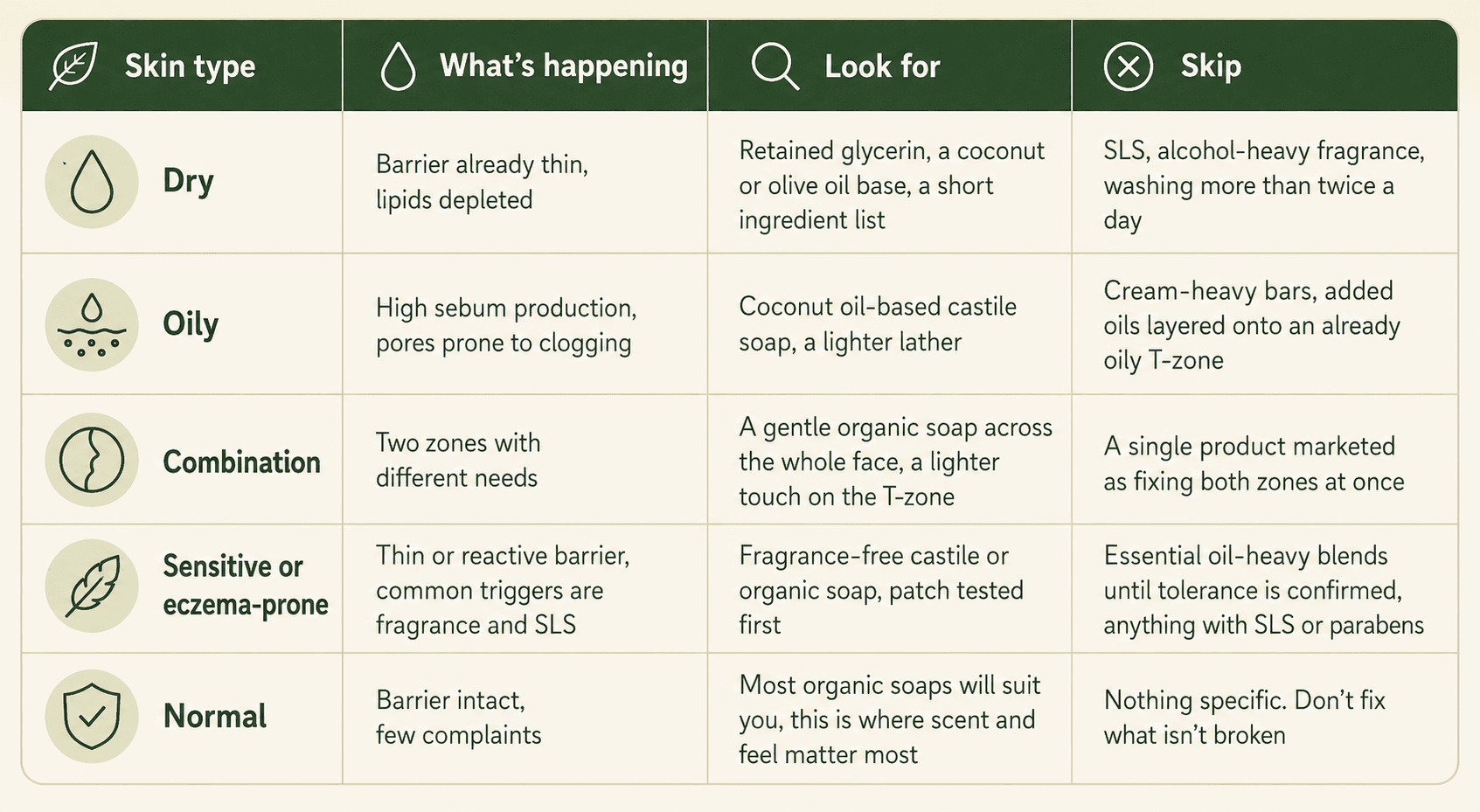
Matching soap to your skin type
Here's how that plays out by category, once you know which one you're in.
The two-week window most people quit before finishing
Every soap switch comes with an adjustment period, and this is where most people give up and blame the new product. The common explanation is that oil glands used to compensating for constant stripping take a while to recalibrate, and the acid mantle needs a few wash cycles to rebuild. That mechanism isn't proven with hard data the way the SLS numbers above are, but the pattern shows up consistently enough in customer feedback that it's worth planning around rather than dismissing.
In the messages we get from customers switching over, the most common question in the first ten days is some version of "is this supposed to feel different." Usually yes. A short adjustment window, some extra shine or a bit of tightness in week one, is normal. What isn't normal is redness, stinging, or breakouts that get worse past day ten. That's a sign to stop, not push through.
Give it two weeks before deciding either way. Judging a soap switch after three days is like judging a gym programme after one session.
Reading a soap label in Singapore
A few things specific to shopping here. Singapore's tap water, according to PUB data, falls in the soft to moderately soft range, roughly 16 to 106 mg/L of hardness depending on your area. A lot of soap advice is written for places where the water actually is hard, and it blames dryness on the water itself. Here, that's rarely the cause. If your skin is dry in Singapore, look at the soap and your air-conditioning use before you look at the tap.
On the label, the ingredients worth avoiding are the same regardless of where you live: sodium lauryl sulfate or sodium laureth sulfate, parabens, and synthetic fragrance listed simply as "parfum" with no breakdown. What you want to see instead is a short list: saponified oils (coconut, olive, or similar) and glycerin. If the bar is scented, look for named essential oils rather than an undisclosed fragrance blend. Essential oils aren't automatically gentler, some are common irritants in their own right, so if you're in the sensitive or eczema-prone group above, patch test a scented bar the same way you'd patch test anything new.
There's also a storage habit worth changing once you switch. A bar left sitting in a humid bathroom stays wet longer here than it would in a drier climate, and a soap dish that doesn't drain turns into a breeding ground on the surface of the bar itself. This matters more with organic soap than with a preservative-heavy commercial bar, since fewer synthetic preservatives means less built-in resistance to that kind of buildup. A slotted dish or a draining soap saver fixes it, and it's a five-dollar problem, not a reason to avoid organic soap.
One more thing worth knowing before you buy. Under Singapore's Health Products Act and the ASEAN Cosmetic Directive, cosmetic products are prohibited from claiming to treat or prevent a medical condition, including eczema. If a product's marketing promises to cure a skin condition rather than support the skin around it, that claim is itself a reason to be skeptical.
FAQ
Is castile soap good for eczema-prone skin?
It can suit eczema-prone skin better than an SLS-heavy soap, since it skips the synthetic detergents most linked to barrier disruption. It cannot treat or prevent eczema itself, and no cosmetic product legally can claim that. Patch test on your inner forearm for 48 hours before using it anywhere near a flare-prone area.
Can I use the same soap on my face and body?
You can, if it's a mild, fragrance-light organic or castile soap and your face isn't notably more reactive than your body. If your face reacts to products your body tolerates, which is common, keep a separate, gentler soap for it.
What does "saponified" mean on a soap label?
It means the oil has already fully reacted with the alkali during manufacturing, so there's no leftover lye sitting in the finished bar. "Saponified coconut oil" or "saponified olive oil" is the sign of true soap made through that process, as opposed to a detergent bar built from synthetic surfactants.
How long should I give a new soap before judging it?
Two weeks. The first week is adjustment, not a verdict. Redness, stinging, or breakouts that worsen past day ten are the signal to stop. Mild tightness or extra shine in week one usually isn't.
Is organic soap actually better, or is it just marketing?
The chemistry difference is real: no SLS, no synthetic fragrance, retained glycerin. The ingredients are better. The pH story doesn't change, since true soap, organic or not, is alkaline by nature.
Skip the shopping trip until you've done the water test above and written down what your skin actually does over thirty minutes. Then pick one soap, an organic or castile bar without SLS if dryness or sensitivity is your reason for switching, patch test it on your inner forearm for 48 hours, and commit to the two-week window before judging it. That's the whole decision. Everything else is picking a scent.
Appreciate the creator