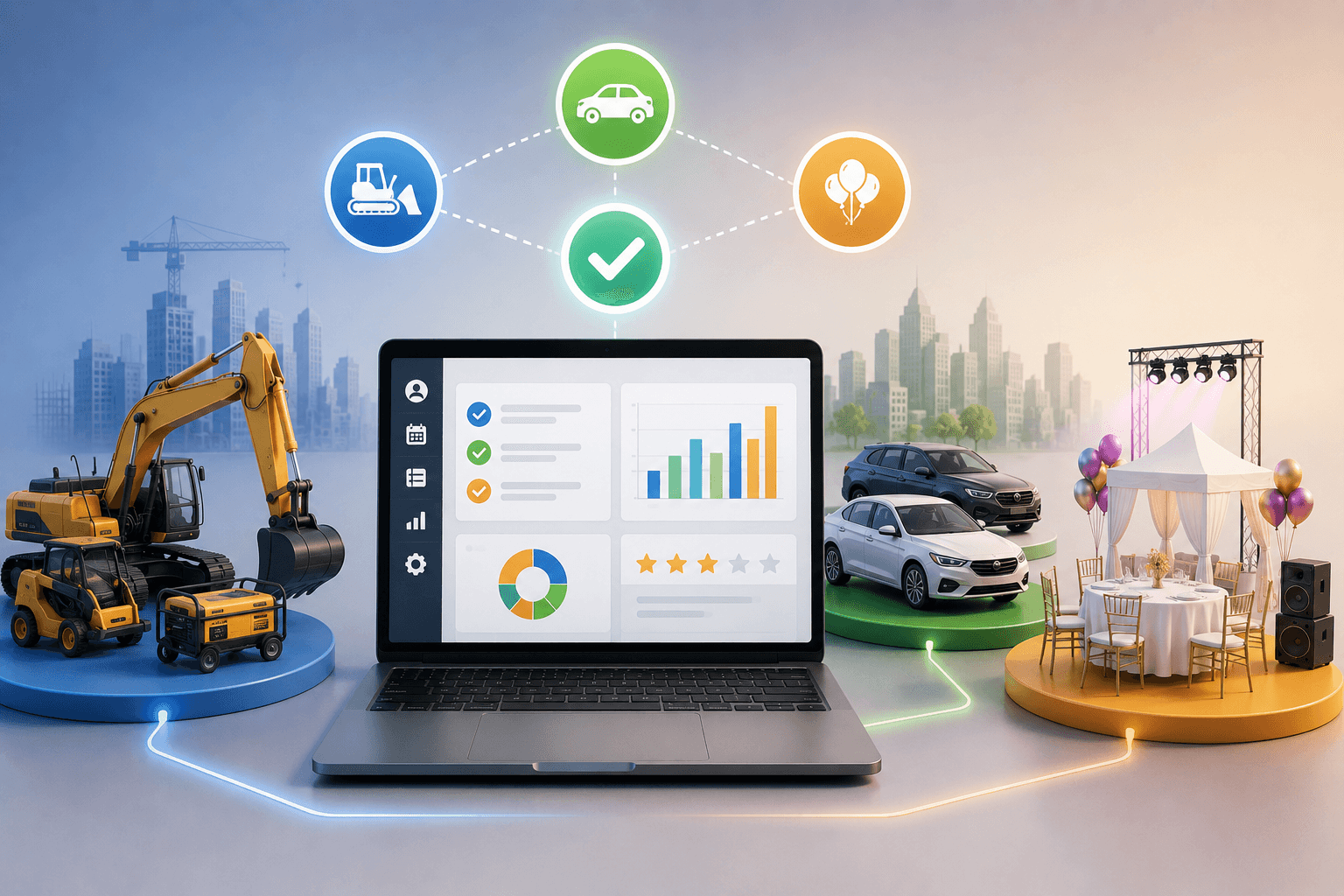
How to Choose Rental Software for Equipment, Car, and Party Rental Businesses
Rental businesses operate differently from traditional retail businesses. Instead of selling products once, rental companies must manage inventory availability, reservations, returns, deposits, maintenance, pricing, and customer relationships throughout the rental lifecycle. As the business grows, managing these activities through spreadsheets, phone calls, and separate tools can quickly become complicated.
This is where rental business software can make a significant difference. The right platform can centralize daily operations, reduce manual work, prevent double bookings, and create a smoother experience for both businesses and customers. Whether you rent construction equipment, cars, party supplies, furniture, or other assets, choosing the right software can help you build a more organized and scalable operation.
What Is Rental Business Software?
Rental business software is a digital platform designed to help companies manage products or assets that are rented for a specific period. Unlike conventional eCommerce software, rental-focused solutions account for time-based availability, reservations, returns, deposits, rental pricing, and asset utilization.
Modern rental platforms can combine inventory management, online bookings, payment processing, customer management, reporting, and scheduling in one system. Some solutions are designed for specific industries, while others support multiple rental categories.
For businesses managing complex rental operations, rental business management software (https://www.yo-rent.com/how-to-start.html) can provide centralized control over inventory, customers, orders, pricing, and other essential processes.
Why Do Rental Businesses Need Specialized Software?
Rental operations involve several moving parts. A single asset may be reserved by one customer today, returned tomorrow, inspected for maintenance, and rented again later. Managing these activities manually increases the risk of errors.
Specialized software helps businesses:
Track inventory availability in real time
Automate invoices and payment collection
Manage security deposits
Maintain customer records
Monitor business performance
Manage multiple locations or vendors
Offer customers online booking options
The goal is not simply to digitize existing processes but to create a connected workflow where different parts of the rental business work together.
Best Rental Software Solutions by Business Type
Different rental industries have different operational requirements. Therefore, the best solution depends on the type of assets being rented, the rental model, and the size of the business.
1. Equipment Rental Software
Equipment rental companies often manage valuable assets such as construction machinery, power tools, industrial equipment, medical devices, landscaping equipment, and event equipment. Inventory utilization and asset availability are particularly important in this sector.
A suitable equipment rental platform should allow businesses to create detailed product listings, specify rental rates, manage availability, and monitor rental periods. Advanced inventory controls can also help businesses identify which assets are available, rented, under maintenance, or unavailable.
Businesses should look for features such as:
Equipment inventory management
Asset availability calendars
Hourly, daily, weekly, and monthly pricing
Rental extensions
Security deposit management
Online reservations
Customer and vendor management
Reporting and analytics
Some modern platforms also support both single-vendor and multi-vendor rental models, allowing entrepreneurs to operate their own inventory or build a marketplace connecting multiple suppliers.
2. Car Rental Software
Car rental businesses need software that goes beyond basic inventory management. Since vehicles are high-value assets, operators must carefully manage availability, reservations, customer information, pricing, documentation, and vehicle utilization.
Car rental software should make it easy for customers to search for vehicles based on dates and availability. Businesses can then manage reservations, customer details, rental agreements, payments, and vehicle status from an administrative dashboard.
Important features include:
Real-time availability
Online booking
Location and pickup management
Flexible rental durations
Customer verification
Digital rental agreements
Payment processing
Map-based search and detailed vehicle listings can also improve the customer experience by helping users quickly find suitable vehicles and understand important rental information before booking.
3. Party & Event Rental Software
Party rental companies typically deal with large quantities of products, including tables, chairs, tents, decorations, lighting, sound equipment, inflatables, photo booths, and wedding supplies.
The challenge is that multiple events may take place on the same day. A business may need to know which items are reserved, when they need to be delivered, when they will return, and whether they are available for another event.
A good party rental solution should provide:
Event-based booking
Real-time inventory availability
Delivery and pickup scheduling
Online payments
Security deposits
Customer management
Event calendars
Modern party rental platforms increasingly combine bookings, inventory, payments, contracts, and delivery management to reduce the need for multiple disconnected tools.
Essential Features to Look for in Rental Software
Regardless of the rental niche, certain capabilities should be considered essential when evaluating a software solution.
1. Inventory Management
Inventory management is the foundation of rental operations. The system should provide an accurate picture of available, reserved, rented, returned, damaged, and unavailable assets.
Real-time inventory visibility helps prevent double bookings and makes it easier to maximize asset utilization.
2. Online Booking and Reservations
Customers increasingly expect to research and reserve rental products online. An online booking system allows customers to select products, choose rental dates, review pricing, and submit orders without relying entirely on phone calls or emails.
Automated reservations can also reduce administrative work for employees.
3. Availability Calendar
A visual availability calendar can help rental companies understand which assets are booked and when they become available again. This is especially useful for businesses handling high-volume or event-based rentals.
4. Flexible Pricing
Rental businesses rarely use one fixed price for every situation. Rates may vary according to rental duration, season, demand, quantity, or customer type.
The software should therefore support flexible pricing rules and multiple rental periods.
5. Payments and Security Deposits
A rental transaction may involve rental charges, taxes, delivery fees, discounts, and refundable security deposits. Software should make it possible to manage these financial components accurately.
Integrated payment functionality can also make online checkout faster and more convenient.
6. Customer Management
A centralized customer database allows businesses to maintain contact details, booking history, invoices, communications, and other relevant information. This can help improve customer service and encourage repeat rentals.
7. Reporting and Analytics
Business owners need more than booking information. Reports can reveal revenue trends, popular products, asset utilization, customer behavior, cancellations, and other performance indicators.
These insights can support better inventory purchasing and pricing decisions.
How to Choose the Right Rental Software
Selecting a rental platform should begin with business requirements rather than simply comparing feature counts.
First, identify your rental model. Determine whether you operate a single-vendor rental store, a multi-vendor marketplace, a B2B rental operation, or a combination of rental and sales.
Next, evaluate your inventory. Consider how many products or assets you manage and whether they require serial numbers, maintenance schedules, different pricing structures, or availability restrictions.
You should also consider the customer journey. A good platform should make it easy for customers to discover products, check availability, select rental periods, make payments, and receive booking information.
Finally, assess scalability. The software should be capable of supporting additional products, users, locations, vendors, and customers as your business grows.
Ready-Made vs. Custom Rental Software
Businesses generally have two major options: develop software from scratch or use a ready-made rental solution.
Custom development offers extensive control over functionality and design, but it generally requires more development time, technical resources, testing, and ongoing maintenance.
A ready-made solution can provide a faster route to market because many core rental features are already available. Businesses can then customize the platform according to their specific requirements.
For entrepreneurs who want to launch quickly while retaining room for customization, a ready-made platform such as Yo!Rent can provide rental-focused functionality for equipment, vehicle, party, furniture, dress, and other rental categories.
Benefits of Using Rental Software
Implementing the right software can deliver benefits across the entire rental operation.
Greater efficiency: Automation reduces repetitive administrative tasks and manual data entry.
Fewer booking errors: Real-time availability helps minimize scheduling conflicts and double bookings.
Better customer experience: Online product discovery, booking, payments, and order updates make renting more convenient.
Improved asset utilization: Businesses can monitor how frequently assets are rented and identify underutilized inventory.
Centralized operations: Managers can oversee bookings, customers, inventory, payments, and reports from one platform.
Scalable growth: Digital systems can make it easier to expand inventory, locations, vendors, and customer reach.
Final Thoughts
The right rental software can transform a rental business from a collection of manual processes into a more organized, scalable, and customer-friendly operation. Equipment rental companies can benefit from asset tracking and maintenance workflows, car rental businesses can focus on vehicle availability and booking management, while party rental companies can simplify complex event orders and delivery schedules.
The best solution is ultimately the one that matches your rental model, operational requirements, budget, and growth plans. Businesses seeking a customizable platform for different rental niches can also consider Yo!Rent (https://www.yo-rent.com/), which supports equipment, vehicle, party, and other rental business models through industry-specific functionality.
By investing in the right rental platform today, businesses can reduce administrative work, improve asset utilization, deliver smoother customer experiences, and build a stronger foundation for long-term rental industry growth.
Appreciate the creator