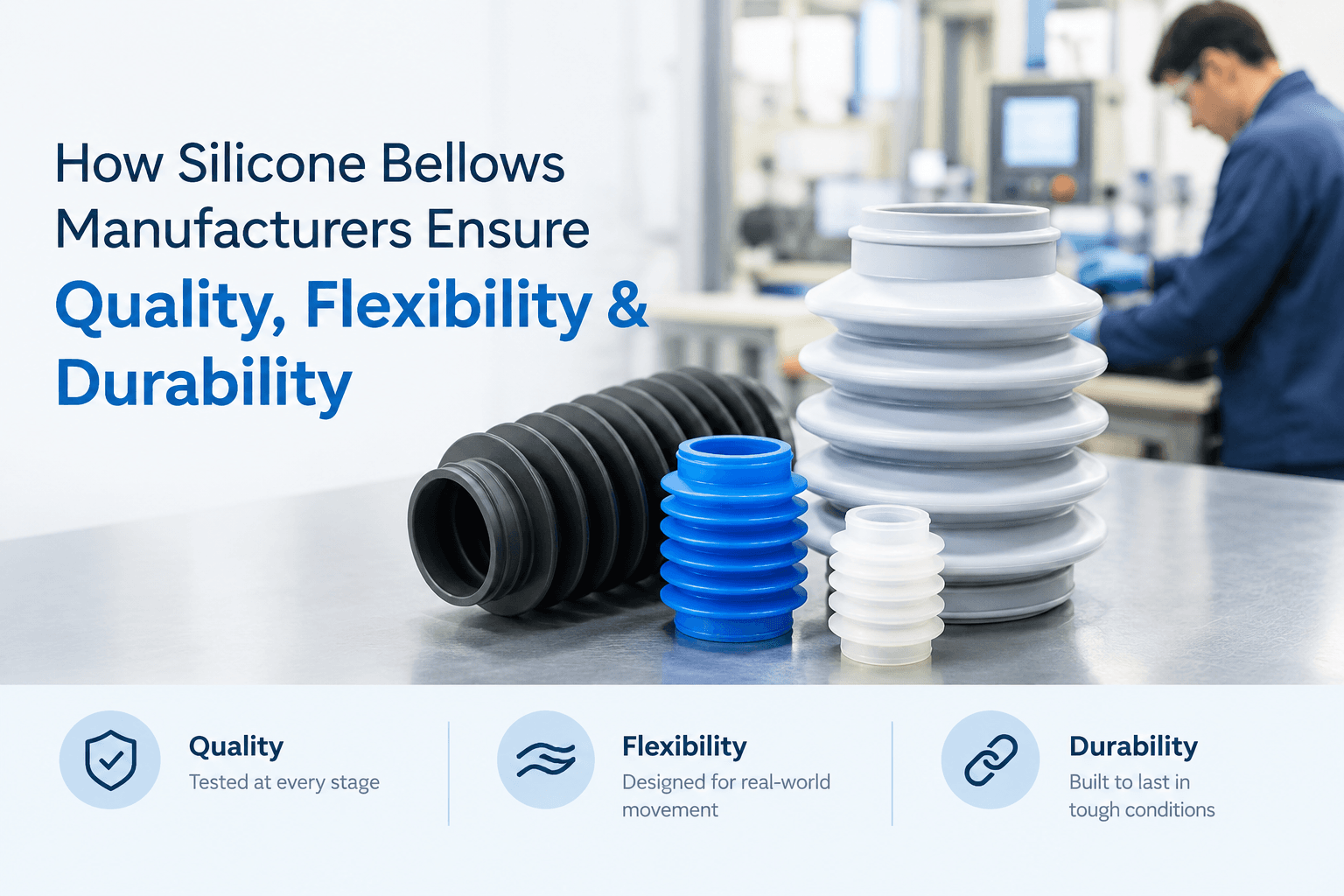
How Silicone Bellows Manufacturers Ensure Quality, Flexibility & Durability
A bellows looks simple, but it does a hard job. It flexes thousands of times, keeps out dust and moisture, and survives heat that would crack ordinary rubber. When it fails, the machine behind it often fails too.
That is why experienced silicone bellows manufacturers focus on three things: the right material, a controlled process, and a design that fits the application. This guide explains how they work, so you can judge any supplier with confidence.
1. Start with the Right Rubber Material
Every good silicone rubber bellow starts with the compound. Most silicone bellows suppliers work with these materials:
MaterialTypical Temperature RangeBest ForVMQ (standard silicone)-55°C to 200°CGeneral industrial use, dust covers, flexible jointsPVMQ (phenyl silicone)-100°C to 200°CVery cold environmentsFVMQ (fluorosilicone)-60°C to 175°CContact with fuels and oilsLSR (liquid silicone rubber)-50°C to 200°CSmall, precise, complex bellows
Hardness usually falls between 30 and 80 Shore A. Softer grades (30-50) bend easily. Harder grades (60-80) resist pressure and wear better. For food or medical use, platinum-cured, FDA-compliant silicone is the usual choice. You can see more options on the materials page (https://www.customrubber-bellows.com/materials).
2. Know the Real Temperature Limits
Silicone's biggest strength is its stable performance across a wide range. Where natural rubber turns brittle in the cold or hardens in the heat, standard silicone stays flexible from about -55°C to 200°C.
A datasheet limit, however, is not a promise for every condition. Constant heat near the upper limit shortens life, and steam or oil contact changes the picture. Good silicone bellows manufacturers ask about your actual working temperature, not just the maximum. For hotter jobs, see high temperature silicone bellows (https://www.customrubber-bellows.com/high-temperature-silicone-bellows-companies).
3. The Manufacturing Process: Prototype to Full Production
Quality is built step by step. At Custom Rubber Bellows, the process runs from a single prototype to full-scale production:
Design support: Engineers review your drawing, sample, or idea and decide size, shape, convolutions, hardness, and reinforcement. A free consultation with CAD design is offered, so you can see the part before a mold is made.
Compound mixing: The silicone is blended to the target hardness and strength.
Mold design: Bellows have deep folds, so the mold must release the part without tearing it.
Molding: Compression molding, injection molding, or LSR injection is chosen based on size, shape, and quantity. Small, detailed parts often suit LSR. Larger parts and smaller runs often suit compression molding.
Curing: Controlled heat sets the rubber. Under-cured parts lose strength.
Post-curing: An extra heat cycle improves stability, which matters for food and medical parts.
Trimming: Extra material (flash) is removed from the edges and ends.
4. Quality Checks Before Dispatch
A good bellows should be checked before it reaches your machine. Standard checks for silicone rubber bellows include:
Dimensional check: Length, diameter, wall thickness, and end connections against your drawing.
Hardness check: Shore A testing to confirm the material matches the specification.
Visual inspection: Folds, seams, and sealing surfaces are checked for cracks, bubbles, and tears.
Flex test: The bellows is stretched and compressed to confirm it moves freely without cracking at the folds.
Fit check: Samples are tried on the mating part to confirm the seal and clamp fit.
We also recommend approving a sample before bulk production. It is much cheaper to change wall thickness or hardness at the sample stage than after a full order.
5. Design Considerations That Affect Durability
Even the best material fails if the shape is wrong. When designing custom silicone bellows, manufacturers look at:
Convolution shape and count: More folds give more stroke but less pressure resistance.
Wall thickness: Thin walls flex easily. Thick walls handle pressure but can crack at uneven folds.
Movement type: Axial (push-pull), angular, lateral, or a mix.
End connections: Flanges, cuffs, or clamp grooves must seal tightly.
Pressure and vacuum: Some bellows need support rings to avoid collapsing.
Chemical exposure: Oils and solvents may call for fluorosilicone.
Shrinkage: Rubber shrinks slightly after molding, so molds are built with that in mind.
Sharing a drawing and a clear description of movement and environment makes your quote and final part far more accurate. Read more in why custom bellows design matters (https://www.customrubber-bellows.com/custom-rubber-bellows-design-important).
6. Where Industrial Silicone Bellows Are Used
Industrial silicone bellows protect and connect moving parts across many industries:
Industrial machinery: Dust and debris covers on linear guides and actuators.
Medical and laboratory equipment: Clean, non-reactive flexible parts.
Electrical and electronics: Protective covers and flexible connections.
Food and beverage: Easy-to-clean flexible seals. See food grade silicone bellows (https://www.customrubber-bellows.com/food-grade-silicone-bellows-manufacturer).
Marine and aerospace: Protection against weather, vibration, and temperature swings.
Plumbing and construction: Flexible joints and expansion connectors.
7. How to Choose Among Silicone Bellows Suppliers
When comparing silicone bellows manufacturers, ask:
Which silicone grades do you work with, and can I see datasheets?
Can you make a prototype or sample before full production?
What checks do you run on finished parts?
Do you offer design or CAD support?
What are your minimum order quantity and lead time?
Do you hold certifications such as ISO 9001 or material compliance such as FDA or RoHS?
A reliable supplier answers clearly and is honest about what they can and cannot do. To start, you can explore custom rubber bellows (https://www.customrubber-bellows.com/custom-rubber-bellow-manufacturer).
Frequently Asked Questions
What is a silicone rubber bellow used for?
It is a flexible, accordion-shaped part that protects moving components, seals out dust and moisture, and allows controlled movement in equipment.
What temperature can silicone bellows handle?
Standard silicone handles about -55°C to 200°C. Special grades go higher for short periods, and phenyl silicone handles colder conditions.
Can silicone bellows be made in custom sizes?
Yes. Custom silicone bellows can be made to your drawing or sample, including length, diameter, convolutions, hardness, and color.
Is silicone better than other rubbers for bellows?
Silicone suits wide temperature ranges, flexibility, and clean applications. For heavy oil contact, fluorosilicone or other rubbers may be better.
How long do industrial silicone bellows last?
It depends on heat, movement frequency, and chemicals. A well-designed bellows used in the right environment can last for years.
What should I send to get a quote?
Send a drawing or sample, quantity, operating temperature, movement type, and any food-contact or chemical requirements.
Final Thoughts
Strong silicone bellows manufacturers do not leave quality to chance. They match the material to the job, control each stage of production, and design for real working conditions. Choose a supplier who explains these steps openly, and you will get bellows that stay flexible and last longer.
Need custom silicone bellows? Share your drawing or requirements and ask for a sample before you commit.
Appreciate the creator