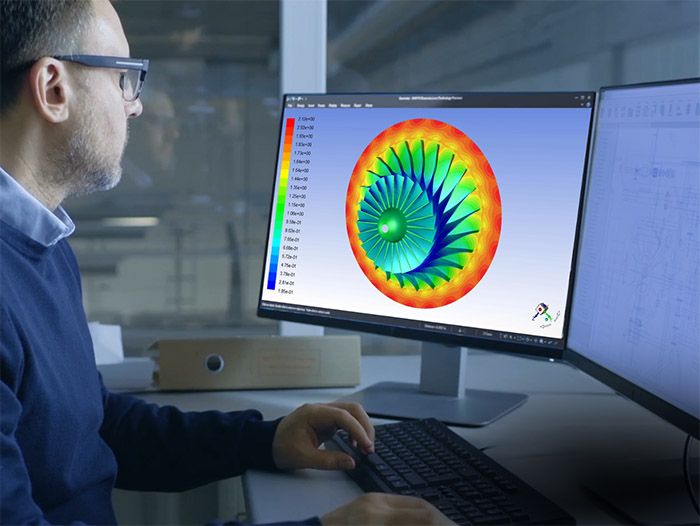
How Electronic Engineering Companies Use FEA Consulting, CFD Analysis, and Electromagnetic Simulation Software
In today’s competitive engineering landscape, electronic engineering companies are under constant pressure to deliver faster, lighter, more efficient, and highly reliable products. From aerospace systems and clean energy technologies to electric motors and photonics devices, performance expectations continue to rise. To meet these demands, companies increasingly rely on engineering simulation software, supported by expert FEA consulting, CFD analysis, and electromagnetic simulation software.
These advanced simulation tools enable engineers to predict real-world behavior, optimize designs early, and reduce costly physical prototyping.
The Growing Importance of Simulation-Driven Engineering
As electronic systems become more compact and multifunctional, traditional trial-and-error design approaches are no longer sufficient. Simulation-driven engineering allows electronic engineering companies to evaluate thermal performance, structural integrity, fluid behavior, and electromagnetic compatibility before manufacturing begins.
By integrating finite element analysis, CFD simulation, and electromagnetic modeling into the design workflow, companies gain deeper insight into system performance while significantly shortening development cycles.
FEA Consulting for Structural and Multiphysics Reliability
FEA consulting plays a critical role in ensuring the mechanical and structural reliability of electronic components and systems. Through FEA analysis and structural analysis, engineers can accurately assess stress, strain, vibration, fatigue, and thermal expansion effects.
Electronic enclosures, circuit boards, connectors, and housings must withstand mechanical loads, thermal cycling, and harsh operating environments. Finite element analysis helps identify weak points, validate material selection, and improve durability without over-engineering.
In aerospace consulting and clean energy consulting projects, FEA consulting becomes even more vital, where safety, compliance, and long-term performance are non-negotiable.
CFD Analysis for Thermal and Fluid Performance
Thermal management is one of the biggest challenges in electronic engineering. Overheating can degrade performance, reduce lifespan, or cause complete system failure. This is where CFD analysis and CFD simulation become essential.
Using CFD, electronic engineering companies can simulate airflow, heat transfer, and cooling efficiency in electronic assemblies. CFD analysis helps optimize heat sinks, fans, liquid cooling systems, and ventilation layouts while minimizing noise and power consumption.
In clean energy consulting and electric motor design, CFD simulation also supports fluid flow optimization, cooling efficiency, and energy loss reduction, leading to more sustainable and high-performance products.
Electromagnetic Simulation Software for Signal Integrity and EMI Control
As operating frequencies increase and devices become more compact, electromagnetic performance becomes critical. Electromagnetic simulation software enables engineers to analyze signal integrity, electromagnetic interference (EMI), and electromagnetic compatibility (EMC) at early design stages.
Electronic engineering companies use electromagnetic simulation to optimize antenna performance, reduce signal loss, and prevent unwanted interference between components. This is especially important in aerospace consulting, high-speed electronics, and communication systems.
By identifying EMI issues virtually, companies avoid costly redesigns and ensure compliance with international standards.
Optical Engineering and Photonics Simulation Advancements
Modern electronic systems increasingly integrate optical components for sensing, communication, and data transmission. Optical engineering and photonics simulation allow engineers to model light propagation, reflection, refraction, and coupling efficiency.
Electronic engineering companies working with photonics devices, lasers, and optical sensors benefit from simulation-driven design to enhance accuracy, performance, and reliability. When combined with FEA and electromagnetic analysis, photonics simulation supports complete multiphysics optimization.
Electric Motor Design and Simulation Excellence
Electric motor design is another area where simulation is indispensable. Electric motor design and simulation rely on finite element analysis, CFD analysis, and electromagnetic simulation software to maximize efficiency, torque, thermal stability, and durability.
Electronic engineering companies involved in clean energy consulting use simulation to improve motor performance for electric vehicles, renewable energy systems, and industrial automation while reducing energy losses and material costs.
The Strategic Value of Simulation Consultants
Partnering with experienced simulation consultants gives electronic engineering companies access to deep technical expertise, advanced tools, and industry best practices. Simulation consultants help integrate engineering simulation software into existing workflows and ensure accurate, validated results.
This approach reduces development risk, accelerates innovation, and supports scalable growth across aerospace consulting, clean energy consulting, and advanced electronics markets.
Conclusion
High-performance design in today’s electronic engineering industry is no longer possible without simulation-driven decision-making. By leveraging FEA consulting, CFD analysis, and electromagnetic simulation software, electronic engineering companies can deliver safer, more efficient, and more reliable products.
Appreciate the creator