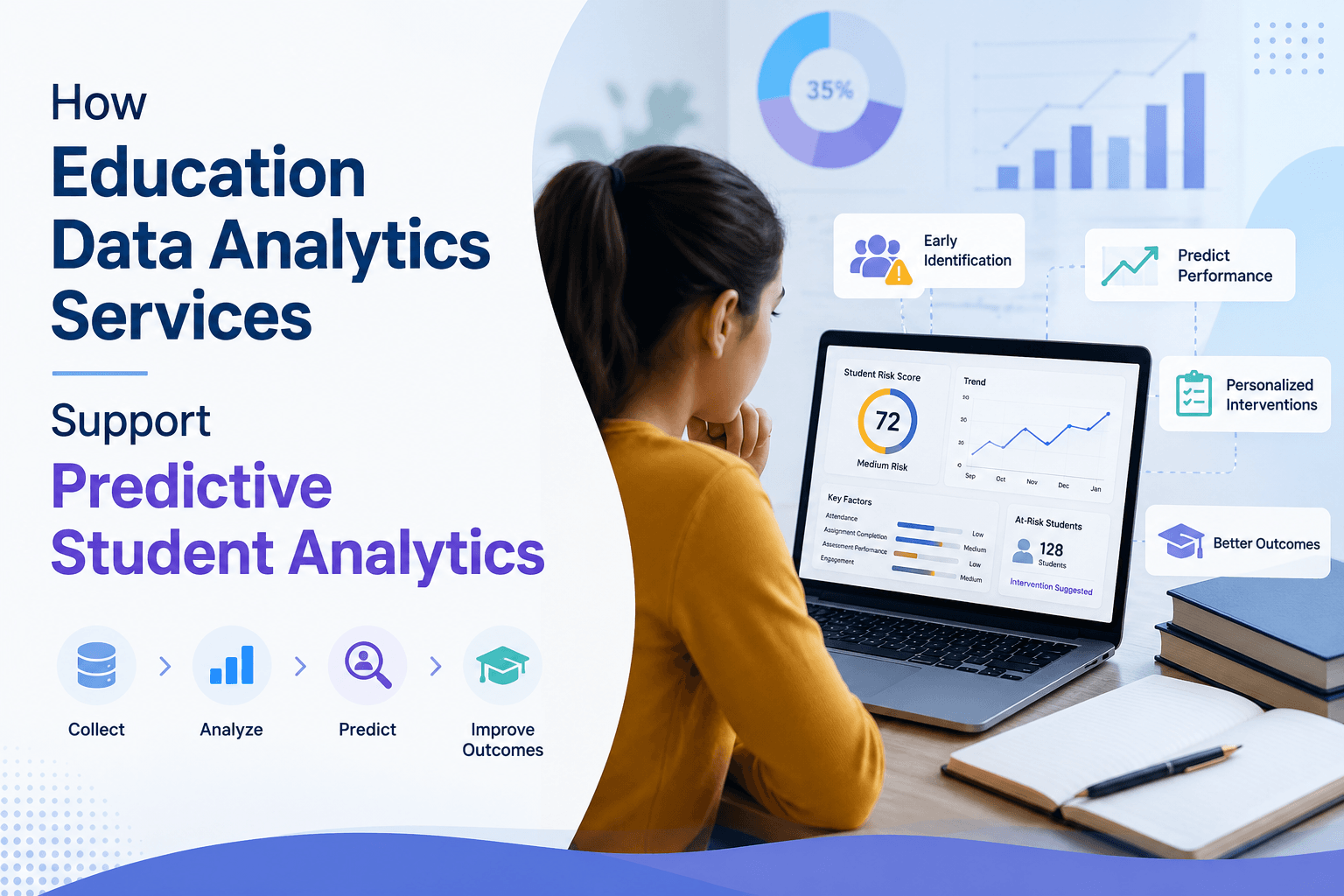
How Education Data Analytics Services Support Predictive Student Analytics
The education sector is rapidly evolving with the integration of digital technologies, online learning platforms, and AI-driven tools. As educational institutions generate massive amounts of student-related data every day, the ability to analyze and use this information effectively has become a major competitive advantage. This is where Education Data Analytics Services play a crucial role.
One of the most impactful applications of data analytics in education is Predictive Student Analytics. By using historical and real-time data, educational institutions can predict student behavior, academic performance, dropout risks, learning patterns, and engagement levels. This proactive approach helps schools, colleges, universities, and EdTech companies improve educational outcomes and student success rates.
In this blog, we will explore how Education Data Analytics Services support predictive student analytics, their benefits, technologies involved, challenges, and future trends shaping the education industry.
What Are Education Data Analytics Services?
Education Data Analytics Services involve collecting, processing, analyzing, and visualizing educational data to help institutions make informed decisions. These services transform raw academic and administrative data into actionable insights.
Educational institutions generate data from multiple sources, including:
Student attendance systems
Online learning platforms
Learning Management Systems (LMS)
Examination portals
Student Information Systems (SIS)
Classroom interactions
Assessments and assignments
Behavioral tracking tools
Mobile learning applications
Analytics services help institutions organize and analyze this data to improve academic planning, operational efficiency, and student engagement.
Understanding Predictive Student Analytics
Predictive student analytics uses historical and current student data along with machine learning algorithms to forecast future student outcomes.
These predictions may include:
Student performance trends
Risk of student dropout
Course completion probability
Attendance patterns
Learning difficulties
Student engagement levels
Career readiness
Exam success probabilities
Predictive analytics allows educators to identify potential issues before they become serious problems, enabling timely intervention and personalized support.
How Education Data Analytics Services Enable Predictive Student Analytics
1. Collecting and Integrating Student Data
Predictive analytics starts with data collection. Education Data Analytics Services gather information from multiple educational systems and integrate it into a centralized platform.
This includes:
Academic records
Attendance reports
Online learning behavior
Assignment submissions
Participation metrics
Exam scores
Social and behavioral data
A centralized data ecosystem improves visibility and ensures institutions have accurate, real-time information for analysis.
2. Identifying At-Risk Students
One of the biggest advantages of predictive analytics is early identification of students who may struggle academically or drop out.
Analytics systems can detect warning signs such as:
Low attendance
Poor assignment completion
Declining grades
Reduced LMS activity
Low engagement levels
Frequent late submissions
Institutions can then provide:
Academic counseling
Personalized tutoring
Mental health support
Additional learning resources
Parent communication
Early intervention significantly improves student retention and academic performance.
3. Supporting Personalized Learning
Every student learns differently. Predictive analytics helps institutions create personalized learning experiences based on individual student behavior and performance patterns.
Education Data Analytics Services help educators:
Recommend customized learning materials
Adjust teaching methods
Create adaptive learning paths
Identify preferred learning styles
Track individual progress
This personalized approach increases student engagement and improves learning outcomes.
4. Improving Academic Performance Forecasting
Predictive analytics can estimate future academic performance using past student data.
For example, analytics systems can predict:
Semester GPA trends
Likelihood of passing exams
Subject-specific difficulties
Skill development progress
Teachers can use these insights to:
Modify lesson plans
Offer remedial classes
Focus on weak subjects
Enhance classroom strategies
This data-driven approach improves educational effectiveness.
5. Enhancing Student Retention Rates
Student dropout is a major challenge for educational institutions worldwide. Predictive analytics helps reduce dropout rates by identifying students at risk early in the academic journey.
Analytics models evaluate factors such as:
Attendance consistency
Financial challenges
Engagement levels
Academic performance
Behavioral indicators
Institutions can then implement targeted retention strategies to improve student success and institutional reputation.
6. Optimizing Curriculum Development
Education Data Analytics Services help institutions analyze curriculum effectiveness using student performance data.
Analytics can reveal:
Which subjects students struggle with
Course completion trends
Effectiveness of teaching methods
Student satisfaction levels
Skill gaps
This enables institutions to continuously improve course structures and educational content.
7. Improving Resource Allocation
Predictive analytics also supports operational decision-making in educational institutions.
Institutions can use analytics to optimize:
Faculty allocation
Classroom utilization
Budget planning
Infrastructure management
Student support services
Better resource planning leads to improved institutional efficiency and reduced operational costs.
Technologies Used in Predictive Student Analytics
Modern Education Data Analytics Services rely on advanced technologies to process and analyze educational data efficiently.
Artificial Intelligence (AI)
AI systems identify learning patterns, automate insights, and support intelligent recommendations.
Machine Learning (ML)
ML algorithms continuously improve prediction accuracy by learning from historical student data.
Big Data Analytics
Big Data platforms process large volumes of educational data from multiple sources in real time.
Cloud Computing
Cloud-based analytics platforms provide scalability, flexibility, and secure data access for institutions.
Data Visualization Tools
Dashboards and visualization platforms help educators understand complex analytics insights quickly.
Benefits of Predictive Student Analytics
Better Student Outcomes
Institutions can proactively support students before academic problems worsen.
Increased Student Engagement
Personalized learning experiences improve participation and motivation.
Higher Graduation Rates
Early intervention strategies help students stay on track academically.
Smarter Decision-Making
Administrators gain data-driven insights for institutional planning.
Improved Institutional Reputation
Better student success rates strengthen institutional credibility and competitiveness.
Reduced Operational Costs
Efficient resource management improves financial performance.
Challenges in Implementing Predictive Student Analytics
Although predictive analytics offers significant advantages, institutions may face several implementation challenges.
Data Privacy Concerns
Educational institutions must protect sensitive student data and comply with privacy regulations.
Data Quality Issues
Incomplete or inaccurate data can affect prediction accuracy.
Integration Complexity
Combining data from multiple educational systems can be technically challenging.
Lack of Skilled Professionals
Institutions often need experienced data scientists and analytics experts.
Resistance to Technology Adoption
Faculty and staff may initially resist analytics-driven educational changes.
Best Practices for Successful Predictive Student Analytics
To maximize the value of predictive analytics, institutions should follow these best practices:
Build a centralized data management system
Ensure high-quality and accurate data collection
Invest in scalable cloud-based analytics platforms
Prioritize data security and compliance
Train educators and staff on analytics usage
Continuously monitor and improve analytics models
Focus on ethical AI and transparency
Future Trends in Education Predictive Analytics
The future of predictive student analytics is highly promising as educational institutions increasingly adopt AI-driven technologies.
Emerging trends include:
AI-Powered Virtual Learning Assistants
AI tutors will provide personalized support based on predictive insights.
Real-Time Learning Analytics
Institutions will analyze live classroom and online learning data instantly.
Emotional and Behavioral Analytics
Advanced analytics may assess student emotions and engagement levels.
Predictive Career Guidance
Analytics systems will recommend career paths based on student performance and interests.
Advanced Adaptive Learning Platforms
Learning systems will automatically customize educational content for each student.
Why Educational Institutions Need Education Data Analytics Services
In today’s highly competitive education landscape, institutions can no longer rely solely on traditional teaching and administrative methods. Data-driven decision-making is becoming essential for improving educational quality, student success, and operational efficiency.
Education Data Analytics Services help institutions:
Make smarter academic decisions
Improve student retention
Enhance personalized learning
Increase institutional efficiency
Support digital transformation initiatives
Deliver better educational experiences
As predictive analytics technologies continue to evolve, institutions that adopt these solutions early will gain a significant competitive advantage.
Conclusion
Education Data Analytics Services are transforming the way educational institutions understand and support students. Through predictive student analytics, schools, colleges, universities, and EdTech companies can proactively identify challenges, improve student outcomes, personalize learning experiences, and optimize institutional performance.
By leveraging AI, machine learning, cloud computing, and big data analytics, educational organizations can create smarter, more efficient, and student-focused learning environments.
As education continues to move toward digital transformation, predictive analytics will become an essential component of modern educational strategies, helping institutions deliver better academic success and long-term student growth.
Appreciate the creator