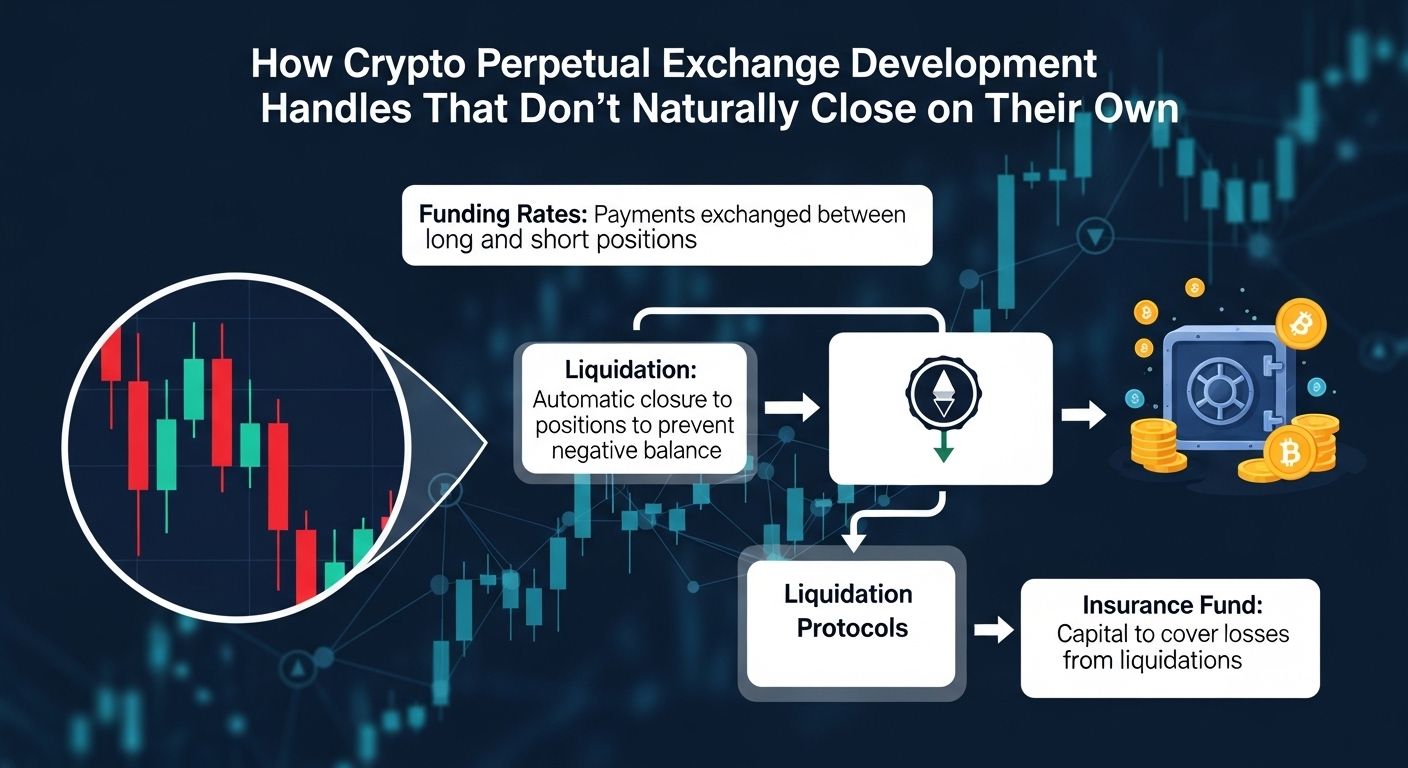
How Crypto Perpetual Exchange Development Handles Trades That Don’t Naturally Close on Their Own
Crypto derivatives trading has fundamentally changed how markets operate by removing traditional constraints like contract expiry. In perpetual trading environments, positions remain open indefinitely unless specific conditions trigger closure. This creates a need for highly dynamic systems that can continuously manage trades without relying on fixed timelines.
Crypto perpetual exchange development focuses on replacing expiry-based logic with condition-based systems that ensure stability, fairness, and efficiency. For any Crypto Perpetual Dex Development Company, handling trades that don’t naturally close is not just a technical challenge—it is a core architectural requirement.
Key aspects of this model include:
Continuous monitoring of open positions without time limits
Real-time profit and loss updates based on live market prices
Margin-driven lifecycle management instead of expiry-based closure
Automated systems for liquidation and risk control
Integration of funding mechanisms to maintain market balance
These elements work together to create an ecosystem where trades can remain open as long as conditions allow, while still protecting both traders and the platform.
What It Means When Trades Don’t Close Automatically
When trades do not naturally close, the exchange must take full responsibility for managing their lifecycle. Unlike traditional futures contracts that settle at a predefined date, perpetual contracts remain active indefinitely. This shifts the entire operational model from time-based execution to condition-based management.
Crypto perpetual exchange development ensures that:
Positions remain active until manually closed or liquidated
Market exposure is continuous and uninterrupted
Profit and loss calculations update in real time
Risk is managed dynamically rather than periodically
This model introduces both flexibility and complexity. Traders gain the ability to hold positions for as long as they want, which is particularly useful for long-term strategies or continuous hedging. However, it also requires the platform to maintain constant oversight of every open position.
A Crypto Perpetual Dex Development Company designs systems that treat each position as an independent entity. Instead of grouping trades into settlement cycles, the system continuously evaluates their status based on market conditions. This includes tracking entry price, leverage, margin levels, and unrealized profit or loss.
Additionally, the absence of automatic closure means that traders must be more aware of their positions. The platform supports this by providing real-time updates, alerts, and detailed analytics. This ensures that users can make informed decisions without relying on external triggers like expiry dates.
Ultimately, managing non-closing trades requires a shift in both system design and user behavior. Crypto perpetual exchange development bridges this gap by creating an environment where trades remain open, yet fully controlled through advanced mechanisms.
How Margin Systems Govern Open Trades
Margin systems are the foundation of perpetual trading. Since trades do not close automatically, margin becomes the primary factor that determines whether a position can remain open. Crypto perpetual exchange development uses advanced margin frameworks to continuously evaluate the health of each trade.
Key components of margin systems include:
Initial margin requirements for opening positions
Maintenance margin thresholds for sustaining trades
Real-time margin recalculations based on price changes
Alerts and warnings for margin depletion
A Crypto Perpetual Dex Development Company builds systems where margin is not static but dynamically adjusted. As market prices fluctuate, the value of a trader’s position changes, which directly impacts their margin ratio. This requires constant recalculation to ensure accuracy.
Margin systems also support different trading preferences. For example, isolated margin allows traders to allocate specific collateral to individual positions, limiting risk to that trade. Cross margin, on the other hand, shares collateral across multiple positions, increasing flexibility but also exposure.
Another critical aspect is leverage. Higher leverage amplifies both potential profits and risks, making margin management even more important. Crypto perpetual exchange development integrates leverage controls that automatically adjust margin requirements based on position size and market volatility.
The system also includes safeguards to prevent sudden losses. If margin levels approach critical thresholds, traders receive notifications, giving them the opportunity to add collateral or reduce their position. This proactive approach helps minimize forced liquidations.
In essence, margin systems act as the backbone of open-ended trading. A Crypto Perpetual Dex Development Company ensures that these systems are precise, responsive, and capable of handling continuous market fluctuations.
How Liquidation Mechanisms Replace Natural Closure
In perpetual trading, liquidation serves as the primary method for closing positions that become too risky. Since there is no expiry date to enforce closure, crypto perpetual exchange development relies on automated liquidation engines to maintain market stability.
Liquidation mechanisms operate based on predefined risk thresholds. When a trader’s margin falls below the maintenance requirement, the system initiates liquidation to prevent further losses. This process is fully automated and designed to act instantly.
Key features of liquidation systems include:
Continuous monitoring of margin ratios and market prices
Calculation of liquidation price for each position
Partial or full liquidation depending on risk exposure
Protection against negative balances
A Crypto Perpetual Dex Development Company designs liquidation engines that are both efficient and fair. Instead of immediately closing an entire position, some systems use partial liquidation to reduce risk while keeping the trade active. This approach helps minimize losses for traders.
Liquidation also plays a critical role in protecting the platform. Without it, traders could accumulate losses beyond their collateral, creating systemic risk. By enforcing strict liquidation rules, the platform ensures that all positions remain within manageable limits.
Additionally, advanced systems include insurance funds to cover extreme cases where liquidation cannot fully offset losses. This adds another layer of protection, ensuring that the platform remains stable even during high volatility.
Ultimately, liquidation replaces the role of natural trade closure. Crypto perpetual exchange development ensures that this process is seamless, transparent, and capable of handling rapid market changes.
How Funding Rates Influence Open Positions
Funding rates are a unique feature of perpetual trading that directly impact positions that remain open indefinitely. Crypto perpetual exchange development integrates funding mechanisms to maintain price alignment and encourage balanced market participation.
Funding rates are periodic payments exchanged between long and short traders. These payments are determined by the difference between the perpetual contract price and the underlying spot price.
Key aspects of funding systems include:
Regular funding intervals (e.g., every 8 hours)
Dynamic rate calculation based on market conditions
Incentives for traders to balance long and short positions
Continuous integration with open trades
A Crypto Perpetual Dex Development Company ensures that funding rates are calculated accurately and applied consistently. When the perpetual price is higher than the spot price, long traders pay short traders, and vice versa. This mechanism encourages traders to take positions that bring prices back into alignment.
Funding rates also influence trading strategies. Traders may choose to hold or close positions based on funding costs, creating additional market activity. This dynamic interaction helps maintain liquidity and price stability.
For open positions, funding acts as a continuous cost or reward. Unlike traditional fees that occur only during trade execution, funding payments happen periodically as long as the position remains active. This makes it an essential factor in long-term trading decisions.
Crypto perpetual exchange development ensures that funding systems operate seamlessly alongside margin and pricing mechanisms. A Crypto Perpetual Dex Development Company builds infrastructure that can handle these calculations in real time without disrupting trading activity.
How Risk Management Systems Maintain Stability
Risk management is critical in an environment where trades do not naturally close. Crypto perpetual exchange development incorporates advanced systems to continuously monitor and control risk across all positions.
These systems operate in real time, ensuring that every position is evaluated based on current market conditions. This includes tracking price movements, margin levels, and overall exposure.
Core risk management features include:
Continuous position monitoring and evaluation
Portfolio-level risk assessment
Automated alerts for high-risk scenarios
Integration with liquidation and margin systems
A Crypto Perpetual Dex Development Company designs risk frameworks that go beyond individual trades. The system evaluates the entire platform to ensure that no single position or group of positions can destabilize the market.
Insurance funds are another important component. These funds act as a safety net, covering losses that exceed a trader’s collateral. This helps maintain platform integrity during extreme market conditions.
Auto-deleveraging mechanisms may also be implemented to handle situations where liquidation is insufficient. These systems redistribute risk across the market, ensuring that losses are contained.
Additionally, risk management systems adapt to market volatility. During periods of high volatility, margin requirements and liquidation thresholds may be adjusted to reduce risk exposure.
Crypto perpetual exchange development ensures that all these elements work together seamlessly. A Crypto Perpetual Dex Development Company builds systems that are not only reactive but also proactive, identifying potential risks before they escalate.
Conclusion: Managing Open-Ended Trades with Precision
Crypto perpetual exchange development represents a shift from traditional trading models to a continuous, condition-based system. Trades that don’t naturally close are managed through a combination of margin systems, liquidation mechanisms, funding rates, and advanced risk controls.
Key takeaways include:
Trades remain open indefinitely, requiring continuous system oversight
Margin replaces expiry as the primary lifecycle determinant
Liquidation ensures risk is controlled and positions are managed
Funding rates maintain market balance and influence trader behavior
Risk management systems provide stability in volatile conditions
For any Crypto Perpetual Dex Development Company, the challenge lies in building systems that can handle this complexity while maintaining performance and reliability. This requires a deep understanding of both market dynamics and technical architecture.
As perpetual trading continues to grow, platforms that effectively manage open-ended trades will lead the evolution of decentralized derivatives. By combining flexibility with robust safeguards, crypto perpetual exchange development creates a trading environment that is both innovative and sustainable.
Appreciate the creator