How AI Is Revolutionizing Lecture Video Creation for Indian Educators
How AI Is Revolutionizing Lecture Video Creation for Indian Educators
India has one of the largest and most diverse education ecosystems in the world.
From school teachers and college professors to coaching institutes, online tutors, corporate trainers, and EdTech creators, educators are constantly looking for better ways to explain complex topics clearly and at scale.
But creating good lecture videos is not easy.
A teacher may have excellent knowledge, well-prepared notes, and years of classroom experience. Still, turning that knowledge into a polished video lesson usually requires scripting, recording, editing, voiceover, subtitles, slides, and sometimes even a studio setup.
For many educators, this is too time-consuming.
This is where AI is beginning to change the way lecture videos are created.
Instead of starting from a blank screen, educators can now use AI tools to turn existing notes, PDFs, PowerPoint slides, lesson plans, and scripts into structured lecture videos. This shift is especially important for Indian educators who often teach large batches, multilingual students, exam-focused learners, and remote audiences.
AI is not replacing teachers. It is helping teachers create better learning content faster.
Why Lecture Videos Matter in India
Lecture videos have become an essential part of modern education.
Students use them to revise concepts, prepare for exams, revisit difficult topics, and learn at their own pace. Teachers use them to explain topics once and reuse them across multiple batches. Coaching institutes use them to scale learning programs. Corporate trainers use them for onboarding and employee training.
In India, lecture videos are especially useful because of a few practical challenges.
First, classroom sizes are often large.
A single teacher may need to explain the same topic to hundreds or thousands of students. Recording a high-quality lecture video allows that explanation to be reused.
Second, students learn at different speeds.
Some students understand a topic immediately, while others need to pause, replay, and revise. Videos make this possible.
Third, education is increasingly hybrid.
Students may attend physical classes, online sessions, recorded lectures, or blended programs. Lecture videos fit naturally into this environment.
Fourth, language diversity matters.
India has learners who are comfortable in English, Hindi, Tamil, Telugu, Bengali, Marathi, Kannada, Malayalam, and many other languages. AI-generated subtitles and voiceovers can make lecture content more accessible.
The Traditional Problem With Lecture Video Creation
Even though lecture videos are useful, creating them has traditionally been difficult.
An educator usually has to go through several steps.
Prepare a script.
Record the lecture.
Create or clean up slides.
Set up lighting and audio.
Edit mistakes.
Add subtitles.
Export the video.
Upload and distribute it.
For a professional video, this can take hours or even days.
This is manageable for large EdTech companies with production teams. But for individual teachers, small coaching institutes, school departments, and internal training teams, the process can be too heavy.
Many educators already have the raw material. They have notes, slides, PDFs, lesson plans, and explanations. The challenge is converting those materials into engaging video lessons without spending too much time on production.
How AI Changes the Workflow
AI changes lecture video creation by automating many of the repetitive parts of the process.
A typical AI-powered workflow looks like this:
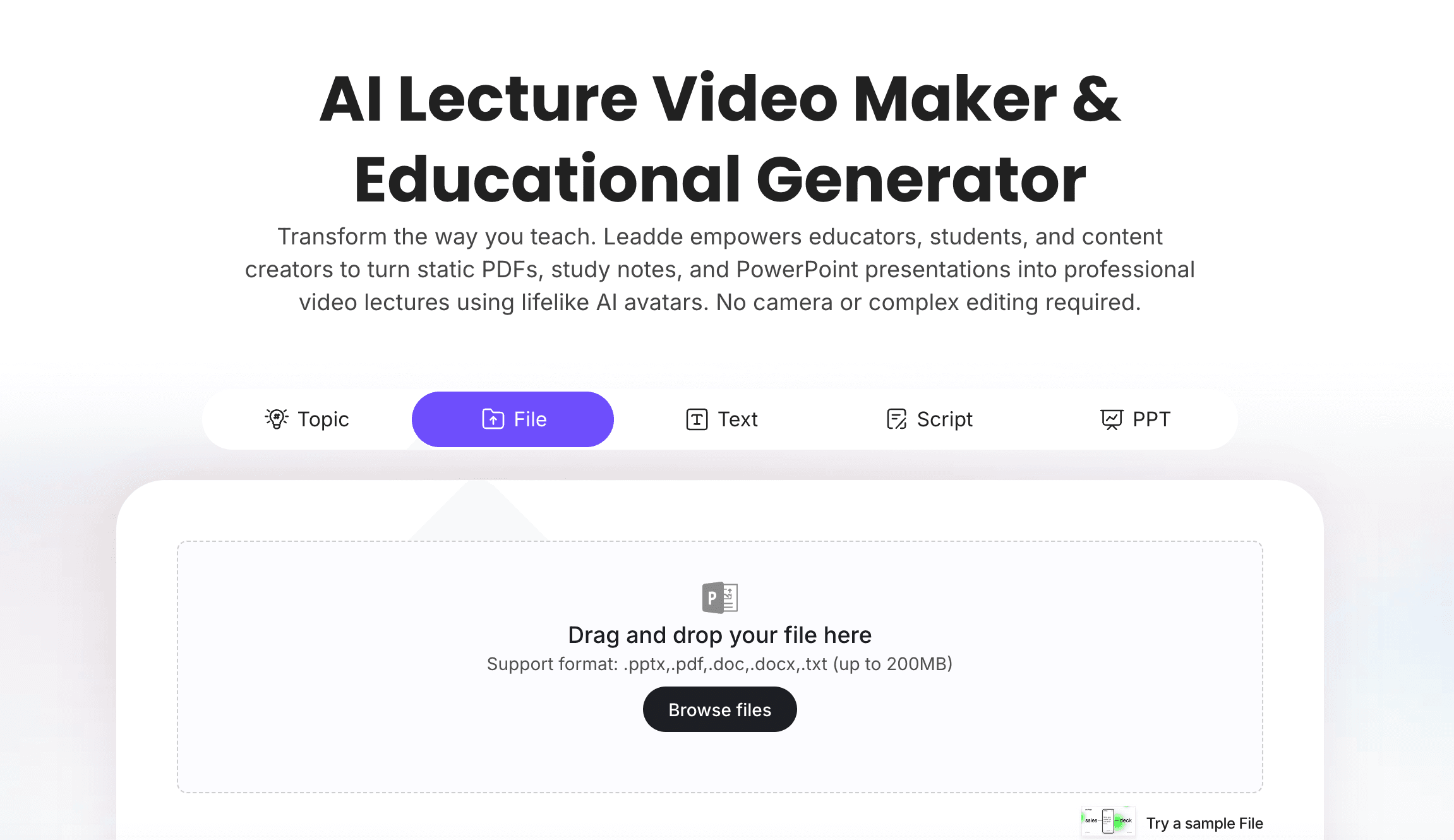
1. Upload or paste the source material
The educator starts with lecture notes, a script, a PDF, a Word document, or a slide deck.
2. AI analyzes the content
The system identifies headings, key points, learning objectives, and topic structure.
3. A video script is generated
The content is rewritten into a natural teaching script that can be spoken clearly.
4. Scenes are created
The lecture is divided into short sections or scenes, making it easier for students to follow.
5. Voiceover is generated
AI voice can turn the script into narration.
6. Avatar or presenter style is selected
An AI avatar or presenter can explain the content visually.
7. Subtitles and layouts are added
The system can add captions, bullet points, highlights, and visual structure.
8. The educator reviews and edits
The teacher still controls the final output and checks for accuracy.
This workflow reduces the time needed to turn teaching material into video.
Where Indian Educators Can Use AI Lecture Videos
AI lecture video creation is useful across many education and training scenarios.
School Teaching
Teachers can convert lesson plans into short concept videos. These videos can help students revise chapters before exams or understand difficult topics after class.
For example, a science teacher can create a short video explaining photosynthesis, electric circuits, or chemical reactions using existing notes.
College Lectures
Professors can turn lecture outlines, research summaries, and presentation slides into structured video lessons.
This is useful for flipped classrooms, where students watch the lecture before class and use classroom time for discussion.
Coaching Institutes
India has a massive coaching ecosystem for exams like JEE, NEET, UPSC, CAT, GATE, CUET, and banking exams.
Coaching institutes can use AI to create revision videos, topic summaries, question explanation videos, and concept breakdowns.
This helps them scale content production without recording every lecture from scratch.
Online Tutors
Independent tutors often struggle with video production. AI can help them create professional-looking lessons from simple scripts or notes.
This allows tutors to focus more on teaching and less on editing.
Corporate Training
Lecture videos are not only for schools and colleges.
Companies also need training videos for onboarding, compliance, product training, sales enablement, and internal processes.
L&D teams can turn training documents, SOPs, and presentations into video modules that employees can watch on demand.
EdTech Creators
Creators building educational content for YouTube, learning apps, or private communities can use AI to speed up video production.
They can create explainers, micro-lessons, course introductions, and revision videos more efficiently.
What Makes a Good AI Lecture Video?
AI can speed up production, but quality still depends on instructional design.
A good lecture video should not simply read a document aloud.
It should be structured for learning.
Here are a few principles educators should follow.
Keep Each Video Focused
One video should explain one topic or one learning objective.
Instead of making a 60-minute video that covers an entire chapter, it is often better to create shorter videos of 5 to 10 minutes.
Use Simple Language
AI-generated scripts should be reviewed to make sure they sound natural.
If the content is for school students or exam aspirants, avoid unnecessary jargon. If technical terms are required, explain them clearly.
Add Examples
Examples make concepts easier to understand.
For Indian learners, locally relevant examples can improve engagement. A finance lesson can use Indian household budgeting examples. A business lesson can reference Indian startups or local markets.
Use Subtitles
Subtitles are essential.
They help students revise, support learners in noisy environments, and make content more accessible.
Support Multiple Languages
If the audience is multilingual, educators can create versions in different languages or add translated subtitles.
This can be especially useful for regional education, vocational training, and corporate learning programs.
Review Before Publishing
AI-generated content should always be checked by the educator.
The teacher’s role remains important because accuracy, context, and explanation quality matter.
Benefits for Educators
AI lecture video tools offer several practical benefits.
They save time.
Educators can create videos faster from existing material.
They reduce production barriers.
Teachers do not need advanced video editing skills.
They improve consistency.
The same lesson can be delivered clearly across multiple batches.
They support revision.
Students can replay difficult topics as many times as needed.
They help scale teaching.
One educator can reach more learners without repeating the same lecture manually.
They enable multilingual learning.
AI voice and subtitles can make lessons more accessible to diverse learners.
Benefits for Students
Students also benefit from AI-generated lecture videos.
They can learn at their own pace.
They can pause, replay, and revise.
They can access explanations outside classroom hours.
They can use subtitles for better understanding.
They can revisit concepts before exams.
This is especially useful for competitive exam preparation, remote learning, and self-paced education.
The Human Teacher Still Matters
It is important to be clear about one thing: AI does not replace the educator.
AI can help generate scripts, scenes, subtitles, and voiceovers. But the teacher decides what matters, what examples to use, how to explain difficult ideas, and whether the final content is accurate.
The best results come when educators use AI as a production assistant.
The teacher provides the knowledge.
AI helps package that knowledge into a video format.
What to Check Before Using AI for Lecture Videos
Before adopting AI lecture video tools, educators and institutions should consider a few points.
Accuracy
Make sure the script does not distort the original meaning.
Privacy
Do not upload confidential student data or sensitive internal documents without proper controls.
Language Quality
Check whether the voiceover and subtitles sound natural.
Editing Flexibility
The tool should allow changes after the first draft.
Content Ownership
Educators should understand how their uploaded material is used and stored.
Student Experience
The video should be easy to understand, not just visually polished.
The Future of AI Lecture Videos in India
AI lecture video creation is likely to become a normal part of education workflows.
In the future, a teacher may prepare notes in the morning and generate a short video summary by evening. A coaching institute may turn every chapter into revision videos. A college professor may provide AI-generated lecture summaries after each class. A company may convert every SOP into a training module.
This does not mean every video will be perfect automatically.
But it does mean that more educators will be able to create useful learning content without needing a production team.
For India, where scale, affordability, language diversity, and access are major education challenges, this can be a meaningful shift.
Conclusion
AI is revolutionizing lecture video creation by making it faster, easier, and more accessible.
Indian educators no longer need to depend only on expensive studios, complex editing software, or long production cycles. They can start with what they already have: notes, slides, PDFs, scripts, and teaching experience.
The real value of AI is not just automation. It is helping educators spend less time on production and more time on teaching.
For teachers, trainers, coaching institutes, and L&D teams that want to experiment with this workflow, an AI lecture video maker can help turn existing learning material into structured video lessons with AI voice, avatars, subtitles, and scenes.
AI will not replace great educators. But educators who use AI well may be able to teach more clearly, reach more learners, and create better learning experiences at scale.
Appreciate the creator