Geometry Dash: A Rhythm Adventure Through Sound and Shapes
If games could sing, Geometry Dash would be a symphony of chaos — a rhythm-driven explosion of shapes, color, and sound where every beat demands perfection. It’s not just a game; it’s a dance between patience and madness, between art and precision. Behind its simple look hides one of the most iconic rhythm-platformers ever created, a game that can make your heart race and your fingers tremble, all while a pulsing soundtrack guides your every move.
1. The Beginning of the Beat
The story of Geometry Dash begins with a single cube and a dream — a dream crafted by Robert Topala, the Swedish developer who released the game in 2013 under his studio RobTop Games. What started as a mobile game with just a few levels and a bouncing cube quickly evolved into a worldwide phenomenon.
Topala’s goal wasn’t to build a massive game with hundreds of features. He wanted to create something simple but deeply challenging — a game that anyone could play, but few could master. And so, Geometry Dash was born, blending rhythm-based gameplay with platforming precision.
It looked innocent at first: jump over spikes, avoid obstacles, and reach the end of the level. But soon players discovered the truth — this was not a casual game. This was a test of rhythm, timing, and mental endurance.
2. A Symphony of Sound and Motion
Every level in Geometry Dash is like a living song. The obstacles move to the rhythm, the jumps land on the beat, and every crash feels like a missed note in a beautiful melody. The player doesn’t just play to the music — they become part of it.
Each level features a unique soundtrack, created by talented artists from the electronic music community. Tracks like “Stereo Madness,” “Back on Track,” “Polargeist,” and “Dry Out” have become legendary among fans. As the cube dashes through neon tunnels and leaps across symmetrical platforms, the beat guides your reflexes like an invisible conductor.
It’s this perfect harmony between sight and sound that makes Geometry Dash hypnotic. The longer you play, the more you forget where the music ends and where your movement begins.
3. Simplicity, Reinvented
At first glance, Geometry Dash looks incredibly simple. The player controls only one thing: jumping. There’s no shooting, no double-jumping, no extra lives. Yet within that simplicity lies endless complexity.
The levels are carefully designed with split-second timing, where a jump too early or too late means instant failure. But unlike many frustrating games, Geometry Dash makes you want to try again. Every death teaches you something. Every new attempt feels closer to perfection.
Over time, the cube stops being a geometric shape — it becomes you. Your heartbeat syncs with the rhythm, your focus narrows to a single goal: survive the next beat.
That’s the secret behind Geometry Dash’s design philosophy: minimal mechanics, maximum intensity.
4. The Rise of the Community
Perhaps the most extraordinary thing about Geometry Dash isn’t the game itself — it’s the community it inspired.
RobTop gave players the ultimate creative power through the Level Editor, a tool that lets anyone design their own levels. Suddenly, Geometry Dash became not just a game, but a creative platform. Players began composing their own music-based challenges, designing art, animations, and even storytelling sequences inside the rhythm mechanics.
Names like Viprin, Etzer, Zobros, and Michigun became legends within the community — creators whose fan-made levels pushed the limits of what Geometry Dash could be.
From simple jump puzzles to massive, cinematic experiences, the creativity exploded. Some levels are now so complex that they feel like playable works of digital art, blending light, color, and sound into stunning rhythm choreography.
Today, there are millions of custom levels, and the game’s community continues to grow, collaborating across YouTube, Discord, and Twitch.
5. The Psychology of Perfection
Why do people play Geometry Dash — a game famous for its difficulty and frustration?
The answer lies in psychology. Geometry Dash perfectly taps into the human desire for mastery. Every time you die, you immediately restart. There’s no waiting, no punishment, just an instant invitation to do better. This fast feedback loop trains your reflexes and encourages persistence.
It’s similar to learning an instrument or practicing a sport: repetition, rhythm, and reward. Each completed level feels like finishing a song you’ve been practicing for weeks. The satisfaction is pure, earned through rhythm, patience, and timing.
Geometry Dash also creates a unique flow state — a mental condition where you are completely immersed in the task, losing track of time. When players talk about “being one with the beat,” it’s not just a metaphor — it’s a real psychological experience.
6. The Visual Identity of Geometry
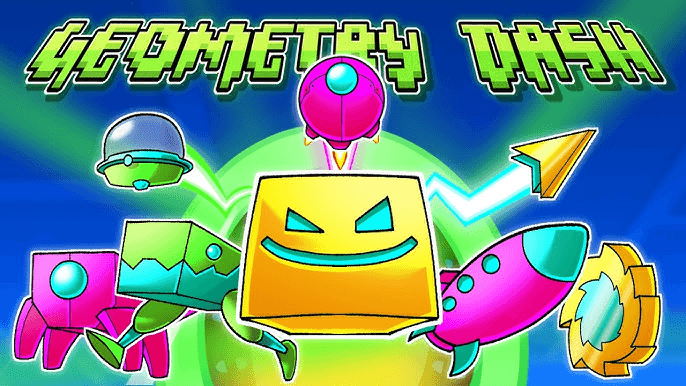
The art style of Geometry Dash is a feast of geometry — sharp angles, glowing edges, and vibrant color palettes that pulse to the music. The cube is the star, but it’s joined by rockets, balls, UFOs, waves, and robots as players progress through new game modes.
Each transformation changes the way you move, adding variety and challenge. The cube jumps, the ship flies, the wave zigzags, and the robot leaps higher with charged energy.
What’s impressive is how each mode syncs perfectly with the rhythm. The design never feels random — every obstacle, every shape, and every motion seems crafted to serve the beat.
7. From Frustration to Triumph
There’s a universal Geometry Dash experience that every player knows: the endless loop of failure and triumph. You start confident, fail at 3%, groan, and restart. Fail again at 67%. Then 95%. Then — victory!
That moment when you finally complete a level after hundreds of attempts is one of the most satisfying feelings in gaming. You might even shout in joy, hands shaking, music blaring. Geometry Dash doesn’t hand out victories easily — you earn them.
This emotional rollercoaster is what makes the game unforgettable. Every success feels personal, like conquering your own limits.
8. Geometry Dash in Pop Culture
Over the years, Geometry Dash has transcended its origins to become a cultural icon in gaming. YouTube is filled with millions of videos — walkthroughs, custom levels, challenges, memes, and music remixes.
The game has inspired fan art, animations, parodies, and even remixed versions that use Geometry Dash physics in entirely new ways. The soundtrack itself has become a recognizable part of internet culture, with songs like “The Seven Seas” and “Theory of Everything” instantly triggering nostalgia for millions.
What makes Geometry Dash so enduring is that it’s not tied to trends. It doesn’t rely on flashy graphics or online multiplayer. It’s built on something timeless — rhythm, timing, and challenge.
9. The Awaited Sequel and the Endless Future
For years, fans have been anticipating the release of Geometry Dash 2.2, the long-awaited major update promised by RobTop. Each teaser from the developer sparks excitement across the community, with new mechanics, camera controls, and creative tools expected to redefine what players can build.
But even without the new version, Geometry Dash remains vibrant. The existing version continues to thrive thanks to player-made levels and a dedicated fanbase that refuses to let the rhythm die.
Geometry Dash has outlived many modern games, not because of marketing or graphics, but because it speaks the universal language of rhythm and challenge.
10. The Magic of Simplicity
Geometry Dash is more than just jumping over spikes. It’s about rhythm, perseverance, creativity, and the beauty of simplicity. It shows that a game doesn’t need photorealistic worlds or cinematic storytelling to make an impact. Sometimes, a cube, a beat, and perfect timing are all you need.
It’s a reminder that games, at their core, are about feeling — the rush of success, the frustration of failure, the joy of rhythm. Every beat, every jump, every crash tells a story of growth.
Conclusion: The Cube That Never Stops
In the end, Geometry Dash isn’t just a rhythm game — it’s a metaphor for life. You fall, you get back up, and the music never stops. Each mistake brings you closer to mastery, each beat a new chance to jump higher, to move forward.
That’s why Geometry Dash endures — because it’s more than pixels and sound. It’s determination turned into rhythm. It’s chaos turned into art.
So next time you hit “Play,” remember: the cube isn’t just running — it’s dancing to your heartbeat. And as long as the music keeps playing, the game — and you — will never stop moving.
Appreciate the creator