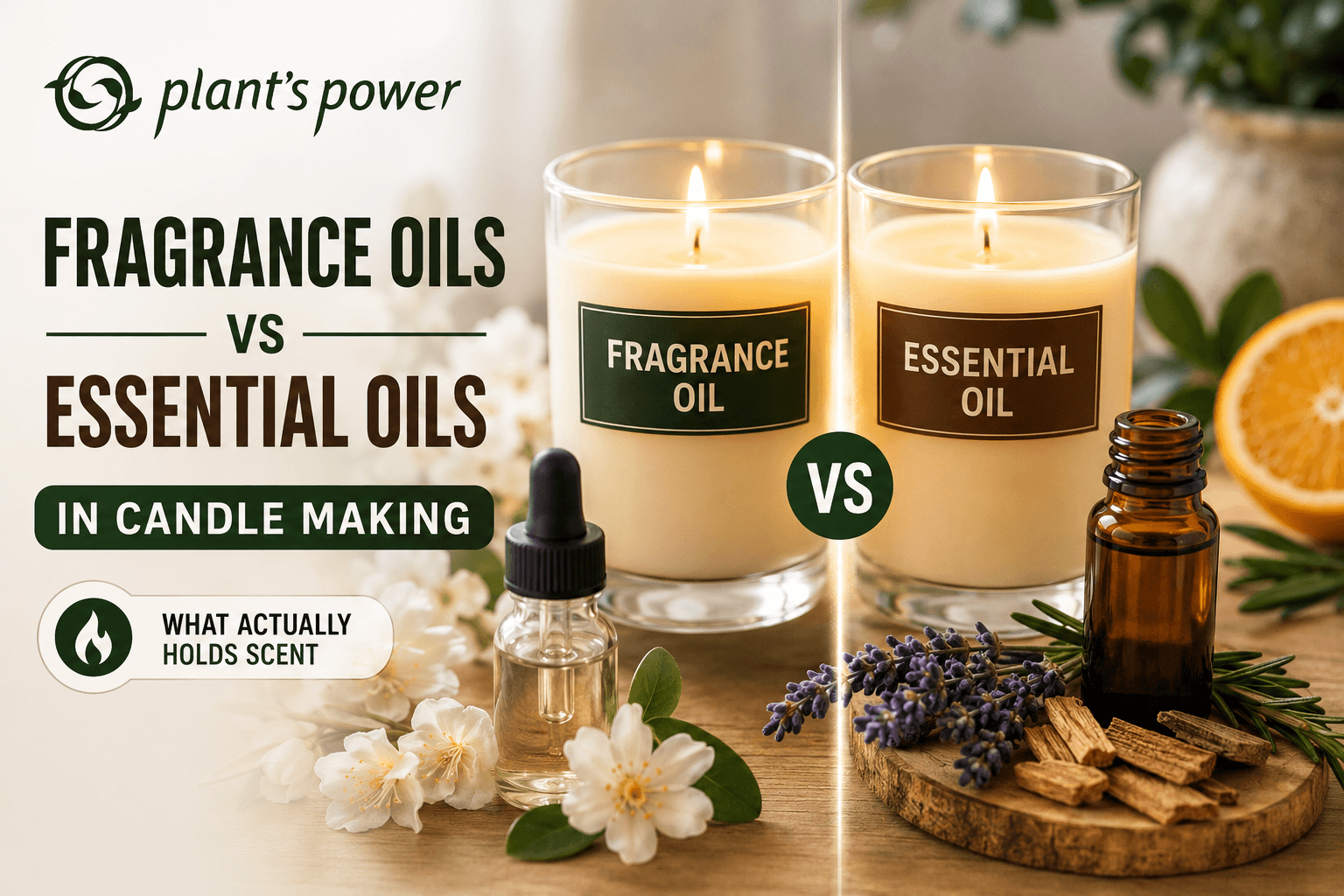
Fragrance vs Essential Oils in Candle Making: What Actually Holds Scent
Quick Answer: Fragrance oils generally hold scent better in burning candles because they are lab-formulated with flash points engineered for the 150–180°F wax pool temperature. Essential oils are more volatile and often have lower flash points, so a portion of the scent burns off during the first hour. Essential oils can still work well in candles when you choose heavier base-note oils, use soy wax, control the fragrance load, and cure the candle properly. This guide breaks down exactly why, and which essential oils perform best.
What's the Actual Difference Between Fragrance Oils and Essential Oils?
Fragrance oils are formulated in a lab specifically to survive heat and hold scent through a full burn. Essential oils are extracted directly from plant material through steam distillation, cold pressing, or CO2 extraction, with no engineering for candle-specific heat performance. This origin difference explains most of the performance gap between the two in candles.
Fragrance oils: Blended from natural and synthetic aroma compounds, tested against IFRA usage limits, and built with a stable flash point for candle applications.
Essential oils: 100% plant-derived, variable in composition by harvest and origin, and not engineered for any specific application.
Why Essential Oils Lose Scent Faster When Burned
A lit candle's wax pool runs at roughly 150–180°F for the entire burn. Most essential oils have flash points below this range, so a meaningful portion of the fragrance evaporates within the first 30 minutes instead of releasing steadily over the burn. This is a physics problem, not a quality problem - even a premium, 100% pure essential oil like Lavender 40/42 will flash off early in a hot wax pool because its chemical structure is volatile by nature.
Two factors drive how much scent survives the burn:
Flash point - the temperature at which an oil's vapors ignite or evaporate rapidly. Oils with flash points below 150°F burn off fastest.
Molecular weight - heavier, base-note oils (like woods and resins) evaporate slower than light, top-note oils (like citrus).
Fragrance Oils vs Essential Oils in Candles: Side-by-Side
Factor
Fragrance Oils
Essential Oils
Hot throw (scent while burning)
Strong and consistent
Weaker, fades faster
Cold throw (scent unlit)
Strong
Moderate to strong
Flash point
Engineered for candle wax pools
Often below wax pool temperature
Batch-to-batch consistency
Highly consistent
Varies by plant harvest and origin
Cost per ounce
Lower
5–10x higher
Scent range
Unlimited (bakery, ocean, fantasy scents)
Limited to what plants produce
Natural/plant-derived
Not always
Always
Which Essential Oils Actually Hold Scent Best in Candles?
Base-note and heavier woody essential oils outperform light citrus oils in candle applications because they evaporate more slowly at wax-pool temperatures. Candle makers sourcing essential oils should prioritize oils with these heavier molecular profiles:
Cedarwood Texas (Juniperus mexicana) - a true base note with strong heat stability, ideal as a scent anchor.
Sandalwood McGregorri (Santalum macgregorii) - dense, woody, and slow to evaporate, giving longer-lasting warmth in a candle blend.
Ylang Ylang Complete (Cananga odorata) - a floral base-to-middle note that holds up better than lighter florals.
Rosemary ct. Cineole - a middle note that performs reasonably well when blended with a heavier base.
Light top-note oils like Lemongrass and citrus essential oils burn off fastest and work best as accent notes layered over a heavier base, not as the primary scent driver.
How to Improve Scent Throw When Using Essential Oils
Candle makers can meaningfully improve essential oil performance with four adjustments:
Pour into soy wax, not paraffin. Soy wax runs slightly cooler than paraffin, which is gentler on delicate essential oil compounds and slightly narrows the throw gap.
Layer base, middle, and top notes. Anchor the blend with a base-note oil like Cedarwood Texas, add a middle note, and use top notes sparingly as an accent.
Stay within IFRA usage limits. Treat every essential oil like any other fragrance material - check its usage level for candles and its flash point before formulating.
Cure candles for 1–2 weeks. Curing time allows the fragrance to bind more fully with the wax, improving both cold and hot throw.
Frequently Asked Questions
Can I use essential oils instead of fragrance oils in candles?
Yes, but expect a softer, less consistent hot throw and a higher cost per candle compared to fragrance oils formulated for candle use.
Do essential oils burn off completely in a candle?
No. Some fragrance survives, especially from heavier base-note oils, but a portion is lost to evaporation before the wax pool reaches full burn temperature.
Which wax works best with essential oils?
Soy wax generally performs better than paraffin for essential oil candles because it burns at a cooler, more consistent temperature.
Is a higher essential oil percentage always better for scent throw?
No. Overloading a candle with essential oil raises fire risk from a low flash point and does not reliably fix a weak hot throw - blend selection and wax type matter more.
Do essential oils need to meet the same safety standards as fragrance oils in candles?
Yes. IFRA usage limits and flash point safety data apply to essential oils the same way they apply to any fragrance material used in a burning candle.
Appreciate the creator