EMS Waterproof Notepad: Built for Clinicals and Field Training
EMS students face a demanding training environment where the ability to document quickly and accurately can shape the outcome of an assessment.
The waterproof notepad from MedTechKits is built specifically for that environment, offering a simple but dependable tool that holds up through the physical demands of clinical and field training.
Moisture, unpredictable conditions, and the pace of real patient contact all test the gear students carry.
A notepad that fails under those conditions creates gaps in documentation at exactly the moments when accuracy matters most.
Understanding what makes the MedTech waterproof notepad a practical choice starts with looking at how it is designed, what it offers on a technical level, and where it delivers real value in the field.
What MedTechKits Brings to EMS Training
Every medkit a student builds reflects the standard they are preparing to meet in the field, and MedTechKits was founded with that standard in mind.
The brand was created by first responders who understood that EMS students needed access to quality gear without having to piece together their kits from unreliable sources.
MedTechKits exists to remove the friction between a student and their training by providing tools that are ready to perform from day one.
The brand serves EMS and paramedic students at every stage of their education, offering gear that meets the real demands of clinicals, practicals, and field rotations.
The MedTechKits Waterproof Notepad for EMS Students
EMS students enter their training with a long list of gear to source, and every item on that list needs to earn its place.
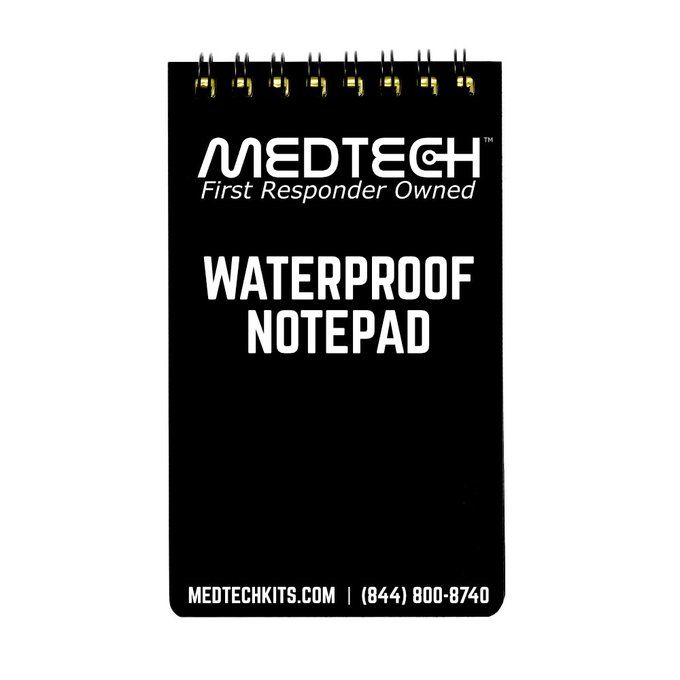
The waterproof notepad from MedTechKits is one of those tools that proves its value from the first day of clinicals.
Compact, durable, and purpose-built for the demands of EMS training, it has become a reliable choice for students across the country.
What sets this notepad apart is not complexity but consistency. It does exactly what a field notepad needs to do, without adding bulk or requiring any special handling.
A Compact 3x5 Size Built for Easy Carry
At three inches by five inches, the MedTech waterproof notepad is sized to fit where students actually need it.
It slides into a uniform pocket, a cargo pocket, or a small compartment in a clinical bag without taking up meaningful space.
The 3x5 format is not a compromise but a deliberate choice that aligns with how EMS students work in real environments.
A larger notepad would create friction, pulling attention away from the patient and toward managing an oversized tool.
College-Ruled Pages Across Fifty Sheets
The college-ruled layout gives students a clean, organized surface for writing notes that need to be legible and retrievable later.
Tighter line spacing means more information fits on each page, which is useful during clinical scenarios where multiple data points need to be recorded in sequence.
The ruled format keeps handwriting structured even when conditions are less than ideal. With fifty sheets per pad, students have enough writing space to carry them through extended rotations without running out mid-shift.
Waterproof Construction That Resists the Elements
The defining feature of this notepad is its waterproof construction, which protects written content from rain, sweat, spills, and the general unpredictability of field environments.
Standard paper notepads deteriorate quickly under those conditions, and notes written on compromised pages become difficult or impossible to read.
The waterproof pages on the MedTechKits notepad hold up through all of it without smearing or breaking down. This level of durability is not a luxury in EMS training.
A notepad that can withstand those conditions without requiring any special care allows students to focus entirely on their work rather than protecting their tools.
Recording Vital Signs During Clinicals
During clinical rotations, accurate documentation is one of the most critical skills an EMS student develops. Vital signs must be recorded quickly, legibly, and in a format that can be referenced throughout the patient contact.
When considering how long does it take to become an emt, these intensive clinical hours represent a pivotal phase where students transition from classroom theory to hands-on patient tracking.
The waterproof notepad gives students the surface they need to capture that information reliably, regardless of what is happening around them.
The waterproof pages are particularly valuable in clinical settings where handwashing and general moisture exposure are frequent.
Staying Organized Through Every Practical
Practicals demand a different kind of note-taking than clinicals, with students often moving between stations, scenarios, and instructors in rapid succession.
Incorporating a durable notebook into your essential emt tools ensures that critical learning moments are captured accurately.
The ruled pages and compact format make it easy to flip back through earlier notes and cross-reference information without disrupting the pace of the session.
Frequently Asked Questions
1. What type of pen should I use to write clearly on the waterproof pages?
Standard ballpoint pens work well on waterproof pages and provide clear, consistent writing during daily use. Most pencils can also be used, especially when making temporary notes or corrections. Ink-based pens usually create sharper and easier-to-read documentation on the synthetic paper surface.
2. Will the pages hold up if I keep taking the notepad in and out of my pocket during a shift?
The waterproof pages are made with a durable material that handles repeated handling better than traditional paper. They resist tearing, folding damage, and general wear from being carried throughout a shift. Even with frequent use, the pages maintain their structure and remain reliable for documentation.
3. Can I scan or copy my notes from the waterproof pages for later reference?
Yes, notes written with a ballpoint pen can be scanned or photocopied without losing readability. The waterproof surface does not absorb ink like regular paper, but written marks remain visible and clear. This makes the notepad useful when you need to save patient notes or training records.
4. Is the 3x5 size practical for writing down complete patient information?
The compact 3x5 format gives EMS students enough space to record important assessment details while keeping the notepad easy to carry. The college ruling helps organize information neatly and makes quick documentation easier during training scenarios.
EMS Essentials Worth Exploring
1. How Durable Trauma Shears Prepare EMS Students for Clinicals
2. MedTech Vitals Kits Guide: Choosing the Right Kit for Your Training
Appreciate the creator