
Employee Onboarding Software and Partner Onboarding Software: The Strategic Case for Automation
Why modern organizations are deploying automated onboarding platforms to accelerate workforce integration, reduce compliance risk, and scale partner ecosystems without proportional operational overhead.
Onboarding is the first operational test of an organization's promises. For a new hire, it is the moment the employer brand becomes tangible. For a channel partner or reseller, it is the moment a commercial relationship either gains momentum or stalls. In both cases, the quality of the onboarding experience directly predicts the quality of the outcome — retention, productivity, partner revenue, and long-term engagement.
Yet most organizations still treat onboarding as an administrative formality: a sequence of forms, induction sessions, and compliance sign-offs that HR or partner operations manages on the margins of their core responsibilities. The cost of this posture is significant. According to Gallup, only 12% of employees strongly agree their company onboards well. The Society for Human Resource Management (SHRM) estimates that replacing a single employee costs between 50% and 200% of their annual salary. For partner programmes, CSO Insights data indicates that companies with formal partner onboarding processes achieve 14% higher win rates than those without.
This article examines the strategic case for employee onboarding software and partner onboarding software — what they are, how they work, why automation changes the calculus, and what best-in-class implementation looks like. It is written for HR leaders, channel programme managers, and technology decision-makers navigating the move from manual to platform-driven onboarding.
What Is Employee Onboarding Software?
Summary: Employee onboarding software is a digital platform that automates and orchestrates the end-to-end process of integrating new hires — from pre-boarding through 90-day assimilation. It coordinates task assignment, document management, system provisioning, training delivery, and compliance tracking across HR, IT, legal, and line management, replacing fragmented manual workflows with a governed, measurable process.
The term is frequently conflated with HRIS or learning management systems, but employee onboarding software occupies a distinct functional layer. Where an HRIS manages the employee record and an LMS delivers training content, an onboarding platform orchestrates the full new hire journey — sequencing actions, assigning responsibilities, tracking completion, and surfacing exceptions.
Modern employee onboarding platforms are built around four structural goals: reducing the administrative burden on HR and managers, ensuring consistent new hire experiences at scale, meeting regulatory compliance requirements, and accelerating the point at which a new hire reaches productive contribution.
Core Components of an Employee Onboarding Platform
Pre-boarding portal: a branded, secure environment where new hires complete forms, review policies, and receive welcome communications before their start date — reducing day-one administrative overload and attrition between offer and arrival.
Task orchestration engine: an automated workflow that sequences onboarding tasks by role, department, and seniority — assigning actions to HR, IT, the hiring manager, and the new hire simultaneously, with dependency logic and deadline tracking.
Document management and e-signature: centralised collection, version control, and legally compliant electronic signing of contracts, policy acknowledgements, tax documents, and compliance certifications.
System access provisioning: integration with IT service management tools to trigger equipment orders and system access requests at defined points in the onboarding workflow, ensuring day-one readiness.
Training module delivery: native LMS functionality or integration with learning platforms to assign and track role-specific induction content, compliance training, and product knowledge modules.
Analytics and progress dashboard: real-time visibility for HR and managers into task completion rates, onboarding stage by cohort, exception flags, and new hire satisfaction scores.
How Employee Onboarding Software Differs from Adjacent Tools
A common implementation failure is purchasing an onboarding tool that duplicates functionality already in the HRIS or LMS without integrating with it. The most effective employee onboarding software acts as an orchestration layer — pulling employee data from the HRIS, triggering training in the LMS, and pushing provisioning requests to IT service management — rather than attempting to replace any of these systems. Integration depth, not feature breadth, is the key differentiator between onboarding platforms.
What Is Partner Onboarding Software?
Summary: Partner onboarding software is a platform that automates the registration, qualification, enablement, and activation of channel partners, resellers, distributors, and technology alliances within a partner programme. It replaces email-heavy, manually managed partner setup processes with a governed, self-service onboarding experience that accelerates partner time-to-revenue and reduces programme management overhead.
While the term shares a structural parallel with employee onboarding software, partner onboarding platforms operate in a fundamentally different commercial context. They are designed to onboard external organisations — not individuals — and must accommodate the complexity of managing multiple partner tiers, certification requirements, co-selling agreements, and revenue-sharing structures simultaneously.
Partner onboarding sits at the entry point of the partner lifecycle, which spans from recruitment and onboarding through enablement, co-selling, and performance management. Poor onboarding — defined as partners waiting weeks for portal access, training credentials, or agreement execution — directly predicts low partner engagement and poor revenue performance. According to Aberdeen Group research, best-in-class companies achieve partner onboarding cycle times of under 14 days; the industry average is 41 days.
Core Components of a Partner Onboarding Platform
Partner self-registration portal: a branded, tiered registration interface where prospective partners submit company information, business credentials, and initial qualification data — initiating the onboarding workflow automatically upon submission.
Agreement and contract management: automated generation, routing, and e-signature capture for partner agreements, NDAs, and programme terms — with version control and compliance audit trails.
Certification and training pathway: structured enablement content — product training, sales methodology, technical certification — delivered and tracked through the platform, gating full activation on completion of defined requirements.
CRM and PRM integration: bi-directional data sync with Salesforce, HubSpot, or dedicated Partner Relationship Management (PRM) systems to maintain a single authoritative partner record and enable co-selling workflows.
Partner portal activation: automated provisioning of access to deal registration, co-marketing assets, pricing tools, and partner support resources upon completion of onboarding milestones.
Performance baseline tracking: initial partner profiling — revenue targets, territory assignment, product specialisation — established during onboarding to enable immediate performance measurement.
Why Automated Onboarding Software Delivers Strategic Value
Summary: Automated employee onboarding software and partner onboarding software deliver strategic value by compressing activation timelines, embedding compliance into the process rather than bolting it on afterwards, producing clean people and partner data for downstream analytics, and creating a consistent experience that directly predicts retention, productivity, and commercial performance.
Reducing Time-to-Productivity and Time-to-Revenue
The most immediate and quantifiable benefit of onboarding automation is the reduction in time between activation and contribution. For employees, Brandon Hall Group research indicates that structured onboarding programmes improve time-to-full-productivity by more than 60% compared to unstructured approaches. For partners, every week of delay in reaching an activated, enabled state is a week of potential revenue unrealised.
Automation achieves this by parallelising onboarding tasks that were previously sequential. In a manual process, IT provisioning is requested after HR paperwork is complete, which is complete after contracts are signed. In an automated workflow, these tracks run simultaneously, triggered by defined milestone events. The structural efficiency gain alone typically reduces onboarding cycle time by 30% to 50%.
Embedding Compliance at the Point of Onboarding
Regulatory requirements affecting employee onboarding — right-to-work checks, GDPR consent management, mandatory policy acknowledgements, role-specific compliance training — cannot be treated as optional add-ons. Employee onboarding software embeds these requirements into the workflow, making compliance completion a prerequisite for activation rather than a post-hire audit exercise.
For partner onboarding, compliance dimensions include anti-bribery and corruption screening (FCPA, UK Bribery Act), sanctions list verification, data processing agreement execution, and certification requirement tracking. Partner onboarding platforms with integrated compliance screening provide the audit trails and documented approval records that satisfy both legal requirements and partner programme governance standards.
Producing Clean Data for Downstream Systems
Every employee and partner record created through a structured onboarding platform is validated, standardised, and complete at the point of creation. This matters enormously for the downstream systems that depend on this data — HRIS workforce analytics, CRM pipeline reporting, LMS completion tracking, and ERP billing. Organisations running manual onboarding processes typically inherit fragmented, inconsistent records that degrade the quality of every analytics output built on top of them.
For AI-driven HR and partner operations tools — which are increasingly embedded in enterprise technology stacks — clean, structured onboarding data is not a nice-to-have; it is the prerequisite for meaningful model performance.
Creating a Consistent Experience That Predicts Retention
The quality of the onboarding experience correlates directly with long-term retention. Glassdoor research indicates that employees who experience a positive onboarding process are 69% more likely to remain with the organisation for three years. For partners, Forrester data suggests that partners who receive a structured, timely onboarding experience are significantly more likely to achieve first-year revenue targets and renew their programme commitment.
Consistency is the key variable. Without an automated platform, onboarding quality is determined by the bandwidth and capability of individual managers and programme coordinators — creating a lottery of experience quality that compounds into measurable retention and engagement variance.
Employee Onboarding Software vs Partner Onboarding Software: Key Differences
Summary: While employee onboarding software and partner onboarding software share structural parallels — both automate registration, document management, training delivery, and system provisioning — they differ significantly in their stakeholder complexity, compliance requirements, integration targets, and success metrics. Understanding these differences is essential for organisations evaluating platforms for either or both use cases.
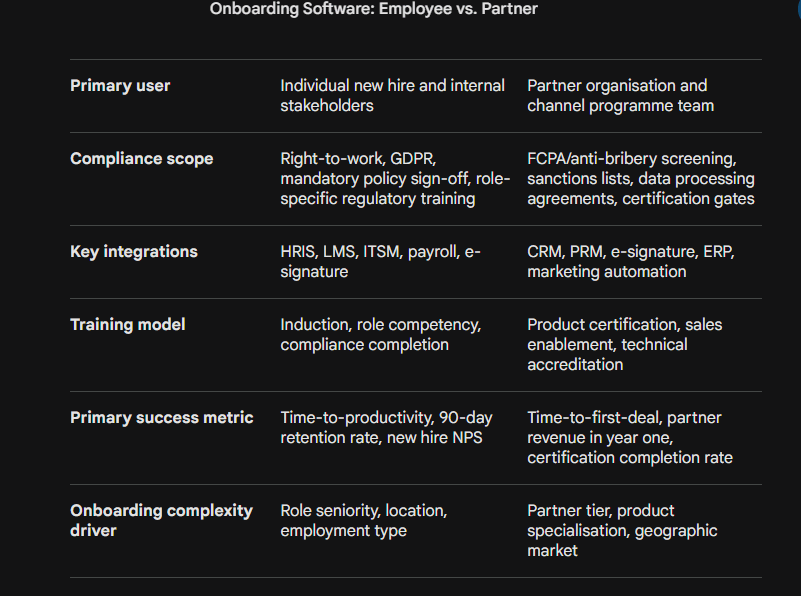
Organisations with both a significant hiring programme and an active channel ecosystem should evaluate whether a single platform vendor can serve both use cases, or whether purpose-built solutions for each domain — integrated at the data layer — deliver superior outcomes. Converged platforms offer administrative simplicity; specialised platforms typically offer deeper functionality and integration quality for their specific domain.
Real-World Use Cases: Onboarding Software in Practice
Summary: Across technology, professional services, manufacturing, and financial services sectors, organisations deploying employee onboarding software and partner onboarding software have achieved measurable reductions in onboarding cycle time, compliance incident rates, and early attrition — with the most significant gains accruing to those that integrate onboarding platforms with their core HR and CRM systems.
Use Case 1: SaaS Company Reduces Employee Onboarding Cycle Time by 55%
A 600-person SaaS business experiencing 40% year-over-year headcount growth was processing new hire onboarding through a combination of email checklists, shared spreadsheets, and ad hoc manager-led induction. Average time from start date to full system access and training completion was 19 days. Following deployment of a dedicated employee onboarding platform with HRIS integration and automated IT provisioning triggers, the cycle time dropped to 8 days. Manager time spent on onboarding administration reduced by 60%, and 90-day new hire satisfaction scores increased from 3.4 to 4.6 out of 5.
Use Case 2: Enterprise Software Vendor Cuts Partner Activation Time from 41 to 12 Days
An enterprise software company with a 300-partner reseller network was losing prospective partners to competitors with faster, more professional onboarding experiences. The manual process — dependent on email exchanges, PDF agreements, and manually issued portal credentials — averaged 41 days from application to full activation. After deploying a partner onboarding platform integrated with Salesforce and their LMS, activation time fell to 12 days. Year-one partner revenue performance improved by 23% across the cohort, attributed primarily to earlier enablement completion and faster deal registration access.
Use Case 3: Financial Services Firm Achieves Audit-Ready Compliance at Scale
A regulated financial services organisation onboarding both client-facing employees and third-party distribution partners faced significant compliance documentation risk under its manual process. Audit reviews regularly surfaced incomplete right-to-work records for employees and missing AML screening documentation for distribution partners. Deploying integrated employee and partner onboarding platforms with embedded compliance gates — where activation is blocked until required documentation is submitted and verified — eliminated audit exceptions across both populations within two quarters of go-live.
Best Practices for Implementing Onboarding Software
Summary: Successful deployment of employee onboarding software or partner onboarding software depends less on the platform selected and more on the quality of the onboarding process design that precedes configuration. Organisations that map their current-state workflows, define minimum viable data requirements, and align internal stakeholders before touching the platform consistently achieve faster time-to-value and higher user adoption.
Map Before You Configure
The most common implementation failure is configuring an onboarding platform against an undocumented, inconsistently applied manual process. Before any platform configuration begins, organisations should map the complete current-state onboarding journey — every task, approval, data collection point, and system integration — across each relevant role type, employment category, or partner tier. This exercise invariably surfaces redundant steps, missing compliance checkpoints, and conflicting stakeholder accountabilities that should be resolved before they are automated.
Define the Minimum Viable Onboarding Record
Resist the temptation to collect every possible data point during onboarding. For employees, define the precise set of fields and documents required for payroll, compliance, and system provisioning — and collect nothing else at this stage. For partners, define the minimum information required for legal agreement execution, CRM record creation, and portal activation. Over-collecting at onboarding creates form fatigue, reduces completion rates, and burdens records management without proportional benefit.
Design for the Recipient's Experience, Not the Operator's Convenience
Employee onboarding portals should be tested with new hires — not just HR administrators — before go-live. Partner onboarding portals should be reviewed by partner representatives, not just channel programme managers. The friction points that drive incomplete submissions, portal abandonment, and poor experience ratings are almost always invisible to internal operators who know the process intimately and interact with the platform daily.
Build Accountability Into the Workflow
Onboarding platforms only realise their value if every stakeholder completes their assigned tasks on time. This requires designing escalation logic into the workflow — automated reminders to managers, IT administrators, and legal reviewers at defined intervals before deadline, with exception reporting to programme owners when tasks remain incomplete. Without escalation logic, onboarding software becomes a sophisticated task list that still depends on individual initiative to function.
Establish Baseline Metrics Before Go-Live
Measure your current-state onboarding cycle time, completion rate, compliance exception rate, and satisfaction scores before deploying the platform. Without a baseline, demonstrating ROI is impossible and continuous improvement has no reference point. The act of measuring baseline performance also frequently surfaces process issues that should be addressed before automation embeds them at scale.
Common Challenges and How to Address Them
Summary: The most frequent challenges in onboarding software implementation are poor adoption by managers and partner coordinators, integration failures with legacy HR or CRM systems, over-engineered workflows that create friction rather than removing it, and insufficient attention to the ongoing governance needed to keep platform configuration aligned with evolving regulatory and organisational requirements.
Manager and Coordinator Adoption
Onboarding platforms succeed only when the people responsible for completing workflow tasks — primarily line managers for employee onboarding and channel programme managers for partner onboarding — use them consistently. Adoption failure is almost always a change management failure, not a technology failure. Equipping managers with clear role-specific guides, brief platform walkthroughs, and a visible escalation path for questions significantly improves adoption rates compared to launching the platform and assuming uptake.
Integration Depth vs. Integration Promise
Many onboarding platforms market extensive integration capabilities that, in practice, require significant custom development to realise. Before selecting a platform, validate integration claims against your specific HRIS, CRM, or ITSM versions in a proof-of-concept environment. The most consequential integrations — HRIS for employee data, ITSM for provisioning, CRM for partner records — should be live and tested before the platform goes into production, not scheduled as post-launch improvements.
Keeping Configuration Current
Onboarding requirements change with regulatory updates, organisational restructuring, product launches, and partner programme evolution. An onboarding platform configured at go-live and never revisited becomes a compliance liability within 12 to 18 months. Build a governance model that reviews and updates platform configuration at least annually — or immediately following a material regulatory or organisational change — with a named owner accountable for platform integrity.
Future Trends: Where Onboarding Software Is Heading
Summary: The next generation of employee onboarding software and partner onboarding software is converging around AI-driven personalisation, predictive risk identification, continuous profile management, and generative AI interfaces that adapt the onboarding journey in real time based on role, learning style, and completion behaviour — shifting onboarding from a fixed workflow to a dynamic, data-responsive experience.
AI-Personalised Onboarding Journeys
Current onboarding platforms deliver configured, role-based journeys that are consistent but static. Emerging platforms are deploying AI models that personalise onboarding content sequencing, communication tone, and task pacing based on individual completion patterns, self-reported preferences, and role-specific knowledge gaps. For partner onboarding, AI personalisation extends to training pathway recommendations based on the partner's existing product expertise, market focus, and historical certification performance.
Predictive Attrition and Disengagement Signals
Early attrition — employees leaving within 90 days, partners disengaging before their first deal — is expensive and, increasingly, predictable. Onboarding platforms are beginning to surface predictive risk signals: new hires who are completing tasks late, skipping optional social touchpoints, or scoring low on mid-point check-in surveys. For partners, signals include delayed training completion, low portal login frequency, and absence from co-selling activities. Flagging these patterns early enables proactive intervention before disengagement becomes departure.
Continuous Onboarding as an Ongoing Capability
The concept of onboarding as a time-bounded event ending at day 90 is giving way to continuous onboarding — a model in which the employee or partner profile is dynamically updated as role responsibilities, product portfolios, and regulatory requirements evolve. An employee who moves into a management role is automatically assigned leadership development content. A partner who adds a new product specialisation triggers a recertification pathway. Continuous onboarding converts a one-time activation process into a persistent capability development and compliance management function.
Generative AI Interfaces
Conversational AI interfaces are beginning to appear in both employee and partner onboarding platforms, enabling new hires and partners to navigate the onboarding process through natural language rather than form-based portals. These interfaces can answer procedural questions, surface relevant policy documents, escalate exceptions to human coordinators, and guide users through complex multi-step processes without requiring them to interpret static help content. The result is a measurable reduction in incomplete submissions, support ticket volume, and onboarding-related helpdesk load.
Key Takeaways
Strategic Purpose: Employee onboarding software and partner onboarding software share structural parallels but serve distinct strategic purposes — one accelerates workforce integration and retention, the other compresses partner time-to-revenue and programme engagement.
Primary Value: Automation delivers value by parallelising onboarding tasks, embedding compliance at the point of registration, and producing clean data for downstream HR and CRM systems.
Multifunctional ROI: The ROI of onboarding software spans HR (retention), finance (reduced replacement cost), legal (compliance defensibility), and sales (partner revenue performance).
Design First: Implementation success is determined by process design quality before platform configuration, not by platform feature breadth.
The AI Future: The future lies in AI-personalised journeys, predictive disengagement detection, and continuous profile management.
Appreciate the creator