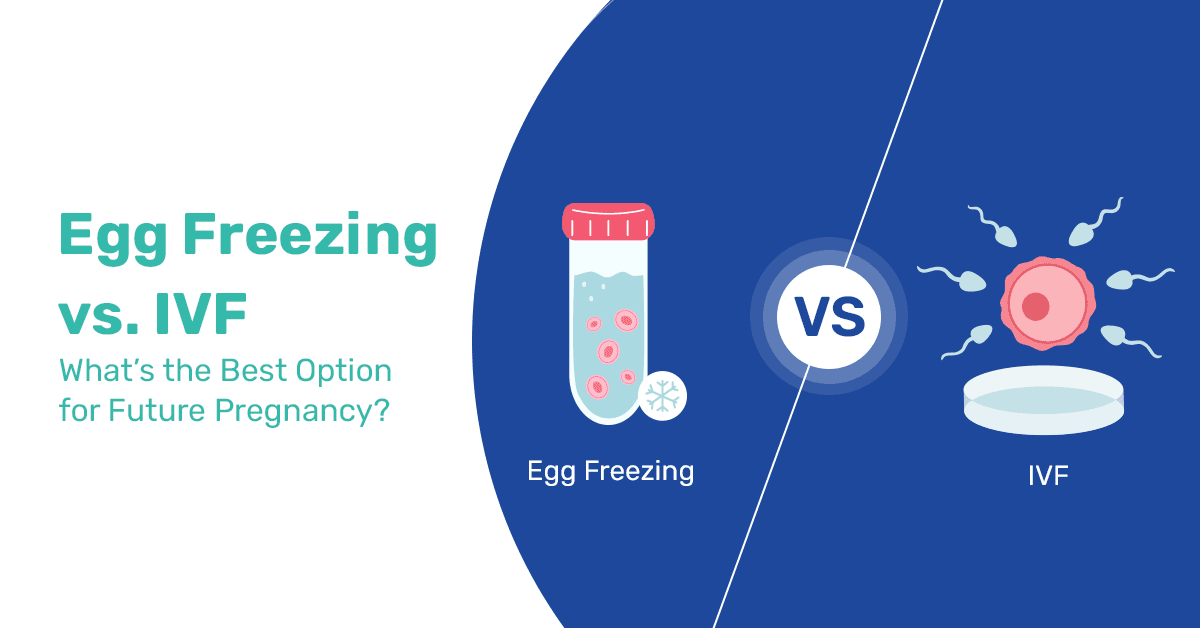
Egg Freezing vs. IVF: What’s the Best Option for Future Pregnancy?
Deciding when to start a family is one of the most personal and emotional decision a woman must make. For many women today, the biological clock and life circumstances do not always align. Which is where fertility preservation and assisted reproductive techniques like egg freezing vs. IVF (in vitro fertilization) come into play.
Both egg freezing and IVF are meaningful ways to achieve parenthood, but they carter to different needs. This guide walks you through the differences, so that you can choose what feels right for your life and your future.
Take control of your fertility timeline because understanding your options is the first step to making informed and empowered choices.
What is Egg Freezing?
Egg freezing, or oocyte cryopreservation, is a fertility preservation technique that allows women to store their eggs for future use. This method is ideal for those individuals who want to delay pregnancy for personal, professional, or medical reasons.
Preserve your future possibilities with a safe and science-backed option.
Egg Freezing Process: Step-by-Step
Wondering how to freeze eggs as a woman? Find below the step-by-step egg freezing process:
Consultation: to review your health and fertility goals, followed by baseline tests like AMH and ultrasound to assess your ovarian reserve.
Ovarian stimulation where hormone injections are given to stimulate multiple egg production.
Monitoring and egg retrieval is carried out under light sedation in an outpatient procedure. A needle is guided by ultrasound to aspirate the mature eggs from the follicles.
Freezing (vitrification) the mature eggs are the stored he frozen eggs are then stored in liquid nitrogen for future use.
When is the Best Time to Freeze Eggs?
Still searching for the right partner or not yet ready for marriage? If you're also noticing the years passing by, that may be the first and most important indication to consider egg freezing. Age is one of the most critical factors in the success of fertility preservation. Fertility specialists strongly recommend freezing your eggs before the age of 35, as both egg quality and quantity begin to decline significantly with age. That’s why understanding the ideal egg freezing age limit is essential.
Why Women Choose Egg Freezing
· Want to delay starting a family for later.
· Social egg freezing, if low ovarian reserve is detected during routine checkups
· Face medical conditions that could affect their fertility.
· Plan to undergo cancer treatment since the treatment itself severely impacts egg quality, so it’s better that healthier eggs are retrieved and preserved before the treatment starts.
· May have a family history of early menopause
· If you have had pelvic surgery in childhood or teenage years
In India, egg freezing cost can vary based on the centre approached, technology used in the lab, and if long-term storage is needed. In most cases, you can store your eggs for up to 10 years, giving you the flexibility to plan for parenthood on your own timeline. When the time is right your body will be ready.
What is IVF?
IVF (In Vitro Fertilization) is a widely used fertility treatment that helps couples or individuals to conceive when natural methods have not worked. Unlike egg freezing, IVF is carried out when you are ready to try for a baby.
IVF Process Overview
The IVF process involves several stages:
Consultation and Preparation to assess medical history and pre-IVF tests like blood work and semen analysis.
Hormonal stimulation of the ovaries to produce multiple eggs.
Retrieval of mature eggs and sperm collection
Fertilization in a lab which can be carried out through conventional insemination or intracytoplasmic sperm injection (ICSI) if needed.
Culturing of embryos
Embryo transfer into the uterus
The cost of IVF in India varies depending on the patient's age, health condition, and the specialist advised procedure. Science that supports your dreams, IVF which combines advanced technology with compassionate care to help make parenthood possible.
Who Can Benefit from IVF?
Women with poor egg quality or low ovarian reserve
Women with blocked or damaged fallopian tubes
Uterine problems like fibroids and endometrial polyps
Cases of male factor infertility
Women of advanced maternal age (35+)
Couples with recurrent pregnancy loss
Individuals using sperm/eggs donors
If all other treatment for pregnancy have failed
Egg Freezing vs. IVF: A Side-by-Side Comparison
Criteria Egg Freezing IVF
Goal Preserve fertility for future Conceive immediately
Requires sperm? No Yes
Timeline Flexible; you can choose Immediate pregnancy
when to try for pregnancy attempt
How it fits into Gives you time to focus on Requires focused
your life your career, health, or commitment and
relationships planning for pregnancy
in the near future
Because your choice matters and knowing the difference helps you make the one that aligns with your life.
IVF Pregnancy Insights
Once IVF is successful, the next big question is: after how many weeks is IVF pregnancy safe?
Typically, when a heartbeat is detected around 5 to 8 weeks, the pregnancy is considered viable. However, close monitoring is essential, especially in the first trimester (3 months).
IVF Pregnancy Symptoms
Early IVF pregnancy symptoms are similar to the natural pregnancy:
Fatigue
Mild cramping
Bloating
Breast tenderness
Light spotting
These symptoms can vary depending on individual hormonal responses and embryo development.
Making the Right Choice for You
Choosing between egg freezing vs. IVF isn't about picking the better technique, it is about choosing what aligns with your personal needs and reproductive goals.
Ask yourself:
Am I ready for a child now or later?
What are my financial and emotional resources right now?
Am I aware of my ovarian reserve and hormone levels?
Emotional Readiness Matters
Both treatments require emotional resilience. Egg freezing offers peace of mind and flexibility as it is about preserving possibilities. IVF, on the other hand, involves anxiety, anticipation, vulnerability, and hope for immediate success.
Whichever path you choose, it is essential to remember that your journey is unique.
Common FAQs
1. What is the best age to freeze eggs?
Fertility starts to decline from the age of 30 and is greatly reduced after 40 years of age. Therefore, it the optimum age to freeze your eggs in your late 20’s. However, freezing eggs at 30 to 35 is also quite common.
2. Can I freeze my eggs if I am aged 40 and over?
Yes, egg freezing after 40 is possible, but egg quality and quantity decline sharply with age. Fewer eggs can be retrieved, making success rates lower and outcomes less predictable. A fertility consult is advised.
3. How much does egg freezing cost in India?
The cost of egg freezing in India can vary depending on the technology used, the clinic, and whether long-term storage is included. It is best to consult directly with a fertility specialist to get a clear picture on your specific needs and plan.
4. What is the cost of IVF, and how can patients finance the procedure?
The cost of IVF varies depending on the patient's age and medical condition. Cost also varies in different states and cities. Patients can finance the procedure through available EMI options or savings plans.
Conclusion
Whether you're freezing your eggs for later or undergoing IVF to conceive now, you're taking a bold and beautiful step toward motherhood. Let your choice reflect your timeline, not society’s. And above all—make it with care, confidence, and support.
Appreciate the creator