Do Protestant and Catholic Women Clergy Follow Different Attire Traditions?
Christianity contains multitudes.
Over two billion people around the world identify as Christian, worshipping in traditions that range from the elaborate ceremonial liturgy of Rome to the stripped-down simplicity of a Baptist fellowship hall. These traditions disagree on theology, church structure, the nature of the sacraments, and the authority of Scripture, and they disagree, visibly and immediately, on what their women leaders wear.
The question of whether Protestant and Catholic women clergy follow different attire traditions has a clear answer: yes, profoundly so. And the differences go deeper than aesthetic preference. They reflect fundamental theological disagreements about ordination, the nature of ministry, and the role of women in the life of the Church.
Why Do Protestant and Catholic Women's Attire Traditions Differ So Dramatically?
The root of the attire difference lies not in fashion but in theology. Catholic and Protestant traditions disagree on whether women can be ordained to the priesthood, and that disagreement produces entirely different clothing categories.
The Catholic Church does not ordain women as priests or deacons. This means that the specific garments tied to ordained priestly ministry , the stole, the chasuble, the clerical collar worn as a mark of presbyteral ordination — are not worn by women in Catholic contexts because those garments represent an office women do not hold in that tradition.
Most major Protestant denominations have moved toward the full ordination of women to pastoral and priestly roles over the past several decades. Women in these traditions do hold ordained offices, and therefore do wear the clerical collar, the preaching robe, and the seasonal stole that those offices have always required.
Women's clerical wear in the two traditions looks different because the two traditions have made fundamentally different decisions about what women are authorized to do in the life of the Church.
How Has This Theological Divide Shaped Visible Attire?
The theological divide produces a visible divide that is immediately readable when you walk into a Catholic church versus a mainline Protestant church where a woman is leading worship.
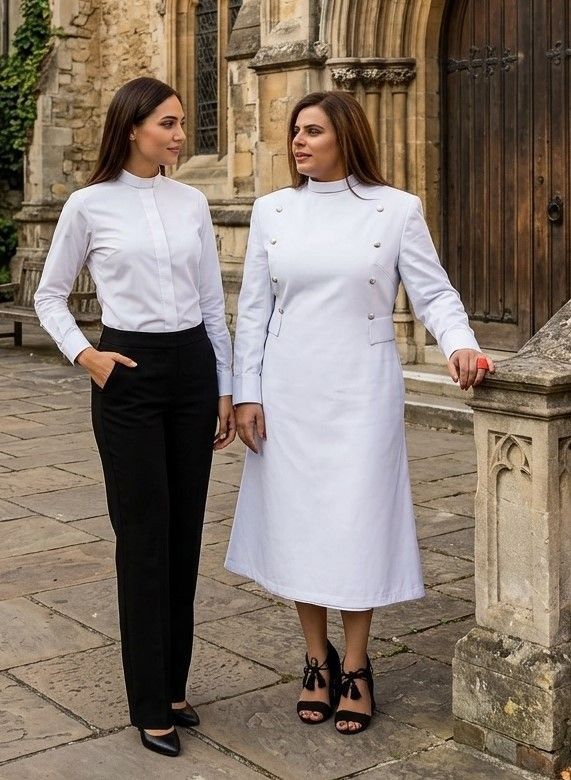
In the Protestant church, the female pastor is visually indistinguishable in her ministerial attire from a male pastor in the same tradition. She wears the same collar, the same robe, and the same stole. Her clergy women attire (https://eclergys.com/collections/clergy-apparel-for-women) marks her as an ordained minister in exactly the way that male clergy attire marks male ministers.
In the Catholic context, a woman in religious life who has dedicated herself to service within the Church wears a religious habit or modest civilian clothing. She does not wear a clerical collar or stole because those garments mark presbyteral ordination, which the Catholic Church reserves to men.
What Do Protestant Women Clergy Wear?
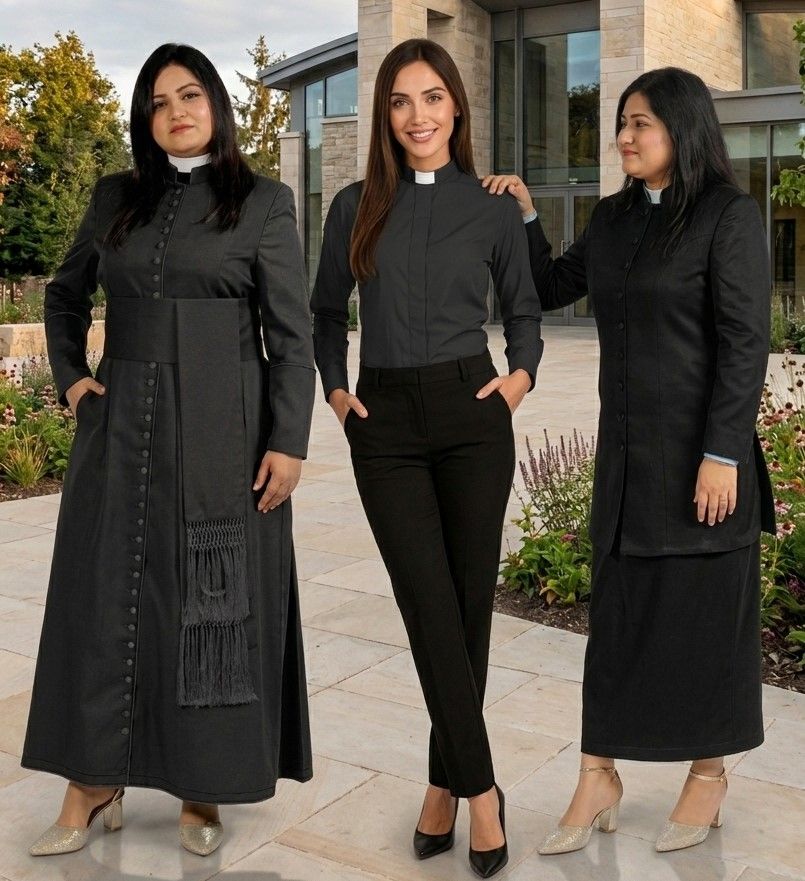
Women clergy attire in Protestant traditions follows the same general system as male clergy attire within each denomination, with tailoring modifications that serve the female form specifically.
In mainline Protestant denominations including Anglican, Episcopal, Lutheran, Methodist, and Presbyterian traditions, ordained women wear clerical collars in both tab collar and full collar styles for everyday ministry and pastoral calls. During formal Sunday services, they wear preaching robes or pulpit gowns in the tradition's standard style. Stoles in the liturgical color of the current church season are draped over the robe collar.
The visual language is clear and consistent: an ordained woman in these traditions looks like what she is, an ordained minister in the same visual tradition as every ordained minister before her.
How Do Evangelical Protestant Women Differ From Mainline Protestants?
Womens clerical wear in evangelical and non-denominational Protestant contexts often looks significantly different from mainline Protestant women clergy attire.
Many evangelical traditions have historically resisted distinctive clerical dress for both men and women, preferring professional business attire that communicates a deliberate equality between minister and congregation rather than a visual distinction. A female pastor in a Southern Baptist or non-denominational evangelical church may wear a professional suit or a modest dress rather than any recognizable clerical garment.
The theological reasoning here is similar to the theological reasoning behind the broader resistance to clerical dress in Reformed Protestant traditions: the minister's authority comes from the Word she preaches, not from the garments she wears.
Ladies clergy attire in evangelical contexts therefore tends toward conservative professional dress rather than the robes and collars of mainline liturgical traditions. Both approaches reflect genuine theological commitments rather than simple fashion preferences.
What Do Catholic Women in Religious Life Wear?
Catholic women who have dedicated themselves to religious life within the Church fall into a different category entirely from Protestant ordained women ministers. They are not ordained clergy, and their attire reflects that distinction.
Women religious in the Catholic tradition, including nuns and sisters of various religious orders, wear attire specific to their particular order rather than the clerical collar or vestments associated with ordained priesthood.
Traditional religious orders maintain the full religious habit: a long, often white or black dress with a distinctive veil, an apron or scapular depending on the order, and a crucifix worn visibly at the chest. The specific details of the habit are unique to each religious order and mark the wearer as belonging to that particular community.
What Do Modern Catholic Women Religious Wear?
Many religious orders that updated their practices following the Second Vatican Council in the 1960s have moved toward simpler, more contemporary civic attire for women that retains the cross or a small religious pin as the primary marker of their consecrated life but otherwise looks similar to modest professional clothing.
A member of such an order might be nearly indistinguishable from a professional laywoman except for the cross she wears. This reflects a deliberate choice to be more present in secular spaces and more visually accessible to the communities those orders serve, rather than separated from them by distinctive religious clothing.
Neither the habit nor the modern modified attire includes a clerical collar or any of the vestments associated with ordained priesthood, because that ordination remains closed to women in the Catholic tradition.
How Does Women's Clerical Wear Vary Within Protestant Denominations?
Women's clergy attire is not uniform even within Protestant Christianity. The diversity of Protestant traditions produces significant variation in what ordained women wear.
Anglican and Episcopal traditions maintain some of the most structured vestment requirements, with ordained women wearing the full range of cassock, surplice, stole, and chasuble appropriate to their specific order of ministry. A female Anglican bishop wears the same rochet, chimere, and mitre as a male bishop.
Lutheran clergy women's wear follows a similar liturgical pattern, with ordained women wearing albs, stoles, and sometimes chasubles for formal Eucharistic services, though specific practices vary by synod and regional tradition.
Methodist and Presbyterian ordained women follow their denominations' own vestment traditions, which range from full Geneva gown and stole to professional attire with a simple clerical collar, depending on the specific congregation's practice.
Where Can Protestant Women Find Quality Clergy Attire?
Finding quality women's clergy attire that meets both the theological requirements of the specific denomination and the practical demands of active ministry has become significantly easier as the market for women's clergy clothing has developed.
eClergys carries a comprehensive range of women's clergy attire options designed specifically for the female form, including tab collar shirts, full collar options, clergy dresses with collar construction, and robes in multiple styles and liturgical colors. Their collections cover the needs of ordained women across Anglican, Lutheran, Methodist, Baptist, and non-denominational ministry contexts.
Clergy women's wear from specialist suppliers like eClergys is designed with a genuine understanding of what ministry requires, offering proper collar construction, ministry-specific fabric performance, and inclusive sizing that serves women of all body types.
What Does a Preacher Outfit Look Like for Women Across Both Traditions?
The concept of a preacher outfit looks entirely different depending on which tradition is being discussed, and the differences go directly back to the theological positions described above.
For an ordained Anglican or Episcopal woman priest, the preacher outfit (https://eclergys.com/) for a Sunday Eucharist includes an alb, a stole in the current liturgical color, and often a chasuble. For a Presbyterian or Methodist female pastor, the Sunday preacher outfit typically centers on a Geneva gown and stole. For an evangelical female pastor, the Sunday preacher outfit may be a professional dress or suit with no clerical markers at all.
For a Catholic woman religious who gives a reflection at a prayer service or leads a faith formation session, there is no specific preacher outfit tied to ordained status, since that ordained status is not part of the Catholic tradition for women. She wears whatever attire reflects her religious community's customs and the context of the gathering.
FAQ
How do Protestants dress?
Protestant clergy dress varies widely by denomination, from full liturgical robes and collars in Anglican and Lutheran traditions to professional business attire in evangelical and non-denominational churches.
Can Protestant women be priests?
Many Protestant denominations fully ordain women as pastors, priests, and bishops, including Anglican, Episcopal, Lutheran, Methodist, and Presbyterian churches, though some conservative Protestant traditions do not.
Are women allowed to wear pants in a Catholic church?
The Catholic Church has no formal dress code requiring skirts for women, though modest dress is generally expected, and specific parish cultures vary in their expectations.
Do popes wear pants under their robes?
The Pope wears a cassock as his standard garment, with standard undergarments beneath it, though the specific details of the papal wardrobe beneath the visible vestment are not formally documented.
Final Thoughts
Protestant and Catholic women clergy follow profoundly different attire traditions because they occupy profoundly different roles within their respective traditions.
Protestant ordained women wear clerical collars, preaching robes, and seasonal stoles because they hold ordained pastoral and priestly offices that those garments have always marked. Catholic women religious wear habits or modest professional clothing because the ordained priestly offices that require those specific clerical garments remain closed to women in the Catholic tradition.
Both attire traditions are internally coherent. Both reflect genuine theological commitments about the nature of ordination, ministry, and the role of women in the life of the Church.
Whether you are an ordained Protestant woman searching for quality women's clergy attire from a trusted supplier like eClergys, exploring ladies clergy attire options for a specific denominational context, or simply trying to understand what you are seeing when women lead worship in different traditions, the clothing you observe is telling a theological story. Learning to read that story makes the diversity of Christian worship richer and more meaningful.
Appreciate the creator