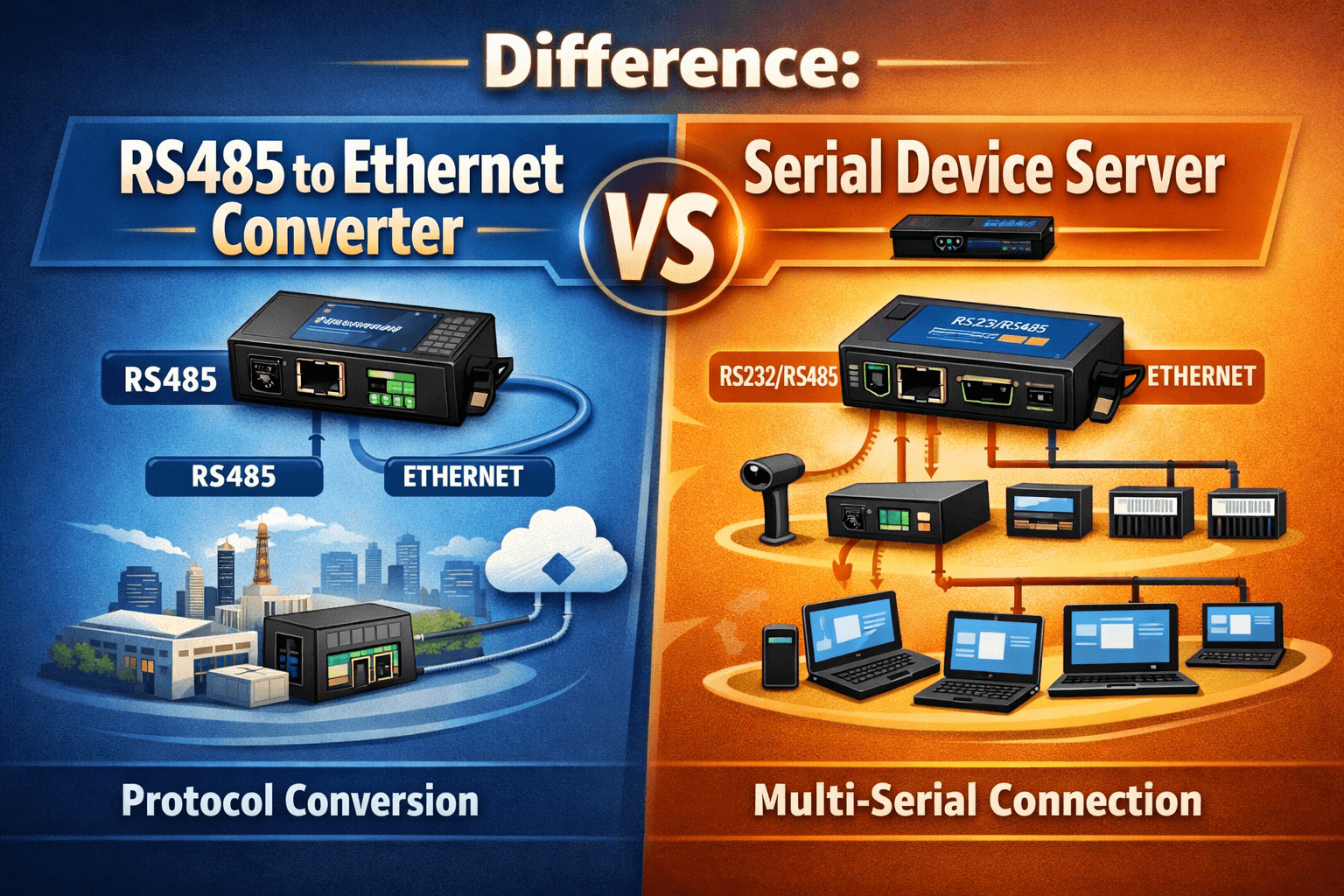
Difference: RS485 to Ethernet Converter vs Serial Device Server
When integrating legacy serial systems with modern IP networks, both RS485 to Ethernet Converters and Serial Device Servers are widely used—but they are not interchangeable. Understanding their differences in depth helps you choose the right solution for your specific application.
At a high level, both devices connect serial communication systems like RS-485 to Ethernet networks, but their purpose, intelligence, and capabilities differ significantly.
1. Core Functionality
An RS485 to Ethernet Converter is primarily a protocol translator. It converts serial communication (often Modbus RTU) into Ethernet-based communication (like Modbus TCP).
It understands industrial protocols
It ensures correct mapping of data formats
It enables seamless communication between PLCs, sensors, and SCADA systems
A Serial Device Server, on the other hand, acts as a network bridge:
It encapsulates serial data into TCP/IP packets
It allows serial devices to be accessed over LAN/WAN
It does not necessarily interpret or convert industrial protocols deeply
Key takeaway:
Converter = Protocol intelligence
Device Server = Network accessibility
2. Communication Approach
Converter: Works at the application layer, translating protocols and ensuring compatibility between systems.
Device Server: Works at the transport/network layer, simply forwarding serial data over IP.
This means converters are more suitable for automation logic, while device servers are ideal for data transport.
3. Level of Intelligence
RS485 to Ethernet Converter
Understands command/response structures
Can manage Modbus queries
Optimized for deterministic communication
Serial Device Server
Treats data as raw byte streams
No deep protocol awareness
Focuses on connectivity rather than interpretation
Result: Converters are smarter for industrial protocols; device servers are more generic.
4. Deployment Environment
Converters are commonly used in:
Manufacturing plants
Power and energy systems
Industrial automation setups
Device Servers are widely used in:
IT and enterprise networks
Remote monitoring systems
Data centers and distributed networks
5. Security and Management
Converters
Basic security (in some models)
Limited remote configuration
Device Servers
Advanced security (SSL/TLS, VPN, authentication)
Web-based dashboards
SNMP/network monitoring support
Device servers are more suitable for network-heavy environments with strict security requirements.
6. Scalability and Flexibility
Converters
Typically used for fixed applications
Limited scalability
One-to-one or small network setups
Device Servers
Highly scalable
Multi-port and multi-user support
Suitable for large distributed systems
7. Cost vs Value
Converters
Lower cost
High value for industrial use
Minimal configuration needed
Device Servers
Higher cost
More features and flexibility
Better long-term scalability
Comparison Table
Feature
RS485 to Ethernet Converter
Serial Device Server
Primary Function
Protocol conversion (serial to Ethernet)
Network enablement of serial devices
Communication Type
Converts Modbus RTU to Modbus TCP
Encapsulates data using TCP/IP
Protocol Awareness
High (understands industrial protocols)
Low (treats data as raw stream)
Use Case Focus
Industrial automation & control
Remote access & network connectivity
Complexity
Simple and application-specific
Advanced and feature-rich
Configuration
Easy setup
Requires detailed configuration
Security Features
Basic
Advanced (encryption, firewall, VPN)
Scalability
Limited
High (multi-device, multi-user)
Device Support
Mainly RS485
RS232, RS422, RS485
Remote Access
Limited
Full remote access over LAN/WAN
Cost
Cost-effective
Higher investment
Best For
PLCs, SCADA, sensors
Enterprise networks, remote systems
Final Verdict
Choosing between these two depends entirely on your application:
If your goal is accurate industrial protocol conversion and real-time control, go with an RS485 to Ethernet Converter.
If your goal is remote accessibility, scalability, and network integration, a Serial Device Server is the better choice.
In many modern deployments, organizations even use both together—leveraging converters for protocol translation and device servers for network distribution.
FAQ
1. What is the main difference between an RS485 to Ethernet Converter and a Serial Device Server?
The main difference lies in functionality. An RS485 to Ethernet Converter performs protocol conversion (e.g., Modbus RTU to Modbus TCP), while a Serial Device Server enables remote access to serial devices over TCP/IP networks without deeply interpreting the data.
2. When should I use an RS485 to Ethernet Converter?
You should use an RS485 to Ethernet Converter when your application involves industrial automation systems, such as PLCs, SCADA, or sensors, where accurate protocol translation and real-time communication are required.
3. When is a Serial Device Server a better choice?
A Serial Device Server is ideal when you need remote monitoring, centralized control, or access to serial devices over a network. It is commonly used in enterprise environments and distributed systems where scalability and remote access are important.
4. Can RS485 to Ethernet Converters and Serial Device Servers be used together?
Yes, in advanced setups, both devices can be used together. The converter handles protocol conversion, while the device server provides network connectivity and remote access, creating a more flexible and scalable system.
5. Which solution is more cost-effective?
RS485 to Ethernet Converters are generally more cost-effective and simpler to deploy for industrial use cases. Serial Device Servers are more expensive but offer advanced features like security, scalability, and remote management, making them suitable for complex networks.
Appreciate the creator