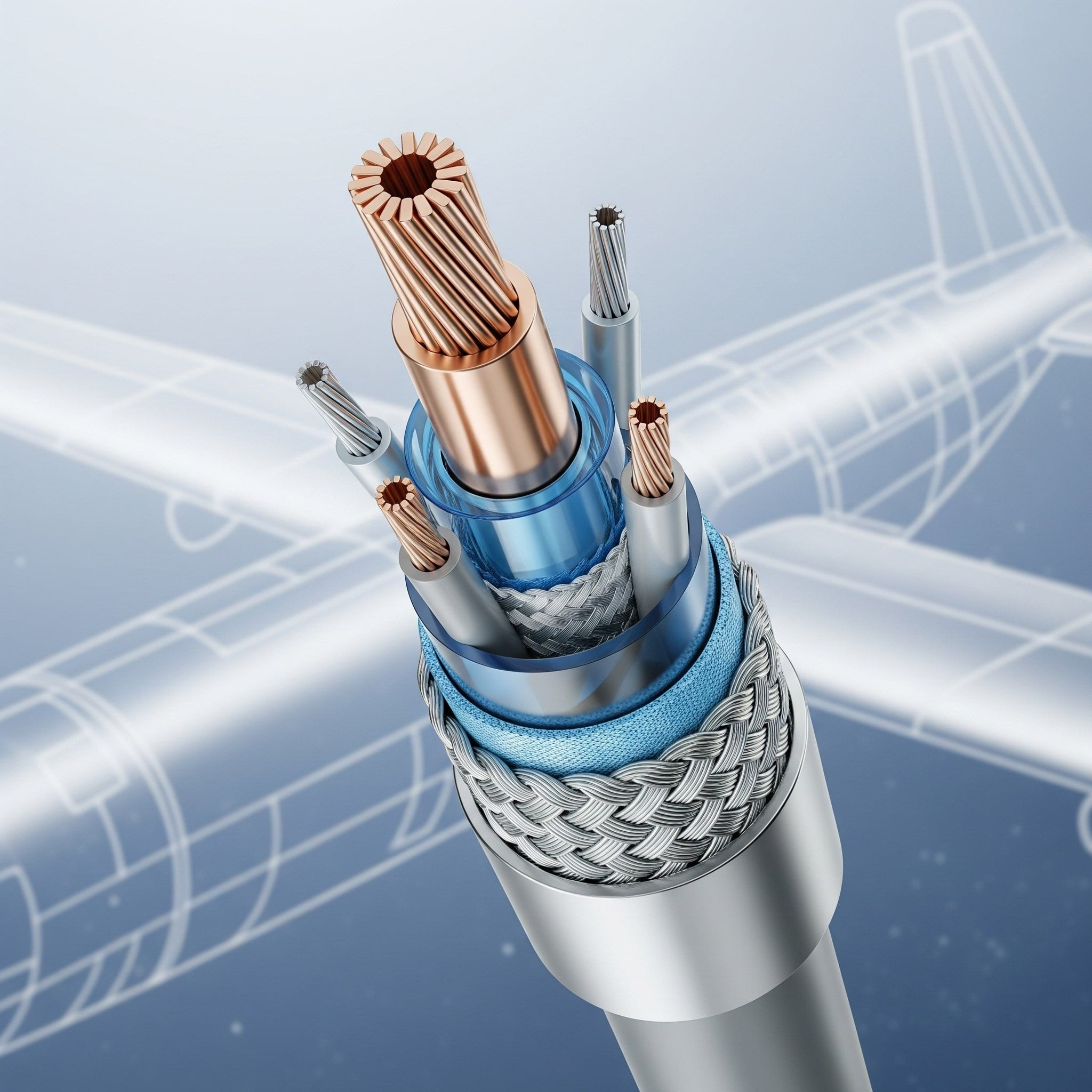
Designing Lightweight Cables for Aerospace and Aviation Applications
In the demanding worlds of aerospace and aviation, every single gram matters. Whether it's a commercial airliner carrying hundreds of passengers, a satellite orbiting Earth, or a high-performance fighter jet, reducing weight is a relentless pursuit. Why? Because less weight directly translates to improved fuel efficiency, increased payload capacity, extended range, and enhanced performance. While often unseen, the vast networks of electrical and data cables within these machines contribute significant weight. This drives a critical engineering challenge: the design and production of lightweight cables that can meet extreme performance requirements without compromising safety or reliability.
The Weight Equation: Why Every Gram Counts
For aircraft and spacecraft, weight reduction is paramount due to its direct impact on:
Fuel Efficiency: Lighter aircraft burn less fuel, leading to significant operational cost savings for airlines and reduced carbon emissions.
Payload Capacity: More payload (passengers, cargo, scientific instruments) can be carried, increasing revenue or mission capability.
Range & Endurance: Lighter vehicles can travel further or stay airborne/in orbit longer on the same amount of fuel.
Performance: Improved acceleration, climb rates, and maneuverability for high-performance aircraft.
Launch Costs (Space): Every kilogram launched into space costs thousands of dollars, making extreme weight savings critical for satellites and spacecraft.
Given that a modern commercial airliner can contain hundreds of kilometers of wiring, even small weight savings per meter add up to tons across the fleet.
The Lightweight Toolkit: Materials and Design Strategies
Achieving significant weight reduction while maintaining (or improving) performance requires innovation across materials, conductors, insulation, and overall cable construction:
1. Advanced Conductor Materials
Aluminum Alloys: While copper is the traditional choice for conductors due to its excellent conductivity, aluminum is significantly lighter. Aerospace-grade aluminum alloys (like aluminum-zirconium alloys) are increasingly used for power distribution cables where weight saving is paramount, despite their lower conductivity compared to copper (requiring larger diameters for the same current).
Copper Alloys: Even within copper, specialized high-strength copper alloys can allow for smaller conductor sizes while maintaining mechanical integrity.
Copper-Clad Aluminum (CCA): A composite conductor where a layer of copper is bonded to an aluminum core. This combines the lightweight properties of aluminum with the surface conductivity and ease of termination of copper, offering a balance.
2. High-Performance, Thin-Wall Insulation
Fluoropolymers: These are workhorses in aerospace due to their exceptional properties. Materials like ETFE (Ethylene Tetrafluoroethylene) and PTFE (Polytetrafluoroethylene) offer excellent electrical insulation, high-temperature resistance, and chemical inertness. Their high dielectric strength allows for very thin insulation walls, saving weight and space without compromising safety.
Polyimide (e.g., Kapton™): Used as extremely thin film insulation or tape wraps. It has outstanding thermal stability, mechanical strength, and radiation resistance, making it ideal for weight-critical applications.
Cross-Linked ETFE (XL-ETFE): Enhanced versions of ETFE offer even better mechanical toughness and abrasion resistance with thin walls.
3. Optimized Cable Construction
Miniaturization: Designing cables with the smallest possible overall diameter while meeting electrical and mechanical requirements. This involves tightly packed conductors and thin-wall insulation.
Composite Cables: Integrating multiple functions (power, data, fiber optics) into a single, optimized jacket reduces the total number of cables and thus overall weight and space.
Optimized Shielding: Using lightweight shielding materials (e.g., aluminized Mylar foils) and efficient braiding techniques (e.g., high-coverage, lightweight braids) to provide necessary EMI protection without adding excessive weight.
Laser Marking: Using laser etching for cable identification instead of traditional ink printing, which avoids the weight (however minimal) and potential outgassing of inks.
4. Connectors and Harness Design
Lightweight Connectors: Using connectors made from lightweight alloys or advanced composites.
Optimized Harness Routing: Designing the entire wiring harness for efficient routing, minimizing excess length and unnecessary bends.
Advanced Termination Techniques: Ensuring reliable, lightweight connections that don't add bulk.
The Design and Manufacturing Imperative
Designing lightweight cables for aerospace is a highly specialized process that demands:
Rigorous Material Selection: Choosing materials (often from specialized quality cable suppliers in uae) that meet extreme performance criteria (temperature, radiation, vibration, outgassing) while minimizing density.
Precision Engineering: Meticulous design to optimize every layer and component for weight, performance, and durability.
Advanced Manufacturing: Utilizing state-of-the-art extrusion, stranding, and cabling processes to achieve ultra-thin walls and tight tolerances. This is a hallmark of leading cable manufacturers in uae who serve the aerospace sector.
Extensive Testing: Subjecting cables to grueling tests that simulate launch vibrations, extreme temperature cycles, vacuum conditions, and radiation exposure to ensure long-term reliability.
Conclusion: Wiring the Skies and Beyond with Efficiency
The pursuit of lightweight cables for aerospace and aviation is a relentless drive for efficiency and performance. Every gram saved translates directly into tangible benefits, from reduced fuel consumption for airlines to increased payload for space missions. By continuously innovating in conductor materials, thin-wall insulation, and optimized cable constructions, engineers are creating the featherlight, yet incredibly robust, electrical arteries that enable the next generation of aircraft and spacecraft to fly further, faster, and more economically, pushing the boundaries of what's possible in the skies and beyond.
Your Lightweight Cable Questions Answered (FAQs)
Why is weight so critical for aircraft and spacecraft?
For aircraft, less weight means significantly better fuel efficiency, which reduces operating costs and carbon emissions. For spacecraft, every kilogram launched into orbit costs thousands of dollars, making weight reduction absolutely critical for mission viability and cost-effectiveness.What are the main materials used for lightweight aerospace cables?
Conductors often use aluminum alloys or copper alloys. Insulation and jacketing frequently rely on high-performance fluoropolymers (like ETFE, PTFE) or polyimide, chosen for their excellent electrical properties, high-temperature resistance, and ability to be extruded in very thin walls.Are aluminum conductors as good as copper for aerospace cables?
Aluminum is significantly lighter than copper for the same volume. However, copper has higher electrical conductivity. So, for the same current-carrying capacity, an aluminum conductor will need to be larger in diameter than a copper one, which can sometimes offset the weight saving in terms of space. The choice depends on the specific application's balance of weight, space, and current requirements.What is "outgassing" and why is it a concern for aerospace cables?
Outgassing is the release of trapped gases or volatile compounds from a material, especially when exposed to the vacuum of space or high temperatures. These released compounds can contaminate sensitive optical instruments (like camera lenses) or condense on surfaces, causing electrical shorts. Aerospace cables must use low-outgassing materials to prevent this.How is the reliability of lightweight aerospace cables ensured despite their thinness?
Reliability is ensured through:
High-Performance Materials: Using inherently strong and stable materials that maintain properties even when thin.
Precision Manufacturing: Achieving extremely tight tolerances during extrusion and cabling.
Rigorous Testing: Subjecting cables to extensive environmental tests (vacuum, extreme temperature cycles, radiation) and mechanical tests (vibration, flex cycles) that simulate real-world aerospace conditions far beyond typical commercial standards.
Appreciate the creator