Designing HIPAA-Ready Web Platforms for Healthcare Providers
Ever feel that building healthcare web platforms is like walking a tightrope over a pit of lawsuits? You are not the only one. Many custom software development companies feel the same. The need to comply with HIPAA, the US law that ensures patient information (PHI) privacy, makes healthcare software development challenging. With penalties including financial and reputational losses, adhering to HIPAA guidelines is no less than a statutory requirement. Also, with healthcare digital platforms powering everything from virtual check-ins to AI-driven diagnostics, getting this right isn't optional; it's your ticket to repeat business.
This blog article is your ready reckoner to crafting HIPAA-ready medical web applications and secure healthcare web platforms. It explores two critical aspects:
Nailing HIPAA-compliant web development
Locking down healthcare website security
So read on to ensure you ship compliant code that impresses providers and regulators alike from your next project onwards.
Mastering HIPAA Compliant Web Development Basics
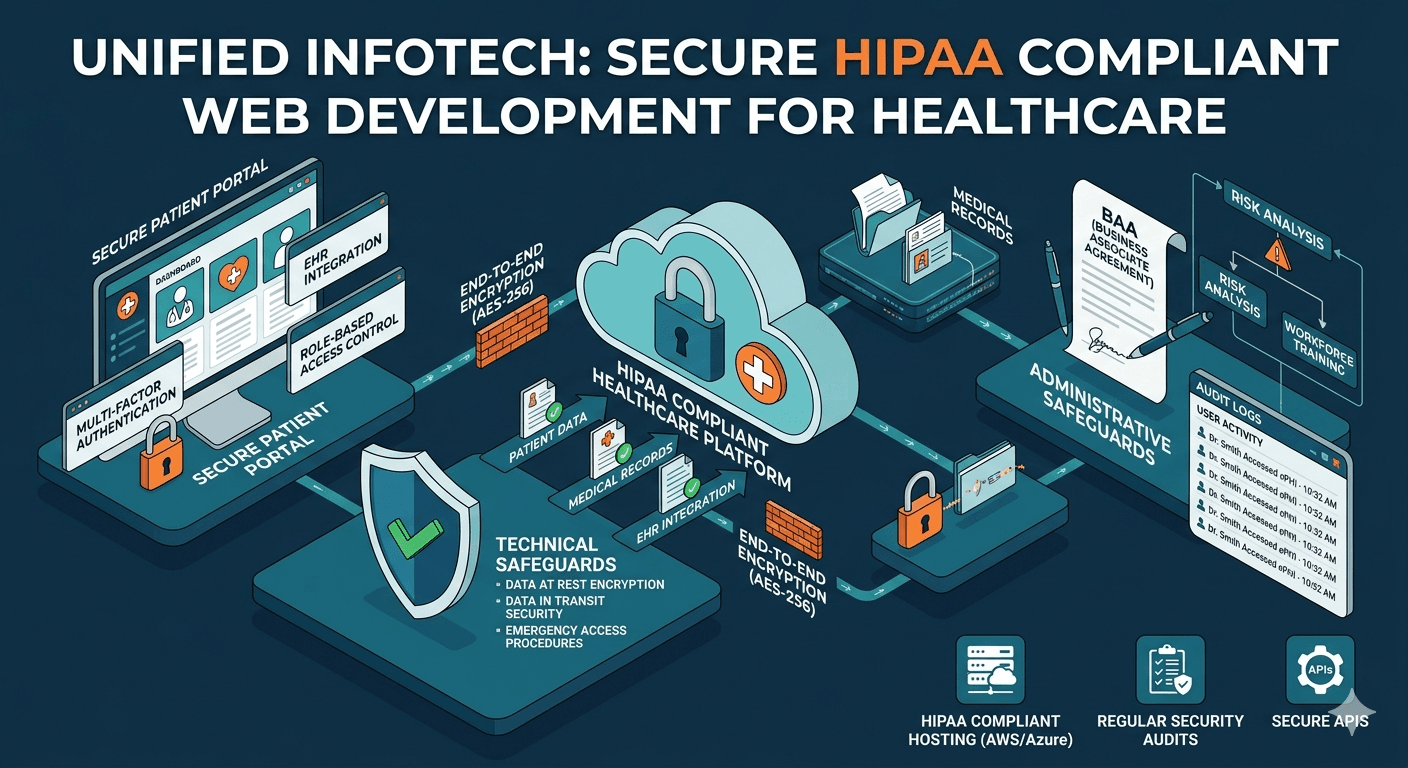
Let's kick things off with HIPAA-compliant web development, the foundation that stops your healthcare web platforms from becoming headline news for all the wrong reasons. HIPAA isn't just some dusty rulebook; it's a living framework with Privacy, Security, and Breach Notification Rules. And it is your job as a healthcare web development service provider to make ePHI (electronic PHI) untouchable.
Step one: Conduct a thorough risk analysis
Map data flows. Explore extensively where PHI enters via forms, APIs, or EHR integrations. Use tools like Microsoft's HIPAA risk assessment template or open-source ones from HITRUST to get you started. Identify threats like insider access or ransomware, then prioritize fixes.
Step two: Access controls are king
Ditch basic logins for zero-trust models using OAuth 2.0 with scopes. Libraries like Passport.js for Node or Spring Security for Java enforce RBAC, so docs get read/write on charts, billers see payments only. Add session timeouts (15 mins idle) and device trust scoring to flag sketchy logins from new IPs.
Step three: Encryption everywhere
TLS 1.3 for transit (Cloudflare or Let's Encrypt freebies), AES-256-GCM at rest. For medical web applications, use Web Crypto API on the client for ephemeral keys. Field-level encryption so even DB admins can't snoop PHI.
Step four: Logging and monitoring
This needs to be continuous and non-stop. Capture who did what when with structured logs in JSON, fed to Splunk or Grafana Loki. Set alerts for bulk downloads or failed MFA. This nails healthcare IT compliance audits because regulators love immutable trails.
Third parties can trip you up. Only use BAA-signed vendors like Twilio for HIPAA SMS, Stripe for billing (their connect works). Self-host if paranoid, but Kubernetes on EKS (AWS HIPAA-eligible) scales healthcare digital platforms beautifully with pod security policies.
Step five: Dev processes matter too
Embed compliance in Agile by ensuring sprints include security stories. Use SonarQube for static analysis to catch weak crypto early. Train devs with PhishingBox simulations; HIPAA requires ongoing education.
For modern twists, handle AI integrations carefully. De-identify data with tools like Presidio before feeding models. Mobile secure healthcare web platforms? SwiftUI or Jetpack Compose with biometric vaults.
Bottom line
HIPAA-compliant web development is an iterative defense. Build it in from day one, and your healthcare web platforms thrive.
Implementing Ironclad Healthcare Website Security
Now, it is time to fortify the healthcare website security. This is the tactical layer that makes secure healthcare web platforms hacker-proof. Use the folling strategies to enable this.
Architecture first: Use serverless or microservices via AWS Lambda/API Gateway to minimize attack surfaces. GraphQL over REST reduces over-fetching PHI; Apollo Server with schema directives enforces auth per query.
Threat modeling: Use STRIDE (Spoofing, Tampering, etc.) workshops. Block injections with query builders (Sequelize, Mongoose), XSS via helmet.js, and CSP headers. Rate-limit endpoints to thwart DDoS. leveraging NGINX or Express-rate-limit also does the trick.
Secrets and keys: Never commit them! Use GitGuardian to scan repos, and Doppler to deliver runtime. For medical web applications, secure client-side secrets via a backend proxy.
Advanced defenses: WAF-like ModSecurity rulesets are used for healthcare and block SQL keywords effectively. Runtime protection with Falco detects container escapes. Enable zero trust between services using mTLS via Linkerd.
Testing gauntlet: SAST/DAST with Veracode, IAST for real-time vulns. Pen tests quarterly, focusing on the supply chain. Chaos test with Litmus to ensure PHI stays safe under load.
Cloud specifics for healthcare digital platforms: Azure's HIPAA Blueprints automate compliant VPCs. Enable Microsoft Defender for Cloud, auto-remediate misconfigs. For multi-tenant use, use AWS Organizations with SCPs to restrict PHI buckets.
UX-security balance: Frictionless MFA with FIDO2 passkeys. Dark mode consent banners for tracking pixels, ensuring GDPR/HIPAA hybrid.
Incident preparation: Run IR drills. Tools like TheHive orchestrate responses and auto-notify via HIPAA timelines. Backup PHI to immutable S3 Glacier.
In 2026, quantum threats loom. So, prep with post-quantum crypto like Kyber in OpenSSL. Ensure IoT security using secure Zigbee gateways.
Implement the above to master healthcare website security, and your secure healthcare web platforms won’t just be compliant; they will transform into a resilient fortress.
Final Thoughts
Healthcare web development deals with everything from HIPAA-compliant web development to bulletproof healthcare website security. Healthcare web platforms demand this rigor and the payoff is substantial in the form of loyal providers, scalable healthcare digital platforms, and peace of mind.
So, start prototyping today. Pick a stack, run a risk assessment, and iterate. Stay sharp with HHS updates and communities like OWASP Healthcare. Remember, your medical web applications can change lives securely. So, do it!
Appreciate the creator