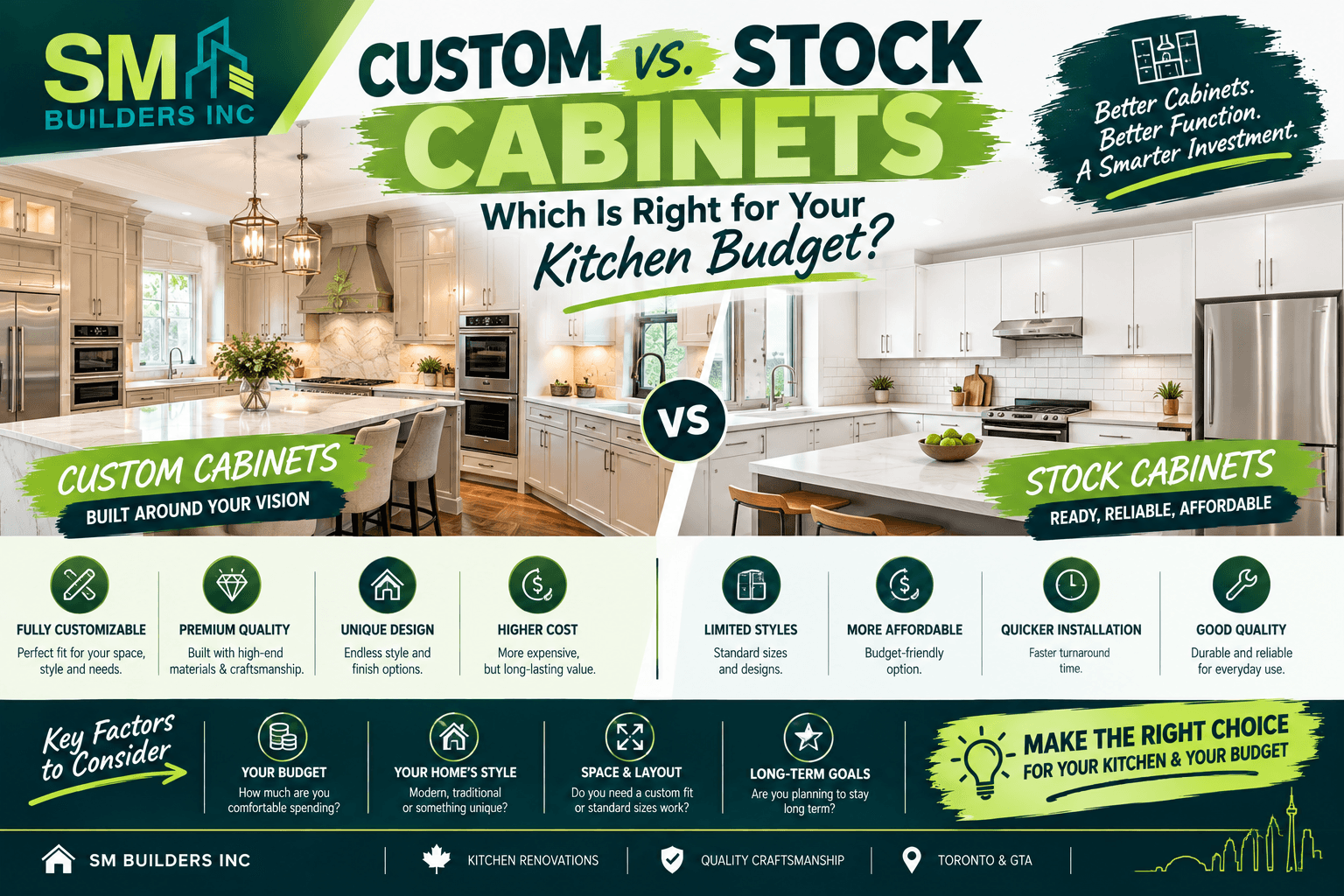
Custom vs. Stock Cabinets: Which Is Right for Your Kitchen Budget?
Cabinetry typically accounts for the largest single cost in a kitchen renovation, often consuming 30 to 40 percent of the total budget. Because of this, the decision between custom and stock cabinets has a bigger impact on both your final cost and your kitchen's finished look than almost any other choice you'll make during the project. This guide breaks down the real differences between the two options so you can decide which fits your budget and design goals.
What Sets Custom and Stock Cabinets Apart
Stock cabinets come pre-manufactured in standard sizes, typically in three-inch increments, and are usually available for quick delivery since they're mass-produced ahead of time. Home improvement stores and cabinet showrooms stock these in a range of common finishes and door styles, making them widely accessible and generally the most budget-friendly option.
Semi-custom cabinets sit in the middle ground, built from standard cabinet boxes but offering more flexibility in sizing, finish options, and interior features like pull-out shelving or specialty storage inserts. This category has grown significantly in popularity as it balances cost against personalization.
Custom cabinets are built entirely to order, matching your kitchen's exact dimensions, layout quirks, and design preferences. Every measurement, material choice, and interior configuration gets tailored specifically to your space, which is particularly valuable in kitchens with unusual layouts, angled walls, or specific storage needs that standard sizing can't accommodate well.
Comparing Cost
For most homeowners planning kitchen remodeling Toronto (https://smbuilders.ca/kitchen-remodeling/) projects, cabinet cost varies significantly based on which category you choose. Stock cabinets generally offer the lowest price point, since manufacturing efficiency and bulk production keep per-unit costs down. Semi-custom cabinets typically run moderately higher, reflecting the added flexibility in sizing and finishes. Custom cabinets command the highest price, often two to three times the cost of comparable stock options, due to the individualized design, materials, and skilled labour required to build each piece to order. Anyone comparing kitchen remodeling Toronto quotes should ask contractors to break out cabinetry pricing separately, since it's the single line item most likely to shift the total significantly.
When budgeting kitchen renovation cost Toronto (https://smbuilders.ca/kitchen-cabinet-renovation-toronto/) homeowners can expect, cabinetry choice alone can shift the total project cost by thousands of dollars. A kitchen using stock cabinets with a moderate countertop and standard fixtures might land toward the lower end of a typical renovation budget, while the same layout with fully custom cabinetry and premium finishes pushes well beyond it. Getting an itemized quote helps clarify exactly how much of your kitchen renovation cost Toronto contractors quote is tied to cabinetry versus other elements like countertops, flooring, and appliances.
Where Stock Cabinets Make Sense
Stock cabinets work well in a few specific situations:
Standard kitchen dimensions. If your kitchen layout aligns reasonably well with common cabinet sizing, stock options can fill the space efficiently without wasted material or awkward gaps.
Tight renovation timelines. Since stock cabinets are already manufactured, they're typically available for delivery in days or a couple of weeks, compared to the six to twelve week lead times common for custom orders.
Budget-conscious renovations. For homeowners prioritizing other elements of the kitchen, such as countertops or appliances, stock cabinets free up budget for those areas.
Rental properties or resale flips. Where maximizing return relative to investment matters more than long-term personalization, stock cabinets offer solid value.
Where Custom Cabinets Make Sense
Custom cabinetry becomes the stronger choice in situations where standard sizing genuinely falls short:
Unusual layouts. Angled walls, low ceilings, structural columns, or irregular room shapes often don't accommodate standard cabinet dimensions efficiently.
Specific storage needs. Households with particular organizational requirements, from a dedicated baking station to specialized appliance garages, benefit from cabinetry designed around those exact needs.
High-end finish expectations. Custom cabinetry offers access to premium wood species, intricate detailing, and finish combinations that stock lines simply don't offer.
Long-term homeownership. If you're planning to stay in the home for many years, the investment in a kitchen tailored precisely to your needs and preferences often feels more worthwhile than it would for a shorter-term owner.
The Semi-Custom Middle Ground
For many homeowners, semi-custom cabinets strike the most practical balance. They offer meaningfully more flexibility than stock options, including a wider range of finishes, door styles, and interior organizational features, while remaining considerably more affordable than fully custom work. Lead times also tend to fall between the two, typically three to six weeks, which allows for some planning flexibility without the extended wait custom cabinetry often requires.
This option works particularly well for kitchens with mostly standard dimensions but a few specific areas, like an island or a corner cabinet, that benefit from more tailored sizing or storage features.
Quality Considerations Beyond the Category
Regardless of which category you choose, cabinet construction quality varies significantly within each tier. A few details worth checking before committing:
Box construction. Plywood boxes generally outperform particleboard in durability and moisture resistance, particularly important in a kitchen environment.
Drawer construction. Dovetail joints and full-extension, soft-close slides indicate higher-quality construction compared to basic stapled boxes and standard slides.
Door and drawer front material. Solid wood offers durability and a premium feel, while MDF with a veneer or paint finish provides a similar look at a lower cost, with reasonable durability for many households.
Warranty coverage. Reputable cabinet manufacturers, whether stock or custom, typically offer warranties ranging from five years to a limited lifetime coverage on cabinet boxes.
A lower-quality custom cabinet isn't automatically better than a well-constructed stock option, so it's worth evaluating construction details directly rather than assuming the custom label guarantees superior quality.
Working With a Kitchen Contractor on This Decision
A knowledgeable kitchen contractor near me Ontario homeowners consult with can help evaluate whether your specific layout and goals justify the added cost of custom or semi-custom cabinetry, or whether stock options would serve the space just as well. This assessment typically considers your kitchen's exact dimensions, any structural quirks, your storage priorities, and how the cabinet decision fits within your overall renovation budget. Companies like SM Builders (https://smbuilders.ca/), which manage kitchen renovations across the GTA, often walk homeowners through this exact comparison during an initial consultation, since cabinet choice affects so much of the project's overall direction. It's worth asking any kitchen contractor near me Ontario you're considering to show side-by-side pricing for stock, semi-custom, and custom options for your specific layout before making a final decision.
For homeowners planning a kitchen renovation Scarborough project, local contractors often have established relationships with specific cabinet suppliers, which can affect both pricing and available lead times. Asking about these relationships during the quote process can reveal opportunities for better pricing or faster delivery than working with an unfamiliar supplier might offer. A kitchen renovation Scarborough homeowner weighing custom against stock cabinets should factor these local supplier relationships into the overall timeline, not just the price comparison.
Making the Right Choice for Your Kitchen
A few questions help clarify which direction makes sense for your specific renovation:
Does your kitchen have a standard, rectangular layout, or unusual angles and dimensions? Standard layouts favour stock or semi-custom; unusual layouts often justify custom.
How soon do you need the kitchen functional again? Tight timelines favour stock cabinets due to shorter lead times.
How long do you plan to stay in the home? Longer ownership horizons make the investment in custom cabinetry easier to justify.
What's your overall renovation budget, and where do you want to prioritize spending? If cabinetry isn't your top priority, stock or semi-custom frees up budget elsewhere.
Final Thoughts
Choosing between custom and stock cabinets ultimately comes down to balancing your kitchen's specific layout needs, your timeline, and how you want to allocate your overall renovation budget. Stock cabinets offer strong value and speed for standard layouts, semi-custom provides a practical middle ground for kitchens needing moderate personalization, and custom cabinetry delivers the best fit for unusual spaces or households with specific long-term design priorities. Evaluating construction quality within whichever category you choose matters just as much as the category itself, since a well-built stock cabinet can outperform a poorly constructed custom one in daily use.
Appreciate the creator