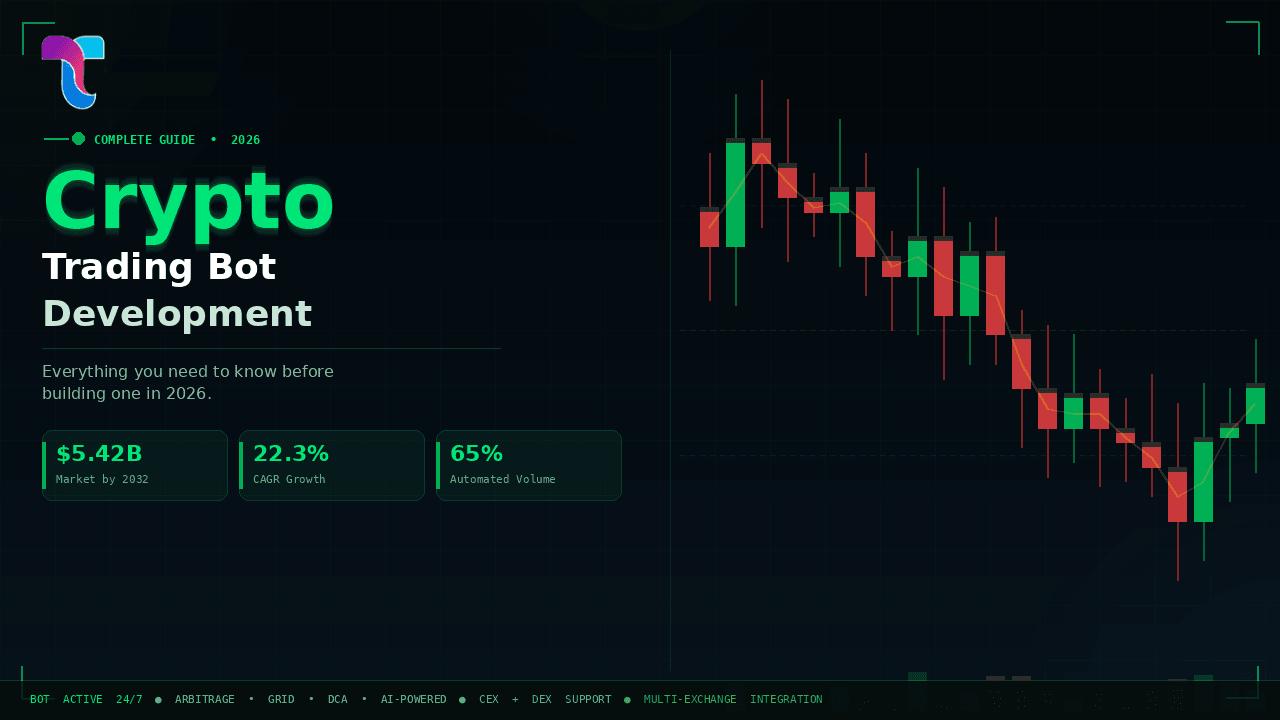
Crypto Trading Bot Development in 2026: Everything You Need to Know Before Building One
In 2026, an estimated 65% of all cryptocurrency trading volume involves some form of automation — from simple grid bots to sophisticated AI-powered systems analyzing on-chain data in real time.
If you are building a crypto business, a trading platform, or an investment product in 2026 and you are not thinking about trading bots — you are already behind.
This guide covers everything you need to know before building one.
What Is a Crypto Trading Bot — And Why Does It Matter?
A crypto trading bot is software that automatically executes buy and sell orders on cryptocurrency exchanges based on predefined rules, technical indicators, or AI-generated signals. Unlike human traders, bots operate continuously, without fatigue, emotion, or distraction.
The practical advantages are significant:
Speed: In volatile markets, milliseconds matter. Bots execute orders faster than any human can react, capturing opportunities before they disappear.
Consistency: Fear and greed drive irrational human decisions — panic selling at bottoms, FOMO buying at tops. Bots execute strategies mechanically, regardless of psychological pressure.
Scale: Manually managing positions across ten trading pairs, two exchanges, and three strategies simultaneously is exhausting. A well-built bot handles all of it without breaking a sweat.
Availability: Crypto markets operate 24 hours a day, 7 days a week, across every time zone. Bots participate continuously — no sleep required.
42% of traders now prefer bots specifically for speed, accuracy, and the elimination of emotional decision-making. That number is only going in one direction.
The Market Opportunity Is Real and Growing
The numbers behind crypto trading bot development are not speculative — they represent genuine, sustained market growth.
The crypto trading bot market was valued at $1.63 billion in 2024 and is projected to reach $5.42 billion by 2032, growing at a CAGR of 16.2%.
The AI crypto trading bot segment alone stood at $1.5 billion in 2024 and is anticipated to surge to $7.8 billion by 2033, at a CAGR of 22.3%.
What is driving this? Three structural forces:
The 24/7 market reality. Human traders cannot monitor markets continuously. Bots solve this problem permanently.
AI integration. AI-powered trading models now capture 38% market preference, while cloud-based bot deployments have seen 46% adoption growth. The technology has matured significantly.
Institutional participation. Financial institutions, hedge funds, and asset managers are deploying automated solutions to manage digital asset portfolios — normalizing bots as serious financial infrastructure, not just retail tools.
For businesses evaluating where to build in crypto, the trading bot development space offers a clear, growing market with genuine user demand.
The 7 Main Types of Crypto Trading Bots
Not all bots are built the same. Before building, you need to understand which type fits your use case.
1. Arbitrage Bots
These bots exploit price differences for the same asset across different exchanges. When Bitcoin trades at a slightly different price on Exchange A versus Exchange B, an arbitrage bot detects the gap and executes trades on both sides simultaneously to capture risk-free profit. Arbitrage bots dominate the segment with 44% market share — the most widely deployed bot type globally.
2. Grid Trading Bots
Grid bots place buy and sell orders at regular price intervals above and below a set price, creating a "grid" of orders. They profit from price oscillations within a range, making them highly effective in sideways or moderately volatile markets.
3. Market Making Bots
These bots simultaneously place buy and sell limit orders around the current market price to profit from the bid-ask spread. They also provide liquidity to exchanges — which is why exchange operators often incentivize market-making bots with reduced trading fees.
4. Trend Following Bots
These bots use technical indicators — moving averages, RSI, MACD — to identify price momentum and enter positions in the direction of the trend. They perform well in strong directional markets and require careful parameter calibration for different market regimes.
5. DCA (Dollar Cost Averaging) Bots
DCA bots automatically purchase fixed amounts of an asset at regular intervals, regardless of price. They remove timing risk from long-term accumulation strategies and are popular among investors who want systematic exposure without active management.
6. Rebalancing Bots
These bots automatically maintain a target portfolio allocation. If ETH grows to represent 60% of a portfolio instead of the intended 40%, the bot sells a portion and reallocates to bring weightings back into alignment.
7. AI-Powered Trading Bots
The most sophisticated category. These bots use machine learning models to analyze vast datasets — price history, on-chain data, social sentiment, macroeconomic signals — and generate trading decisions dynamically. Rather than following fixed rules, they adapt to changing market conditions in real time.
Key Features Every Production-Grade Trading Bot Needs
Whether you are building for retail users, institutional clients, or your own trading operation, certain features are non-negotiable in 2026.
Exchange API Integration: Your bot needs reliable, low-latency connections to major exchanges. Binance, Coinbase, Kraken, OKX, Bybit — each has its own API documentation, rate limits, and authentication protocols. Multi-exchange support is increasingly expected.
Backtesting Engine: Before deploying real capital, every strategy must be tested against historical data. A robust backtesting module allows users to validate performance under different market conditions — bull, bear, and sideways — before going live.
Real-Time Market Data Processing: Bots are only as good as their data feed. Real-time price data, order book depth, trade history, and sentiment signals all need to be processed with minimal latency. Outdated data produces outdated decisions.
Risk Management Controls: Stop-loss limits, maximum drawdown thresholds, position size limits, and daily loss caps are not optional — they are what separates a production-grade bot from a liability. A bot without risk controls can lose an entire portfolio in hours during an adverse market event.
Strategy Customization: Users need the ability to define their own parameters — trading pairs, position sizes, entry and exit conditions, indicator thresholds. Rigid, one-size-fits-all bots have limited commercial appeal in 2026.
Portfolio Monitoring Dashboard: A clean, real-time dashboard showing active positions, P&L, trade history, and performance metrics is essential for user trust and retention. Transparency builds confidence.
Security Architecture: API key management, two-factor authentication, encrypted data storage, and regular security audits are non-negotiable. A single security breach destroys user trust and platform reputation permanently.
The Technical Stack Behind a Modern Trading Bot
For development teams evaluating a build, understanding the typical technical architecture helps frame the scope.
Core execution layer: Python remains the dominant language for trading bot development due to its rich ecosystem of financial libraries — CCXT for exchange connectivity, Pandas and NumPy for data processing, and frameworks like Backtrader for strategy implementation.
Data infrastructure: Real-time market data is typically sourced through WebSocket connections to exchange APIs, supplemented by third-party data providers for on-chain signals and sentiment feeds.
AI/ML integration: Bots with machine learning capabilities typically use TensorFlow or PyTorch for model training, with trained models served through low-latency inference APIs that feed signals to the execution engine.
Cloud deployment: Cloud-based crypto trading bots have seen 46% adoption growth — AWS, GCP, and Azure all offer the infrastructure required for high-availability, low-latency bot deployment at scale.
Database layer: Time-series databases (InfluxDB, TimescaleDB) are commonly used to store tick data and trade history efficiently, with relational databases handling user accounts and configuration data.
Risks Every Builder and Investor Must Understand
A credible guide cannot ignore the genuine risks in this space.
Market Regime Changes: A bot optimized for a bull market may perform poorly or lose money in a bear market. Strategies need to be regime-aware, or they need human oversight to recognize when market conditions have fundamentally shifted.
Security Vulnerabilities: 28% of users report experiencing security vulnerabilities in trading bot deployments. API key exposure, insecure credential storage, and inadequate access controls are common failure points. Security must be a first-class concern from day one.
Over-Optimization (Curve Fitting): A bot that performs brilliantly in backtests but fails in live markets is a common outcome when strategies are over-optimized to historical data. Real-world market conditions always differ from historical patterns in ways that matter.
Regulatory Uncertainty: 31% of trading bot users cite regulatory uncertainty as a challenge affecting their usage. Different jurisdictions have different rules governing automated trading — some require registration, others restrict certain strategy types entirely. Legal frameworks need to be assessed before deployment.
Leverage Risk: Bots operating with leveraged positions can amplify losses just as effectively as profits. Without tight risk controls, a leveraged bot in an adverse market can cause significant financial damage in a very short time.
What the Development Process Looks Like
Building a production-grade crypto trading bot is a multi-phase engineering project, not a weekend side project.
Phase 1 — Strategy Definition: The trading strategy comes first. What is the bot trying to do? What market conditions does it perform in? What risk parameters apply? Strategy definition happens before a single line of code is written.
Phase 2 — Architecture Design: Exchange integrations, data infrastructure, execution engine, risk management layer, and user interface all need to be architected together. Decisions made here determine scalability, latency, and reliability for the bot's lifetime.
Phase 3 — Development and Backtesting: Core bot logic is built, connected to exchange APIs, and rigorously backtested against historical data across multiple market conditions. Performance is validated before any real capital is involved.
Phase 4 — Paper Trading (Simulated Live Testing): Before deployment with real funds, bots are run in paper trading mode — executing the strategy in real time but without real money. This validates live performance versus backtested results.
Phase 5 — Live Deployment with Controlled Capital: Initial live deployment with small, controlled capital allocation. Performance is monitored closely, parameters are adjusted, and the strategy is validated under real market conditions before scaling.
Phase 6 — Monitoring, Optimization, and Maintenance: A deployed bot is never "finished." Market conditions change, exchange APIs update, and strategies need continuous refinement. Ongoing monitoring and maintenance are permanent requirements of any live trading bot.
Building In-House vs. Working With a Development Partner
For businesses evaluating how to build, the choice between an in-house team and a specialist development partner comes down to a few practical factors.
Building in-house gives maximum control and internal knowledge accumulation — but requires hiring specialized engineers with expertise in both financial systems and blockchain infrastructure, and building out all the underlying architecture from scratch. In 2026, that expertise is in high demand and expensive.
Working with an experienced development partner like Technoloader accelerates time to market, reduces the risk of architecture mistakes, and brings proven patterns from previous successful builds. The trade-off is in long-term dependency and the need to choose the right partner carefully.
The right partner has live examples of production trading bots they have already built — not just whitepapers or wireframes. They understand exchange API nuances, latency optimization, risk management design, and the security requirements of handling financial automation.
Final Thoughts
Crypto trading bots have moved from niche tools used by quantitative hedge funds to mainstream infrastructure powering a majority of market activity. In 2026, the question is no longer whether bots matter — it is whether your business is positioned to build and leverage them effectively.
The market opportunity is substantial and still expanding. The technology has matured. The development patterns are well-established. What remains is choosing the right strategy, building the right architecture, and working with a development partner who has the depth to deliver it correctly.
The businesses that build reliable, secure, and well-designed trading bot infrastructure in 2026 are positioning themselves at the center of how crypto markets will operate for the next decade.
Quick Answers:
What is a crypto trading bot?
A crypto trading bot is software that automatically executes buy and sell orders on cryptocurrency exchanges based on predefined rules, technical indicators, or AI-generated signals — operating 24/7 without human intervention.
How much does it cost to develop a crypto trading bot?
Costs vary significantly by complexity. A basic rule-based bot with standard exchange integrations typically ranges from $10,000 to $30,000. A production-grade bot with AI/ML capabilities, multi-exchange support, backtesting infrastructure, and a user-facing dashboard typically ranges from $50,000 to $200,000+.
How long does it take to build a crypto trading bot?
A basic bot can be operational in 4–8 weeks. A full-featured, production-grade system with AI integration, custom dashboards, and thorough testing typically takes 3–6 months from architecture to live deployment.
Is crypto trading bot development legal?
In most jurisdictions, yes — automated trading is legal. However, specific regulations vary by country and exchange. Some jurisdictions have restrictions on high-frequency trading or require licensing for certain automated trading operations. Legal review before deployment is always recommended.
Which exchanges do crypto trading bots support?
Most production bots support major exchanges including Binance, Coinbase, Kraken, OKX, Bybit, and Bitget, through standard REST and WebSocket APIs. Multi-exchange support is increasingly standard in 2026 builds.
What is the difference between a trading bot and a DeFi trading bot?
A centralized trading bot operates through exchange APIs and interacts with order books on centralized platforms. A DeFi trading bot interacts directly with smart contracts on blockchain networks — executing swaps on DEXs, managing liquidity positions, or running yield optimization strategies fully on-chain.
Can a trading bot guarantee profits?
No. Trading bots execute strategies consistently and eliminate emotional decision-making, but they cannot guarantee profits. Performance depends entirely on strategy design, market conditions, risk management, and ongoing calibration. Any provider claiming guaranteed returns should be approached with significant scepticism.
Appreciate the creator