Could Your Difficulty Hearing Conversations Be a Warning Sign?
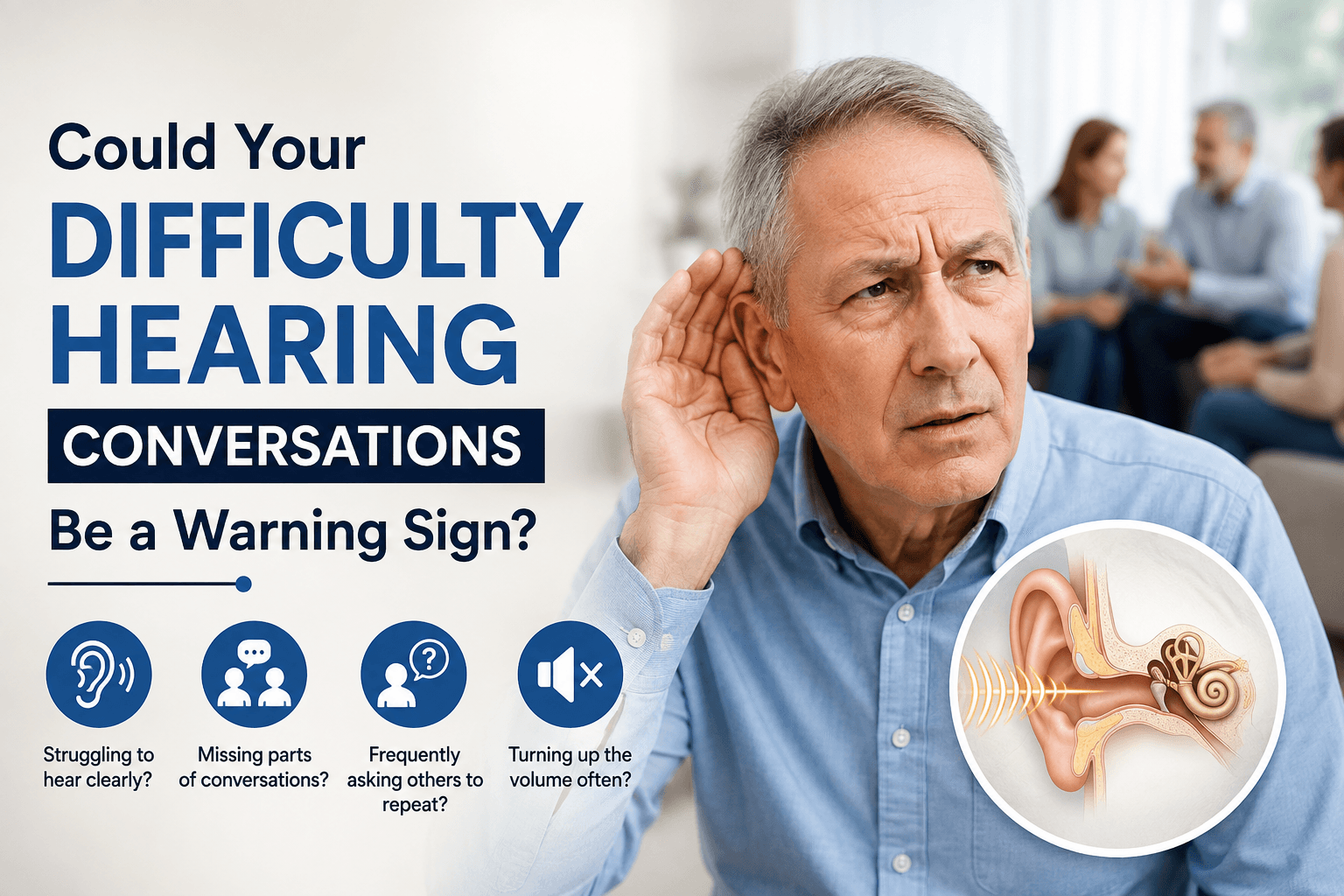
You've started nodding along in group conversations instead of following them. Someone tells a joke, the table laughs, and you laugh half a second late, having caught maybe half the sentence. At home, the television volume has crept up enough that your family keeps commenting on it. You've quietly decided everyone around you has started mumbling. That explanation is common — and it's usually wrong.
Is Struggling to Follow Conversations Actually a Warning Sign?
Often, yes. Difficulty following conversations, especially in groups, is frequently one of the earliest signs of hearing loss, well before someone would call themselves "hard of hearing." This happens because early hearing loss usually affects specific frequency ranges rather than all sound equally, so a person can still hear that someone is speaking while losing the clarity needed to distinguish similar words. It rarely shows up as things being too quiet — more often, it's things being unclear.
Why Noisy Rooms Expose What Quiet Rooms Hide
A one-on-one chat in a quiet room places minimal demand on the ear, so mild changes go unnoticed for years. A crowded restaurant or busy office removes that safety net. Background noise forces the brain to separate speech from clutter — exactly the task that becomes difficult first as hearing sensitivity declines. This is why people insist their hearing is "fine" at home, yet struggle at meetings — the environment, not the ears alone, reveals the gap.
Hearing Sound Is Not the Same as Understanding Speech
This distinction matters because it explains a common confusion. A person can hear that someone is talking without hearing enough detail to know what was said, particularly with consonants like "s," "f," and "th," which carry speech clarity but sit in a frequency range often affected first. Family members may notice this first — repeated requests to repeat sentences, a TV volume others find too loud, or answers to questions that weren't quite asked.
When It's Not Simply a Question of Age
Age-related hearing changes are common and often gradual, but assuming that's the only explanation can delay evaluation. Noise exposure, certain medications, ear infections, earwax buildup, or an underlying condition can all contribute, sometimes independently of age. Dr. Manish Prakash notes that identifying the actual cause matters, since some causes are reversible and some manageable — best determined through proper hearing loss treatment in Gurgaon (https://www.entgurgaon.com/hearing-aid.php) rather than assumption.
What This Can Look Like in Children
The same pattern shows up differently in children, often mistaken for inattention. A child who seems distracted in class, mishears instructions, or speaks unusually loudly may be compensating for a hearing difficulty rather than being careless. Because language development depends on hearing speech clearly early on, delayed identification can affect learning and confidence, not just communication. This is why pediatric hearing loss treatment in Gurgaon (https://www.entgurgaon.com/pediatric-hearing-screening.php) typically starts by ruling out a hearing-based cause first.
How an ENT Specialist Actually Investigates This
Evaluation usually starts with a hearing test, sometimes with an ear exam to rule out simpler causes like fluid or wax buildup. Based on which frequencies are affected, in which ear, and how severely, an ENT specialist can narrow down whether the cause lies in the outer, middle, or inner ear, or the hearing nerve. This matters because a middle-ear cause may respond to medical or surgical treatment, while inner-ear or nerve-related loss more often calls for hearing aids.
What Usually Comes Next
Not every case leads to the same recommendation. For some, treating an underlying cause resolves the issue. For others, a consultation with a hearing aid specialist in Gurgaon (https://www.entgurgaon.com/hearing-aid.php) becomes the practical next step, particularly when hearing loss is permanent but manageable with amplification. Modern hearing aids are far more discreet and adjustable than older versions, and a proper fitting is what actually determines whether someone benefits day to day.
If conversations feel like more effort than before, that's worth attention rather than working around. A hearing test is quick and non-invasive, and gives a clear answer either way. Dr. Manish Prakash and the team at ENT Gurgaon can help identify what's happening and whether treatment, support, or monitoring is right for you.
Frequently Asked Questions
How do I know if hearing loss is causing my struggles? A hearing test is the most reliable way to know. If you regularly miss words in conversation, especially in noisy settings, or turn up the TV louder than others prefer, get checked rather than assuming the cause.
Can hearing loss in children be reversed? It depends on the cause. Fluid buildup or infection are often treatable. Inner-ear or nerve issues are typically managed with hearing aids rather than reversed, which is why early evaluation matters.
Is hearing loss always age-related? No. While age-related changes are common, noise exposure, medications, infections, and other conditions can contribute, sometimes at a younger age. Evaluation identifies the actual cause rather than assuming age is responsible.
Do all types of hearing loss need hearing aids? No. Middle-ear causes may respond to medical or surgical treatment. Hearing aids are typically recommended when the loss involves the inner ear or nerve and isn't otherwise treatable.
When should a child be evaluated for possible hearing loss? If a child seems inattentive, mishears instructions, speaks unusually loudly, or shows delayed speech, rule out a hearing-related cause early, since prompt evaluation can prevent longer-term learning effects
Appreciate the creator