Could Advanced Navigation Surgery Make ENT Procedures Safer?
A patient sits across from her surgeon for the second time in three years, hearing the same recommendation for sinus surgery she heard before — except this time, the surgeon mentions something new. "We'll use image guidance for this one." She nods, says nothing, and googles it the moment she's back in the car. If you've ever had that exact moment — a term dropped into a consultation that sounds important but unexplained — this is for you.
What Navigation Surgery Actually Changes
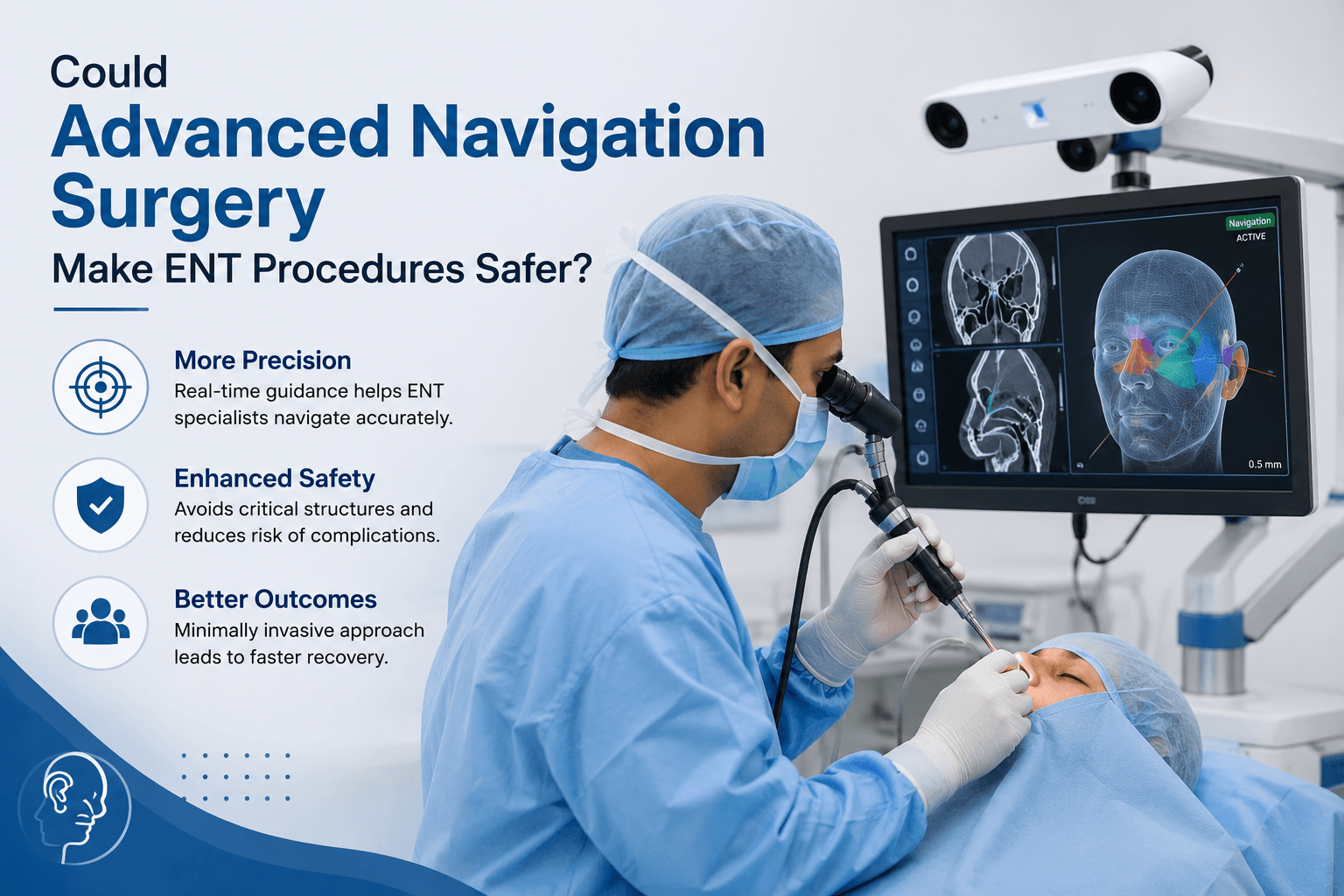
The direct answer is this: navigation surgery uses real-time imaging to show a surgeon exactly where their instruments are inside the nose and sinuses, mapped against the patient's own CT scan, as the procedure happens. It doesn't replace surgical skill, and it isn't a different type of surgery — it's a guidance layer added to procedures that are already being performed, most commonly sinus surgery. The reason it matters comes down to one fact most patients don't think about: the sinuses sit extremely close to the eyes, the base of the skull, and major blood vessels, with only millimetres separating healthy tissue from structures a surgeon absolutely cannot afford to injure.
Why This Particular Surgery Is Harder Than It Sounds
Sinus anatomy is not the same from person to person. Some patients have thin bone separating the sinus from the eye socket. Others have anatomical variations from birth, previous surgery, trauma, or long-term inflammation that has altered the normal landmarks a surgeon relies on. In a first-time, straightforward case, this rarely causes a problem. In revision surgery — operating on someone who has already had one or more procedures — scar tissue and distorted anatomy can make the usual visual cues unreliable. This is precisely the situation where the margin for error shrinks and where a small miscalculation carries a much bigger consequence.
Operating Mostly on Memory, Training, and a Two-Dimensional Scan
Traditional sinus surgery is performed using an endoscope, which gives the surgeon a close-up camera view, combined with a CT scan reviewed beforehand. This approach has worked for decades and remains entirely appropriate for the majority of cases. But it does require the surgeon to mentally translate a flat scan into a three-dimensional decision while working in real time, in a narrow space, often with only partial visibility. For routine cases this isn't a limitation. For complex or revision cases, it's the exact gap that navigation technology was developed to close.
How the System Works, Without the Jargon
Think of it less like advanced machinery and more like a GPS for the inside of the nose. Before surgery, the patient's CT scan is loaded into the system. During the procedure, sensors track the position of the surgical instruments and display their exact location on the scan, updated continuously. If an instrument is approaching the eye socket or skull base more closely than intended, the surgeon can see this on screen immediately rather than relying solely on tactile feel and visual judgment. It doesn't perform the surgery. It confirms, in real time, that the surgery is proceeding exactly where it's meant to.
Who Genuinely Benefits From This Approach
Not every sinus procedure requires this level of guidance, and it would be inaccurate to suggest otherwise. Patients most likely to be advised towardNavigation Surgery in Gurgaon (https://www.entgurgaon.com/navigation-surgery.php) typically fall into a few categories: those undergoing revision surgery after a previous procedure, patients with unusually complex sinus anatomy, cases involving polyps close to the eye or skull base, and situations where a tumour or growth needs to be removed near sensitive structures. Dr. Manish Prakash notes that the decision to use navigation is based on individual anatomy and surgical complexity, not on the general severity of a patient's symptoms — a straightforward case can be entirely appropriate for conventional surgery, while a milder-seeming case with unusual anatomy may still warrant the extra guidance.
Where This Technology Doesn't Change the Outcome
It's worth being honest about the limits here. Navigation surgery does not shorten recovery time on its own, does not eliminate the possibility of surgery being needed again in the future, and does not make an unsuitable case suitable. It is a safety and precision tool, not a shortcut. For a first-time, uncomplicated sinus surgery in a patient with typical anatomy, conventional endoscopic technique often achieves the same result without added equipment. The technology earns its place specifically where anatomical risk is elevated — not as a routine upgrade for every patient walking through the door.
What to Expect If This Is Recommended for You
If a surgeon suggests Navigation Surgery Treatment in Gurgaon (https://www.entgurgaon.com/navigation-surgery.php), the process leading up to it looks similar to standard sinus surgery, with one addition — a detailed CT scan taken specifically for the navigation system, usually shortly before the procedure. The surgery itself takes a similar amount of time, sometimes marginally longer due to the setup and calibration involved. Recovery expectations, including nasal congestion, mild discomfort, and follow-up visits, are generally comparable to conventional sinus surgery, since the technology changes how the surgery is guided, not what is physically done to the tissue.
If you're facing a second or third sinus surgery, or if your anatomy has been described as unusually complex, this is a reasonable question to raise directly with your surgeon rather than assume one approach fits every case. The right decision depends on your scan, your surgical history, and the specific anatomy involved, and that judgment is best made after a proper evaluation. Dr. Manish Prakash and the team at ENT Gurgaon assess this on a case-by-case basis, and for patients where anatomy or surgical history adds genuine risk, Navigation Sinus Surgery in Gurgaon (https://www.entgurgaon.com/endoscopic-sinus.php) is discussed as one part of a broader treatment plan, not offered as a blanket recommendation.
Frequently Asked Questions
Is navigation surgery only used for sinus problems? It is most commonly used in sinus surgery, but the same image-guided technology can assist certain other ENT procedures near the skull base or eye socket where precise anatomical mapping is valuable. Its use depends on the specific procedure and anatomical complexity involved.
Does navigation surgery make the procedure safer for everyone? It improves precision specifically in cases with complex or altered anatomy, such as revision surgeries. For straightforward, first-time cases with typical anatomy, conventional endoscopic surgery is often equally safe and commonly used.
Will I need a special scan before this type of surgery? Yes, a detailed CT scan is typically required shortly before surgery so it can be loaded into the navigation system. This is in addition to any earlier imaging used to diagnose or plan the treatment.
Does using navigation technology mean my surgery was more complicated? Not necessarily. It often means your surgeon identified anatomy or surgical history that benefits from extra precision, which is a proactive safety decision rather than an indication that something went wrong.
How do I know if I need this type of surgery instead of standard sinus surgery? This depends on factors like your surgical history, anatomical complexity on your scan, and how close the affected area lies to sensitive structures. Your ENT specialist can advise after reviewing your imaging and examination findings.
Appreciate the creator