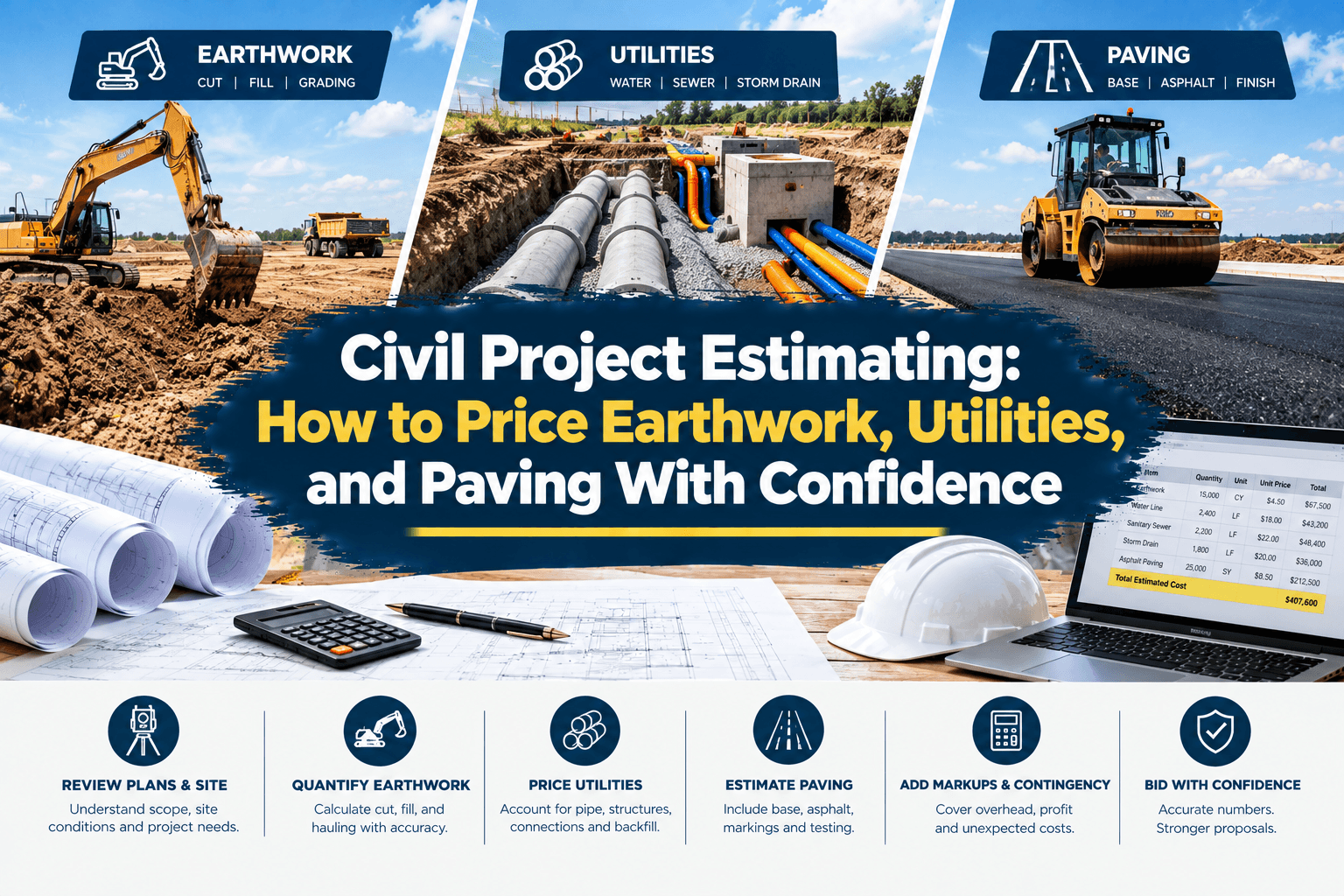
Civil Project Estimating: How to Price Earthwork, Utilities, and Paving With Confidence
Civil work is unforgiving. You are pricing dirt you have never seen, pipes buried where the drawings say they are (or should be), and pavement that has to meet strict standards. Rain can shut down a site for a week. One wrong assumption about soil can turn a tidy profit into a painful loss.
That is why careful estimating matters so much on infrastructure and site projects. This post breaks down how experienced estimators approach the major cost areas and where bids most often fall apart. If you want a broader overview of the fundamentals, this guide tocivil engineering estimating (https://www.smaestimating.com/the-complete-guide-to-civil-engineering-estimating/) is a helpful companion.
What Makes Civil Estimating Different
Building estimates deal with mostly controlled conditions. Civil estimates deal with the ground, the weather, and public infrastructure. That means more unknowns and a bigger need for judgment.
You Are Pricing Uncertainty
Soil conditions, groundwater, existing utilities, and access constraints can all shift once work begins. A strong estimate does not pretend these risks do not exist. It identifies them, prices what can be priced, and clearly states assumptions for the rest.
Quantities Are Measured, Not Counted
Instead of counting fixtures, you are calculating cubic yards of soil, linear feet of pipe, and square yards of pavement. Small measurement errors get multiplied across large quantities very quickly.
Earthwork: The Biggest Swing in the Budget
Earthwork often carries the largest share of cost and the largest share of risk. It deserves the most attention during the takeoff.
Cut and Fill Calculations
Compare existing grades to proposed grades to find how much material must be removed and how much must be brought in. Remember that soil changes volume when it is excavated and again when it is compacted, so the numbers on paper and the numbers on the truck are not the same.
Haul Distances and Disposal
Where the material goes matters as much as how much there is. Long hauls, dump fees, and import costs can change the price of a job dramatically. Confirm the source of fill material and the disposal location before you finalize the bid.
Weather and Site Conditions
Wet ground slows equipment and can require extra stabilization. Build reasonable weather allowances into your production rates rather than assuming ideal conditions all season.
Underground Utilities: Where Small Mistakes Get Expensive
Storm drains, sanitary sewers, and water lines look simple in a plan view. In practice, they involve trenching, bedding, backfill, structures, testing, and coordination with existing lines.
Measure by Run and by Depth
Deeper trenches cost more per foot because of shoring, wider excavation, and slower production. Break pipe into segments by depth range instead of using a single average.
Do Not Forget the Structures
Manholes, inlets, cleanouts, and valves are individually priced items with their own labor and materials. Count them from the profile sheets as well as the plan sheets.
Allow for Connections and Testing
Tie-ins to existing systems and required testing take time and coordination. These items are easy to overlook and hard to absorb later.
Paving and Surface Work
Asphalt and concrete paving are usually priced by area and thickness, but the details behind those numbers drive the cost.
Subgrade and Base Preparation
The quality of the base determines how the pavement performs. Include grading, compaction, and aggregate base in the estimate, and check the specification for required thicknesses.
Curbs, Gutters, and Striping
These finishing items are often priced separately and can be left out of a rushed takeoff. Go through the site plan and detail sheets to capture every one of them.
Common Mistakes in Civil Bids
Relying on averages. Blending different soil types, depths, or conditions into one number hides real differences in cost.
Overlooking mobilization and traffic control. Moving equipment, flagging, and temporary controls add real cost, especially on roadway work.
Ignoring erosion control and permits. Environmental requirements are mandatory and often expensive.
Using stale unit prices. Fuel, aggregate, and pipe prices move constantly, so refresh them for each bid.
Skipping a site visit. Photos and drawings cannot replace seeing access, existing conditions, and staging areas for yourself.
Building Risk Into the Bid
No estimate for ground-based work is perfect. What matters is how you deal with the gaps.
Use Contingency Deliberately
Set contingency based on the actual level of uncertainty in the project, not a flat percentage every time. A job with limited geotechnical information deserves more cushion than one with detailed soil reports.
State Your Assumptions and Exclusions
Write down what you assumed about soil, dewatering, rock, and utility conflicts. Clear exclusions protect you if conditions turn out differently.
When to Bring in Estimating Support
Civil takeoffs are time-consuming, especially on large site packages with dozens of sheets. If your team is stretched thin or you are bidding on an unfamiliar project type, experienced outside help can improve accuracy and free your staff to focus on winning work. To learn how the process works from start to finish, you can read more abouthttps://www.smaestimating.com/the-complete-guide-to-civil-engineering-estimating/estimating for civil engineering projects.
Questions Worth Asking Any Estimating Partner
Do they have real field or civil construction experience?
Will you receive editable takeoffs, not just a final number?
Are assumptions and exclusions clearly documented?
Is every estimate reviewed by a second person?
Final Thoughts
Winning civil work is about more than submitting the lowest number. It takes accurate quantities, realistic production rates, current pricing, and a clear plan for the risks hiding in the ground. Get those right, and your bids will hold up when the excavators start moving.
Appreciate the creator