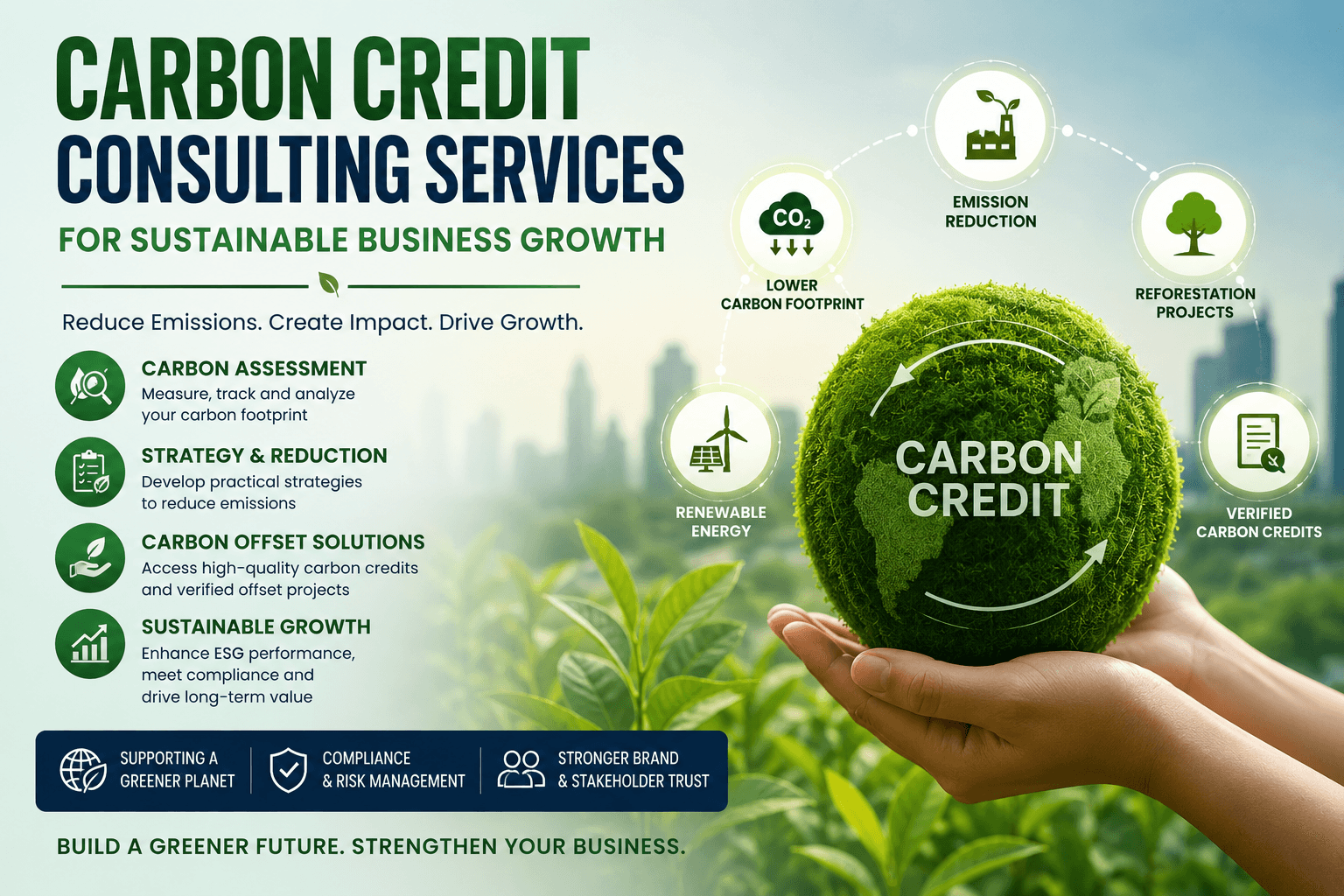
Carbon Credit Consulting Services: Why Sustainable Business Planning Is the Future
The business world is changing rapidly, and sustainability is becoming one of the most important factors influencing long-term success. Companies today are expected to do more than simply generate revenue. Governments, investors, and customers now expect organizations to reduce carbon emissions, improve environmental transparency, and actively support climate-focused initiatives. Because of these changing expectations, carbon credit consulting services are becoming increasingly important for businesses across industries.
Modern organizations face growing pressure to meet environmental regulations and improve ESG performance. However, many businesses still struggle to understand carbon accounting, carbon offsets, and carbon trading systems. Managing sustainability goals without professional expertise can become highly complex. This is why businesses are increasingly working with carbon consulting firms to create structured and practical sustainability strategies.
From carbon footprint assessments to net-zero planning, carbon consultants help organizations reduce environmental impact while improving operational efficiency and long-term business growth.
What Are Carbon Credit Consulting Services?
Carbon credit consulting services help businesses measure, manage, reduce, and offset greenhouse gas emissions. Consultants work with organizations to build sustainability strategies aligned with environmental regulations and future business objectives.
A carbon credit generally represents one metric ton of carbon dioxide removed from the atmosphere or prevented from being released. Businesses purchase carbon credits to compensate for emissions they cannot immediately eliminate through operational improvements.
Carbon consultants help organizations understand climate regulations, identify verified carbon offset projects, and improve environmental reporting systems.
These services commonly include:
Carbon footprint assessments
Carbon accounting
ESG reporting support
Carbon offset planning
Sustainability compliance
Renewable energy consulting
Carbon market advisory
Net-zero strategy development
As global sustainability standards continue evolving, these services are becoming essential for businesses of all sizes.
Why Sustainability Is Becoming Essential for Businesses
Environmental sustainability is no longer only about branding or public image. It is now directly connected to operational performance, investor confidence, and long-term profitability.
Governments around the world are introducing stricter environmental regulations that require businesses to monitor and reduce emissions more accurately. Some industries are already participating in carbon reduction systems and carbon trading programs.
Investors are another major reason businesses are focusing heavily on sustainability. ESG investing continues growing rapidly, and many investment firms now evaluate environmental performance before funding organizations.
Customers are also influencing market trends. Modern consumers increasingly support companies that actively reduce environmental impact and invest in climate-friendly initiatives.
Because of these changes, organizations are increasingly relying on carbon management consulting services to strengthen sustainability performance and future readiness.
Carbon Footprint Assessments and Emissions Tracking
One of the first steps in sustainability planning is understanding where emissions are generated. Carbon consultants perform detailed carbon footprint assessments to analyze environmental impact across business operations.
This process generally includes reviewing:
Energy consumption
Transportation systems
Manufacturing operations
Supply chain activities
Waste management systems
Infrastructure and facilities
Many businesses discover that indirect emissions from suppliers and logistics operations contribute significantly to their total carbon footprint.
Accurate carbon accounting helps organizations identify operational inefficiencies and prioritize sustainability improvements more effectively. It also improves ESG reporting accuracy and supports environmental compliance requirements.
Without proper emission tracking, businesses may struggle to create effective carbon reduction strategies or meet future environmental standards.
Carbon Offsets and Carbon Markets
Some businesses cannot completely eliminate emissions immediately because of operational limitations. Carbon offsets help organizations compensate for unavoidable emissions by supporting projects that reduce greenhouse gases elsewhere.
Examples of carbon offset projects include:
Renewable energy installations
Reforestation initiatives
Methane capture systems
Forest conservation programs
Sustainable agriculture projects
Carbon markets allow businesses to purchase verified carbon credits from these environmental projects. However, not all carbon credits provide the same environmental value or reliability.
Professional carbon credit consulting companies help businesses identify trusted carbon offset providers and avoid low-quality projects that may not provide genuine environmental benefits.
Consultants also help organizations understand the differences between voluntary carbon markets and compliance carbon trading systems.
ESG Reporting and Corporate Transparency
ESG reporting has become one of the most important areas of corporate sustainability management. Investors, regulators, and customers increasingly expect businesses to provide transparent environmental and sustainability information.
Carbon consultants help organizations prepare ESG reports aligned with major international frameworks such as:
GRI
CDP
SASB
TCFD
ISSB
These reports generally include:
Carbon emissions data
Sustainability goals
Renewable energy usage
Climate-related risks
Environmental initiatives
Carbon reduction strategies
Strong ESG reporting improves transparency and strengthens investor confidence. Businesses with reliable sustainability reporting often gain stronger partnerships and improved access to financing opportunities.
Organizations that fail to provide accurate sustainability reporting may struggle to maintain long-term investor trust.
Net-Zero Strategies and Long-Term Sustainability
Many global businesses are now setting net-zero emissions targets as part of long-term sustainability planning. Net-zero means balancing greenhouse gas emissions with equivalent reductions or removals.
Achieving net-zero requires more than simply purchasing carbon credits. Businesses must also reduce emissions directly through operational improvements and energy efficiency initiatives.
Carbon consulting firms help organizations create practical net-zero roadmaps that may include:
Renewable energy adoption
Sustainable transportation systems
Energy-efficient infrastructure upgrades
Waste reduction programs
Sustainable supply chain improvements
Although achieving net-zero may take several years depending on company size and industry type, businesses that begin sustainability planning early often gain stronger competitive advantages.
Companies with clear sustainability goals are also more attractive to investors, customers, and business partners.
Industries Using Carbon Credit Consulting Services
Carbon consulting services are now widely used across many industries because sustainability expectations are increasing everywhere.
Manufacturing companies use sustainability consulting to improve energy efficiency and reduce industrial emissions. Transportation and logistics businesses rely on carbon offset programs to manage fuel-related emissions.
Technology companies are investing heavily in sustainability because large data centers consume significant amounts of electricity. Construction firms are integrating green building practices and sustainable infrastructure planning into projects.
Agricultural businesses are also becoming important participants in carbon markets as sustainable farming practices can generate carbon credits while improving environmental performance.
Retail companies, hospitality businesses, and healthcare organizations are also increasing investments in sustainability reporting and carbon reduction strategies.
As climate regulations continue evolving globally, more industries are expected to adopt carbon management solutions.
Financial Benefits of Sustainability Investments
Many businesses initially believe sustainability initiatives are expensive. However, environmental improvements often create long-term financial advantages.
Energy-efficient systems can significantly lower electricity and fuel costs. Waste reduction programs improve operational efficiency and reduce unnecessary expenses. Sustainable supply chain management can lower future business risks.
Strong ESG performance may also attract environmentally focused investors and improve access to financing opportunities.
In some cases, organizations can generate additional revenue through carbon credit generation projects. Renewable energy systems, forestry initiatives, and methane reduction programs can create tradable carbon credits within global carbon markets.
Because of these opportunities, sustainability is increasingly becoming both an environmental strategy and a business growth opportunity.
Businesses that invest early in sustainability often position themselves more effectively for future market changes.
Common Challenges Businesses Face
Despite increasing interest in environmental responsibility, many organizations face implementation challenges.
One major challenge is understanding changing environmental regulations. Carbon compliance requirements continue evolving across industries and countries.
Another challenge is accurate carbon accounting. Tracking emissions effectively requires technical expertise and reliable reporting systems.
Businesses also struggle to identify trustworthy carbon offset providers and realistic sustainability goals.
Small and medium-sized businesses may face resource limitations when implementing sustainability programs.
Professional carbon consultants help organizations overcome these challenges through structured sustainability planning and technical guidance.
Technology and the Future of Carbon Consulting
Technology is rapidly transforming the sustainability industry. Modern carbon accounting software allows businesses to monitor emissions more accurately and automate ESG reporting processes.
AI-powered sustainability platforms can identify operational inefficiencies and recommend emission reduction opportunities in real time. Data analytics systems help organizations evaluate sustainability investments more effectively.
Blockchain technology is improving transparency within carbon trading systems by helping verify carbon credit authenticity and prevent fraud.
Cloud-based sustainability platforms are also simplifying environmental reporting and compliance management for businesses across industries.
As environmental regulations become stricter globally, digital carbon management tools are expected to become standard business solutions.
Choosing the Right Carbon Consulting Firm
Selecting the right sustainability partner is important because environmental strategies directly affect operational performance and corporate reputation.
Businesses should evaluate consulting firms based on:
Industry expertise
ESG reporting capabilities
Carbon market experience
Technology integration
Verification standards
Sustainability planning knowledge
Reporting transparency
Reliable consultants focus on long-term sustainability improvements instead of simply selling carbon credits.
A strong consulting partner helps businesses create sustainability strategies aligned with operational goals, compliance requirements, and future growth plans.
The Future of Carbon Credit Consulting Services
The global carbon economy is expected to grow significantly during the next decade. Governments continue introducing stricter environmental regulations, while investors increasingly prioritize ESG-focused organizations.
Renewable energy investments, carbon trading systems, green finance, and sustainability technologies are all contributing to market expansion.
Businesses that invest early in sustainability planning may gain stronger market positioning and operational resilience in the future. Companies that delay environmental improvements could face rising compliance costs, operational risks, and reputational challenges.
Carbon consulting is expected to become even more important as organizations continue transitioning toward environmentally responsible operations.
Conclusion
Carbon credit consulting services help businesses reduce environmental impact while improving sustainability performance and operational efficiency. From carbon accounting and ESG reporting to carbon offsets and net-zero planning, consultants provide the expertise organizations need to navigate modern carbon markets successfully.
As sustainability expectations continue increasing globally, businesses must build stronger environmental strategies to remain competitive. Professional carbon consultants simplify this process while helping organizations create future-ready and environmentally responsible business models.
Companies that invest in sustainability today are more likely to strengthen investor confidence, improve customer trust, reduce operational risks, and create long-term business value in an increasingly climate-focused global economy.
Appreciate the creator