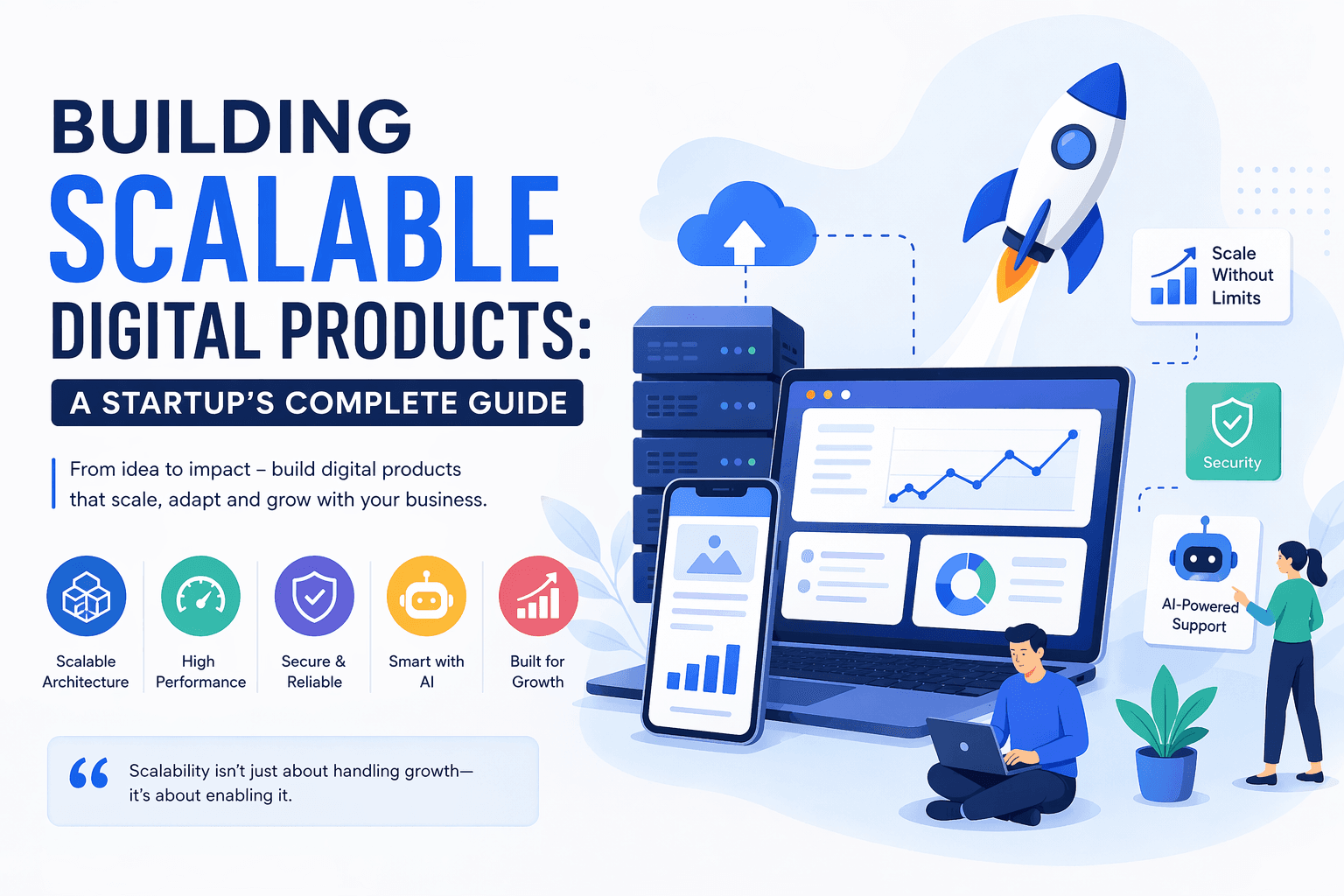
Building Scalable Digital Products: A Startup’s Complete Guide
Building scalable digital products is no longer optional for startups—it’s a necessity. In an increasingly competitive landscape, the difference between rapid growth and early failure often comes down to how well your product can scale with user demand, evolving technology, and shifting market expectations. This guide explores the strategies, technologies, and best practices startups need to build digital products that not only work today but thrive tomorrow.
Introduction: Why Scalability Matters
Startups often begin with a Minimum Viable Product (MVP), designed to validate an idea quickly. But what happens when that idea succeeds? A sudden influx of users can overwhelm systems that weren’t designed to scale. Performance drops, user experience suffers, and growth stalls.
Scalability ensures your product can handle increased load without compromising performance. It’s about designing systems that grow seamlessly—whether you’re onboarding 100 users or 10 million.
Understanding Scalability in Digital Products
Scalability isn’t just about handling more users. It involves multiple dimensions:
Technical scalability: Infrastructure that supports growth.
Operational scalability: Processes that adapt as teams expand.
Business scalability: Models that sustain profitability at scale.
A scalable product is built with flexibility, resilience, and efficiency in mind.
Step 1: Start with a Strong Architecture
Your product architecture is the foundation of scalability. Choosing the right approach early can save you from costly rewrites later.
Monolithic vs. Microservices
Monolithic architecture: Easier to build initially but harder to scale.
Microservices architecture: Modular, flexible, and scalable, but more complex to manage.
Startups often begin with a monolith and gradually transition to microservices as complexity grows.
Cloud-Native Development
Cloud platforms like AWS, Azure, and Google Cloud offer scalable infrastructure out of the box. Features like auto-scaling, load balancing, and distributed storage make it easier to handle growth.
Step 2: Design for Performance and Reliability
Performance is critical to user retention. Even a one-second delay can significantly impact conversions.
Key Practices
Caching: Reduce server load by storing frequently accessed data.
CDNs (Content Delivery Networks): Deliver content faster by using geographically distributed servers.
Load balancing: Distribute traffic across multiple servers.
Reliability also means planning for failure. Use redundancy, backups, and failover mechanisms to ensure uptime.
Step 3: Prioritize User Experience (UX)
Scalability isn’t just technical—it’s experiential. As your user base grows, maintaining a consistent and intuitive experience becomes more challenging.
UX Considerations
Responsive design for multiple devices
Fast load times
Simple navigation
Personalization at scale
User expectations rise as your product grows. Meeting those expectations is key to long-term success.
Step 4: Data Management and Scalability
Data is at the core of every digital product. As your product scales, so does your data.
Strategies for Scalable Data Handling
Database sharding: Splitting data across multiple databases
NoSQL databases: Flexible schemas for large-scale applications
Data lakes and warehouses: For analytics and reporting
Efficient data management ensures faster queries, better insights, and improved performance.
Step 5: DevOps and Continuous Delivery
Modern startups rely on DevOps practices to scale efficiently.
Key Components
CI/CD pipelines: Automate testing and deployment
Infrastructure as Code (IaC): Manage infrastructure programmatically
Monitoring and logging: Track performance and detect issues early
Continuous delivery allows startups to release updates frequently without disrupting users.
Step 6: Security at Scale
As your product grows, it becomes a bigger target for cyber threats. Security must be built into every layer of your system.
Best Practices
End-to-end encryption
Secure authentication (OAuth, MFA)
Regular security audits
Compliance with regulations (GDPR, HIPAA, etc.)
Ignoring security can lead to data breaches, legal issues, and loss of user trust.
Step 7: Leveraging Enterprise Mobile Application Development Services
Mobile usage continues to dominate digital interactions. Startups aiming for scalability must invest in robust mobile solutions. This is where Enterprise Mobile Application development services play a crucial role.
These services help startups build high-performance, secure, and scalable mobile apps tailored to enterprise-grade requirements. They ensure seamless integration with backend systems, support for large user bases, and consistent performance across devices.
By leveraging such services, startups can accelerate development while maintaining quality and scalability.
Step 8: Integrating AI for Smarter Scalability
Artificial Intelligence is transforming how digital products scale. From automation to personalization, AI enables smarter and more efficient systems.
Key Applications
Predictive analytics for user behavior
Automated customer support
Intelligent recommendations
Fraud detection
Partnering with an enterprise ai chatbot development company can significantly enhance customer engagement. AI chatbots handle thousands of queries simultaneously, reducing operational costs while improving response times.
Step 9: Building a Scalable Team
Technology alone doesn’t scale a product—people do.
Team Scaling Strategies
Hire generalists early, specialists later
Build cross-functional teams
Invest in training and development
Foster a culture of collaboration
As your startup grows, your team structure should evolve to support increased complexity.
Step 10: Monitoring and Optimization
Scalability is an ongoing process. Continuous monitoring helps identify bottlenecks and areas for improvement.
Tools and Metrics
Application performance monitoring (APM)
Server health metrics
User engagement analytics
Error tracking systems
Regular optimization ensures your product remains efficient as it scales.
Common Challenges in Scaling Digital Products
Even with the right strategies, startups face challenges:
Technical debt: Quick fixes that become long-term problems
Over-engineering: Building for scale too early
Resource constraints: Limited budget and manpower
Market uncertainty: Scaling before achieving product-market fit
Understanding these challenges helps startups navigate growth more effectively.
Best Practices for Long-Term Scalability
To build a truly scalable digital product, keep these principles in mind:
Start simple, scale smart
Automate wherever possible
Design for failure
Focus on user needs
Continuously iterate and improve
Scalability is not a one-time effort—it’s a mindset.
Case Study Example (Hypothetical)
Imagine a startup launching a fitness app. Initially, it serves 1,000 users with basic features. As popularity grows, the app expands to millions of users worldwide.
By adopting cloud infrastructure, microservices architecture, and AI-driven personalization, the startup successfully scales without performance issues. Mobile optimization ensures seamless access, while AI chatbots handle customer queries efficiently.
This transformation highlights the importance of planning for scalability from the beginning.
Future Trends in Scalable Digital Products
The future of scalability is shaped by emerging technologies:
Serverless computing: Reduces infrastructure management
Edge computing: Brings processing closer to users
5G technology: Enables faster and more reliable connections
AI and machine learning: Automates scaling decisions
Startups that embrace these trends will be better positioned for growth.
Conclusion
Building scalable digital products is both an art and a science. It requires a combination of the right technology, strategic planning, and continuous adaptation. From choosing the right architecture to leveraging AI and mobile solutions, every decision impacts your product’s ability to grow.
Startups that prioritize scalability early can avoid costly setbacks and position themselves for long-term success. Whether you’re developing your first MVP or preparing for rapid expansion, the principles outlined in this guide will help you build digital products that stand the test of time.
Appreciate the creator