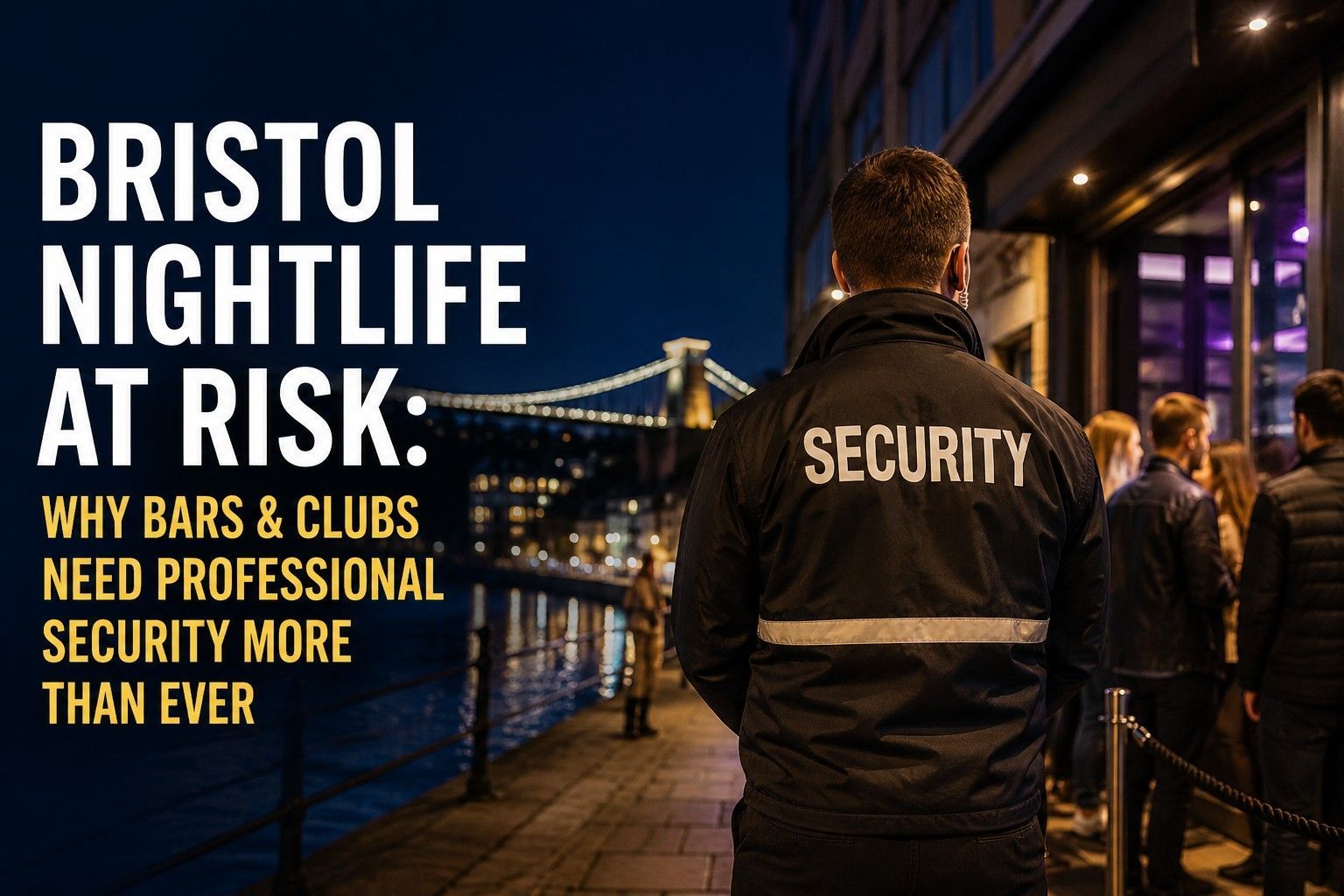
Bristol Nightlife at Risk: Why Bars & Clubs Need Professional Security More Than Ever
In March 2026, the BBC reported that Bristol City Council had ended funding for the Bristol Nights partnership. That scheme had trained over 700 night‑time economy workers in safeguarding, identifying vulnerability, and intervening against harassment.
The future of the wider Bristol Nights campaign, which helped the city hold a Purple Flag for safe nightlife for 16 consecutive years became uncertain.
At the same time, police response times in busy areas like the Harbourside and King Street have lengthened due to wider resourcing pressures. For bar and club owners, this creates a clear gap in public safety provision.
One solution sits outside the public sector: private manned guarding services deployed specifically for licensed venues.
What the Loss of Bristol Nights Means for Venue Safety
The Bristol Nights scheme operated as a coordination hub. It connected door staff, bar managers, taxi drivers, and local police. It ran zero‑tolerance campaigns against harassment of women. It provided free training on de‑escalation and spotting signs of vulnerability.
Without that central support, each venue now shoulders full responsibility for its own safety protocols. Shared intelligence about troublemakers – previously circulated through the scheme – no longer flows automatically. Venues that once relied on a city‑wide safety net must build individual security systems from scratch.
For a small bar on Gloucester Road or a club near the O2 Academy, the most direct replacement is a trained on‑site presence. Manned guarding services provide exactly that: a visible, immediate responder who does not depend on remote call centres or delayed police attendance.
Why CCTV and Alarms Are Not Substitutes for Human Presence
CCTV records events after they occur. Alarms notify someone that a breach has happened. Neither prevents a fight, a crowd crush, or an attempted assault. Neither reads body language nor hears a raised voice.
A guard on the door or inside the floor performs four functions that technology cannot replicate:
Real‑time threat assessment – spotting the early signs of aggression before any physical action.
Crowd flow management – preventing bottlenecks that lead to crushing, as seen in the February 2026 Fishies queue incident reported by Epigram, where one person was hospitalised and several injured.
De‑escalation through communication – using trained verbal techniques to defuse arguments without force.
Immediate liaison – calling police only when necessary, and providing accurate incident logs when they arrive.
These are not generic duties. They are the specific, measurable outcomes of professional security deployment.
Recent Bristol Incidents That Illustrate the Need
Several news reports from the first half of 2026 demonstrate the range of risks facing Bristol’s nightlife venues.
The Fishies crowd crush (Epigram, February 2026) – An electric “crowd crush” outside a venue left one attendee hospitalised with multiple injuries. Witnesses described poor queue control and no visible security directing footfall. A properly staffed door team could have phased entry, managed density, and prevented the surge.
Harbourside safety calls (Bristol Post, May 2026) – After a police officer drowned in the harbour, local voices called for better safety measures. While most discussion focused on lighting and barriers, licensed security personnel on patrol along the water can intervene with intoxicated individuals who climb railings or walk too close to the edge.
Repeat commercial burglaries (Bristol247, May 2026) – A spate of break‑ins affected newly opened businesses. For nightlife venues, a break‑in not only means stolen stock but also damaged premises that cannot open the next evening. A guard on site during closed hours eliminates that window of opportunity.
Each of these cases shares a common thread: a human presence could have changed the outcome. Manned guarding services are that presence.
Core Functions of Professional Security in a Nightlife Setting
A professional security team does far more than check identification at the entrance. For a Bristol venue, the following functions are standard for any reputable provider:
Queue management – maintaining order outside, preventing blocking of pavements, and stopping queue‑jumping arguments.
Entry filtering – refusing entry to anyone already showing signs of intoxication or aggression.
Internal patrols – moving through the venue to monitor dancefloors, corridors, and toilet areas.
Drug detection – using passive techniques (observation, smell, behaviour) to identify use or dealing.
Incident documentation – writing timed, factual reports for police, council licensing teams, and insurance claims.
Coordination with neighbouring venues – sharing descriptions of ejected individuals via radio or messaging apps.
This final point is especially valuable in Bristol’s clustered nightlife districts. On King Street, Baldwin Street, or Park Row, a group ejected from one venue will often try another door within 50 metres. When multiple venues use the same security firm – or firms that communicate – the entire district becomes safer.
How to Select a Professional Security Provider
Not all security suppliers operate to the same standard. Venue owners should look for the following criteria when hiring a security company in Bristol:
Full SIA licensing for every officer – this is a legal minimum, not a differentiator.
Nightlife specialisation – experience in pubs, clubs, and event spaces rather than retail or industrial sites.
Verifiable training records – beyond the basic SIA course, look for additional modules in conflict management, first aid, and physical intervention.
Local knowledge – guards who know Bristol’s geography, transport routes, and trouble spots respond faster and more effectively.
Insurance cover – public liability and professional indemnity policies that specifically include security operations.
A venue owner can request a trial shift or shadow night before signing a contract. During that trial, observe how the guard speaks to customers, handles a refusal, and communicates with bar staff.
The Regulatory and Financial Consequences of Inadequate Security
Bristol City Council’s Licensing Sub‑Committee has the power to impose conditions on any premises licence following an incident. These conditions can include:
Mandated earlier closing times (e.g., 11 pm instead of 2 am).
A ban on entry after a certain hour.
Requirement to hire additional door staff – effectively a forced expense.
Suspension or revocation of the licence for serious or repeated failures.
Financially, a single violent incident inside a venue can lead to:
Immediate loss of trade during the investigation period.
Increased insurance premiums for three to five years.
Legal costs if an injured customer sues.
Reputational damage that reduces footfall for months.
These outcomes are well documented in Avon and Somerset Police’s annual licensing reports. Prevention – in the form of manned guarding services – costs significantly less than any of these consequences.
Conclusion
Bristol’s nightlife remains one of the most vibrant in the South West. But the safety infrastructure that supported it for years – the Bristol Nights partnership, shared training, and coordinated intelligence – has been weakened by funding cuts. Police are not resourced to fill every gap.
For bar and club owners, the logical response is to commission private security that is trained, licensed, and locally knowledgeable. Manned guarding services do not replace the police. They provide the first layer of defence: presence, observation, de‑escalation, and documentation. They prevent incidents that would otherwise become police matters.
The Fishies crowd crush, the Harbourside safety concerns, and the repeat break‑ins reported in Bristol247 all point to the same conclusion. Human intervention at the right moment stops harm. Cameras and alarms only record it.
Venue owners who invest in professional security are not adding an expense. They are protecting their licence, their reputation, and their customers. In a city where nightlife safety can no longer be taken for granted, that investment is the only informed choice.
Appreciate the creator