Blockchain Procurement Augments Efficiency Based on Mutual Trust
Blockchain has become a game changer across businesses as companies look to optimize the supply chain, eliminate intermediaries, bolster security, automate processes, reduce costs and expedite transactions. Blockchain is immutable and no person or an enterprise can remove or update a record without consent from the other individual or enterprise. Technology adoption without procurement analysis can dent the company’s prospects. Blockchain price, cost, supplier and source analysis have fostered the value chain.
A seamless supply chain management strives to improve sales, underscore production and reduce fraud. As enterprises and businesses respond to the trend for cryptocurrencies, non-fungible tokens (NFTs) and Web 3.0, blockchain adoption has gained ground. Seamless procurement policies will enhance the brand position and increase trust. Organizations are leveraging resiliency, transparency and responsible sourcing to augment their product authenticity and streamline supplier onboarding.
Pricing and Cost Assessment Instrumental to Propel Procurement
Prevailing blockchain costs, including data transfer, data storage and retrievals, infrastructure administration and resiliency, could disrupt procurement operations. With blockchain redefining private sector operations, determining prices could solve an important question in finance. For instance, the prices of cryptocurrencies, including Bitcoin, Litecoin and Ethereum, may depend on network and computing power. Besides, resources—hardware and software purchase, cost of establishing mining farms and electricity consumption—can help measure costs.
Blockchain implementation may also involve costs in designing, deploying, maintaining and making changes in smart contracts. Blockchain networks for supply chain, payments, insurance and health records may need a feasibility study and project management to provide a holistic picture of the price and cost intelligence. Predominantly, stakeholders also prioritize transaction size and volume when determining cost.
Transparency Instrumental for Suppliers
Consumers want companies to vouch for their product’s credibility, authenticity, better visibility and responsible sourcing. Blockchain deployment has witnessed a noticeable uptick across developed and developing nations. Mercedes-Benz has emphasized using blockchain-based solutions using smart contracts to manage contracts with suppliers. Meanwhile, in September 2022, IBM collaborated with Valencia Port Foundation to impel seaport logistics with a blockchain solution.
Blockchain solutions for business automation could redefine the global landscape. Lately, blockchain has become a sensation in the advertising industry, which often grapples with ad fraud, lack of transparency and ads on unwanted platforms. Blockchain-based smart contracts can help develop ad funnels for better targeting, layers of checks and RoI. The technology has the innate ability to do away with intermediaries, enhance consumer trust, decentralize ad networks and minimize ad fraud.
Stakeholders Bank on Responsible Sourcing
Responsible sourcing has also grabbed headlines as organizations want to know where their products come from. IBM quoted data stating that around 63% of Americans surveyed would pay up to 36% more for transparently sourced and responsibly made products. Besides, 94% of consumers (surveyed) would show more brand loyalty to brands providing “complete transparency.”
In essence, transparency and security of a supply chain largely rely on the distributors’ legal obligation to render information of sale to suppliers. Blockchain in finance, for example, has streamlined payment systems, connecting payment providers, trade partners and banks. The supplier can use the state-of-the-art solution to receive instant payment through a private permissioned blockchain.
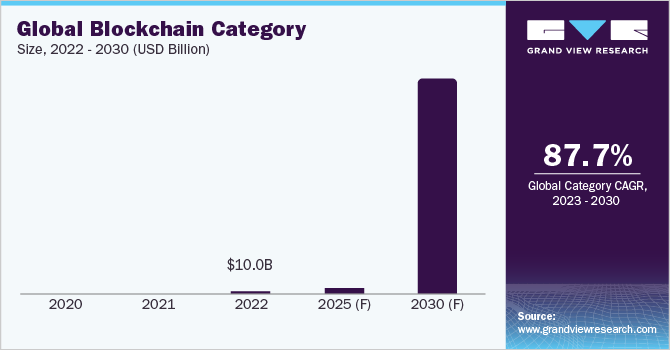
Emerging companies, such as China and India and advanced economies, such as the U.S., South Korea and Singapore, have upped investments in advanced technology. To illustrate, in August 2021, the Securities and Exchange Board of India (SEBI) instructed depositories to use distributed ledger technology to maintain records and monitor the covenants of non-convertible securities. Besides, in June 2023, South Korea gave a green signal to the first standalone digital-asset bill to reinforce investor protection. It is worth mentioning that the U.S. government is reportedly one of the largest holders of bitcoins. These trends allude to a robust growth outlook for the blockchain category; procurement is likely to rev up in the near term.

Appreciate the creator