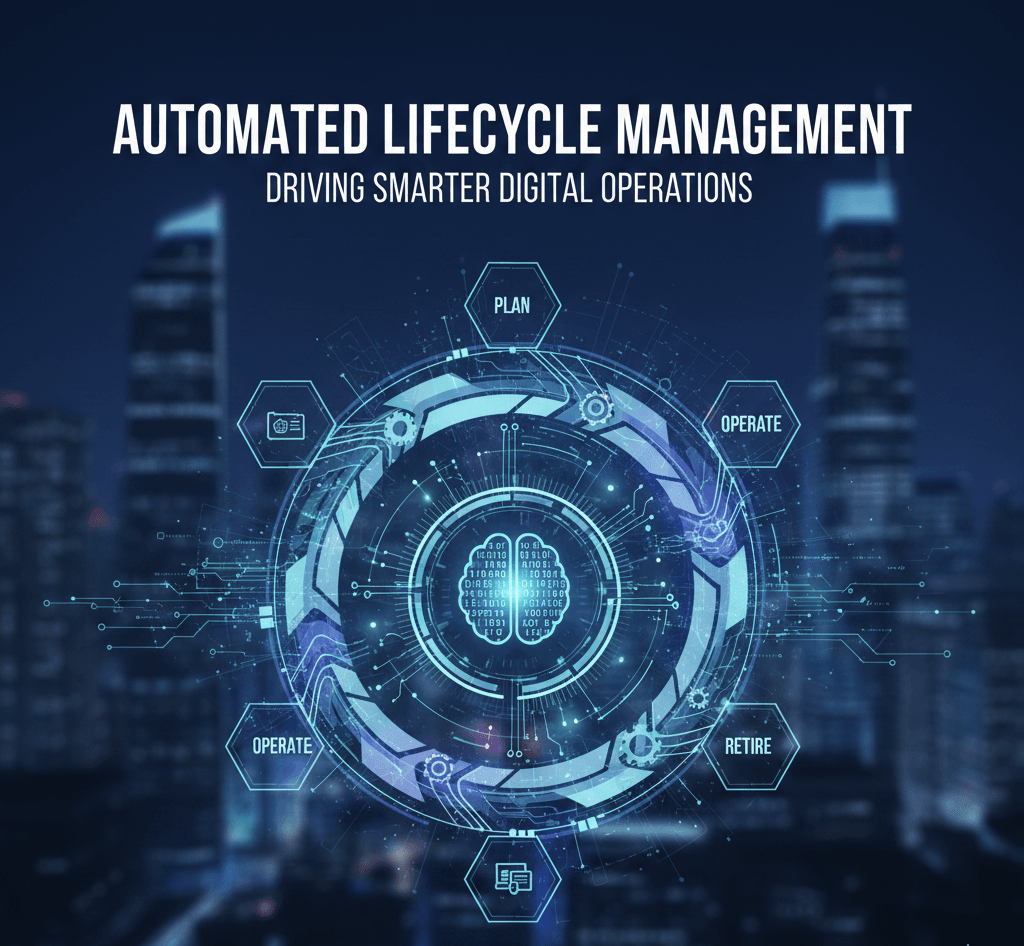
Automated Lifecycle Management Driving Smarter Digital Operations
Introduction
In today’s rapidly evolving digital ecosystem, organizations are under constant pressure to manage applications, infrastructure, and data more efficiently. Manual processes that once worked well are now becoming bottlenecks, leading to delays, errors, and rising operational costs. This is where automated lifecycle management emerges as a game-changing approach, helping businesses streamline operations, improve governance, and scale with confidence.
From development to deployment and eventual retirement, every digital asset goes through multiple stages. Managing these stages manually not only consumes time but also limits visibility and control. By adopting automated lifecycle management, enterprises can ensure consistency, reduce risk, and maintain optimal performance across the entire lifecycle of their systems.
Understanding Automated Lifecycle Management
At its core, automated lifecycle management refers to the use of automation tools and intelligent workflows to manage the complete lifecycle of applications, infrastructure, and digital resources. This includes planning, development, testing, deployment, monitoring, optimization, and decommissioning.
Unlike traditional lifecycle management, automation removes repetitive manual tasks and replaces them with rule-based or AI-driven processes. This ensures that actions are executed consistently and at the right time, minimizing human error while improving efficiency. As digital environments grow more complex, automated lifecycle management becomes essential for maintaining operational stability and agility.
Why Automated Lifecycle Management Matters for Modern Enterprises
Modern enterprises operate in highly dynamic environments where speed and reliability are critical. Frequent updates, security patches, and infrastructure changes are now the norm rather than the exception. Without automation, managing these changes can quickly become overwhelming.
Automated lifecycle management enables organizations to respond faster to business demands while maintaining compliance and quality standards. It allows teams to focus on innovation rather than routine maintenance tasks. As a result, enterprises experience reduced downtime, improved resource utilization, and better alignment between IT operations and business goals.
Automated Lifecycle Management Across the Application Lifecycle
Application development has shifted toward agile and DevOps-driven models that emphasize continuous integration and delivery. In this context, automated lifecycle management plays a critical role in ensuring seamless transitions between each phase of the application lifecycle.
During development, automation supports version control, testing, and validation processes. In deployment, it ensures consistent configurations across environments. Once applications are live, automated lifecycle management helps monitor performance, apply updates, and manage scaling. When applications reach the end of their usefulness, automation ensures secure and compliant decommissioning without disrupting dependent systems.
Role of Automated Lifecycle Management in Infrastructure Optimization
Infrastructure management has become increasingly complex due to hybrid and multi-cloud environments. Managing servers, storage, and networks manually across platforms can lead to inefficiencies and security gaps.
By implementing automated lifecycle management, organizations gain better visibility into infrastructure usage and performance. Automation enables proactive maintenance, capacity planning, and policy enforcement across environments. This not only improves operational efficiency but also reduces costs by eliminating underutilized resources and preventing over-provisioning.
Enhancing Security and Compliance Through Automation
Security and compliance are top priorities for organizations operating in regulated industries. Manual processes often struggle to keep up with evolving security requirements and compliance standards.
Automated lifecycle management strengthens security by enforcing standardized policies at every stage of the lifecycle. Automated patching, vulnerability scanning, and access controls ensure that systems remain secure and compliant without relying on manual intervention. This proactive approach significantly reduces the risk of breaches and compliance violations.
Business Benefits of Automated Lifecycle Management
The adoption of automated lifecycle management delivers tangible business benefits beyond operational efficiency. Organizations gain improved predictability and control over their digital assets, enabling better decision-making and strategic planning.
Automation reduces operational costs by minimizing manual labor and preventing costly errors. It also accelerates time-to-market for new products and features, giving businesses a competitive edge. Over time, automated lifecycle management contributes to higher service quality, improved customer satisfaction, and stronger organizational resilience.
Challenges and Considerations in Implementation
While the benefits are substantial, implementing automated lifecycle management requires careful planning. Organizations must assess their existing processes, tools, and skill sets before introducing automation.
Integration with legacy systems, change management, and data consistency are common challenges. However, these obstacles can be overcome by adopting a phased approach, selecting scalable automation tools, and aligning automation initiatives with business objectives. When implemented strategically, automated lifecycle management becomes a long-term asset rather than a short-term solution.
The Future of Automated Lifecycle Management
As technologies like artificial intelligence and machine learning continue to evolve, automated lifecycle management is becoming even more intelligent and predictive. Future solutions will not only automate tasks but also analyze patterns, anticipate issues, and recommend optimizations in real time.
This evolution will further empower organizations to manage increasingly complex digital ecosystems with minimal human intervention. Businesses that invest in automated lifecycle management today will be better positioned to adapt to future technological and market changes.
Conclusion
In an era defined by speed, complexity, and constant change, manual lifecycle management is no longer sustainable. Automated lifecycle management offers a structured, efficient, and scalable approach to managing applications and infrastructure from start to finish.
By embracing automation, organizations can enhance operational efficiency, strengthen security, and drive innovation with confidence. As digital transformation continues to accelerate, automated lifecycle management will remain a cornerstone of modern, resilient, and future-ready enterprises.
Appreciate the creator