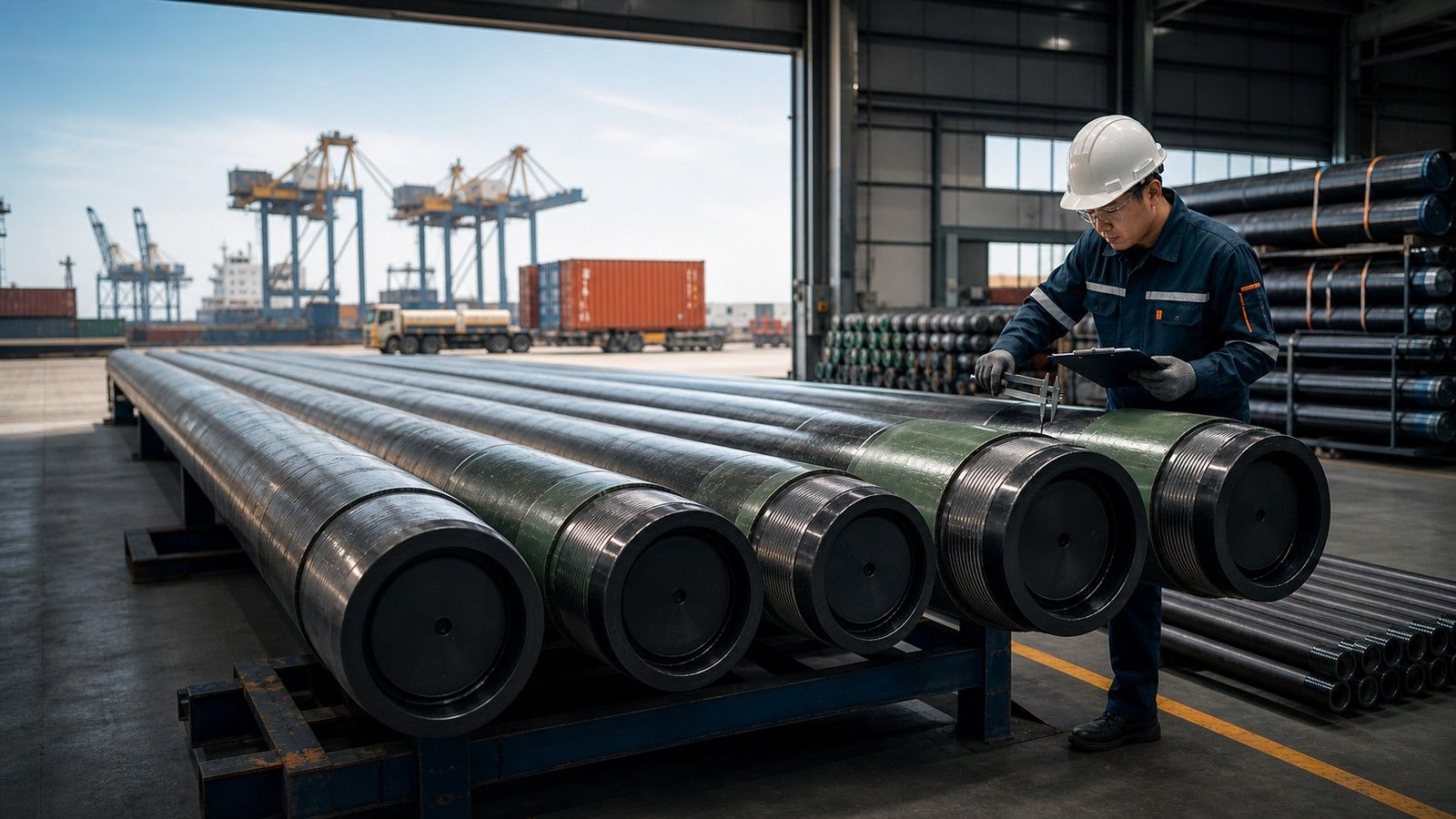
API 5CT Casing and Tubing Procurement
THE BUYER’S SHORT ANSWER
An API 5CT order is not complete when it names only size and grade. A purchase line must also control product type, mass or wall, length range, end finish, connection, service conditions, inspection, traceability, marking and document deliverables.
A casing or tubing enquiry can look precise and still leave the supplier to make important assumptions. “7-inch P110 casing” does not tell the mill which nominal mass, wall thickness, length range, connection, coupling arrangement, drift requirement or supplementary inspection route the project expects. The same problem appears in tubing orders when a buyer names N80 or L80 but omits upset type, connection and service environment.
The practical goal is not to memorize the standard. It is to convert the well program, operator specification and logistics plan into a purchase description that two suppliers will interpret the same way. Buyers can use current API 5CT casing pipe specifications (https://www.forever-steels.com/products-detail/api-5ct-casing-pipe) and API 5CT tubing pipe options (https://www.forever-steels.com/products-detail/api-5ct-tubing-pipe) as product-level references while keeping the engineering design authority with the purchaser.
Casing and Tubing Solve Different Problems
Primary role
· Casing: Supports and isolates the wellbore; commonly cemented in place
· Tubing: Carries produced or injected fluids inside the casing string
Typical buyer concern
· Casing: Collapse, burst, tension, cementing and running loads
· Tubing: Pressure, corrosion, leak path, intervention and workover
Common standard connections
· Casing: STC, LTC or BTC, subject to the design basis
· Tubing: NUE or EUE, subject to the design basis
Replaceability
· Casing: Usually part of the permanent well architecture
· Tubing: More accessible during completion or workover
Order consequence
· Casing: A mismatch can affect well integrity and running program
· Tubing: A mismatch can affect production reliability and intervention
This distinction is why an OCTG sourcing team should resist copying a casing specification into a tubing enquiry—or treating both as generic “oil pipe.” The manufacturing route may overlap, but the service role and connection logic do not.
A Six-Gate Procurement Sequence
· 01 SERVICE: well role and environment
· 02 BODY: OD, mass, wall and grade
· 03 ENDS: thread and coupling
· 04 QUALITY: tests and acceptance
· 05 RECORDS: traceability package
· 06 LOGISTICS: length and protection
1. Start With Service Conditions, Not a Grade Shortcut
Grade is an output of the design case, not a substitute for it. Depth, pressure, temperature, axial loading, external pressure, corrosion mechanism, H₂S exposure, completion chemistry and operating cycle all influence the selection. A higher strength label is not automatically a safer choice: hardness control, toughness, corrosion behavior and operator approval may be equally important.
J55 / K55
· How buyers often encounter it: Routine casing programs and cost-sensitive wells
· What still needs engineering confirmation: Required tensile properties, wall/mass, depth and load envelope
N80-1 / N80-Q
· How buyers often encounter it: Intermediate-strength casing or tubing enquiries
· What still needs engineering confirmation: Heat-treatment route, application limits and operator specification
L80 family
· How buyers often encounter it: Controlled-strength or corrosion-sensitive discussions
· What still needs engineering confirmation: Exact type, chemistry/hardness limits and sour-service requirements
P110
· How buyers often encounter it: High-strength casing and deeper or higher-load programs
· What still needs engineering confirmation: Collapse/burst/tension design, connection performance and environment
C90 / T95 / Q125
· How buyers often encounter it: More specialized or demanding programs
· What still needs engineering confirmation: Availability, qualification, supplementary requirements and lead time
IMPORTANT
Do not use a generic “N80 vs L80 vs P110” ranking as a design rule. The purchaser’s well design and the current contract edition of API 5CT must decide the grade and supplementary requirements.
2. Lock the Pipe Body: OD, Nominal Mass, Wall and Length
API 5CT casing sizes and weights are commonly discussed by nominal outside diameter and nominal linear mass. Those descriptors must resolve to the wall thickness and drift or internal-clearance requirements needed by the well program. For tubing, the same discipline applies: nominal size alone does not establish the full flow area or pressure capability.
· Outside diameter: State the standard size and units used in the contract.
· Nominal linear mass / wall thickness: Include the mass designation and verify the corresponding wall rather than mixing values from different tables.
· Length range: Specify the permitted range and any tally, minimum-length or fixed-length constraints.
· Drift and internal clearance: State the required drift route when completion equipment or passage clearance is critical.
· Quantity basis: Define pieces, total length and/or metric tons, plus the permitted overage or underage.
3. Treat Connections as a Design and Supply Interface
Thread names are not a decorative suffix. They affect make-up practice, coupling geometry, running efficiency, clearance, leak resistance, licensing route and lead time. Casing discussions often begin with STC, LTC or BTC; tubing discussions commonly begin with NUE or EUE. Premium systems may be required when gas-tight performance, combined loads, severe wells or a named operator specification moves the project beyond a standard connection route.
A useful decision aid is this explanation of standard API threads versus premium connections (https://www.forever-steels.com/news-detail/standard-api-threads-or-premium-connections%3A-when-is-stc%2C-ltc%2C-btc%2C-nue%2C-or-eue-not-enough). In the RFQ, identify the connection, coupling type, special clearance, thread compound requirement, protector type, make-up reference and any licensed premium-thread expectation.
4. Make Inspection Requirements Measurable
“Full inspection” is not a purchase requirement because it does not define a method, coverage, acceptance criterion or reporting obligation. The inspection and test plan should connect the governing standard and purchaser specification to hold points, witness points and released records.
Material
· Buyer should define: Grade/type, heat treatment and supplementary requirements
· Typical evidence: Mill test report, heat/lot traceability
Mechanical tests
· Buyer should define: Required tests, frequency and acceptance route
· Typical evidence: Test reports linked to heat and lot
Pipe body
· Buyer should define: Dimensional checks and applicable NDE coverage
· Typical evidence: Dimensional and NDE records
Ends
· Buyer should define: Thread form, gauging, coupling and protector checks
· Typical evidence: Gauge records and visual report
Pressure / passage
· Buyer should define: Hydrostatic and drift requirements as applicable
· Typical evidence: Hydrotest and drift records
Final release
· Buyer should define: Marking, tally, quantity, packing and document review
· Typical evidence: Release note, tally and packing list
5. Build Traceability From the Purchase Line Outward
Traceability fails when documents are requested only at shipment. The order should define the relationship among purchase item, heat, manufacturing lot, test unit, pipe marking, tally and certificate. A third-party inspection stamp cannot repair a missing chain after the material has been mixed.
· Contract basis: Purchase order and approved technical clarification with a clear revision status.
· Material evidence: Mill test report and required test records tied to heat and lot.
· Physical identity: Pipe-by-pipe or bundle tally as required, including length and identification.
· End-to-end release: Thread, coupling, protector, marking and packaging release records.
· Exception control: Any approved deviation, concession or nonconformance closure.
6. Include Logistics Before the Mill Starts
OCTG is vulnerable at the ends. International shipments need suitable thread protectors, corrosion protection, bundle control, lifting instructions and an agreed tally format. The buyer should also confirm whether length distribution affects vessel, container, truck or site-handling limits. A technically compliant pipe that arrives with damaged threads is not a successful order.
Copy-Ready API 5CT RFQ Checklist
Standard basis
· Information to state: API 5CT edition/addenda/errata required by the contract; purchaser specification and revision
Product
· Information to state: Casing or tubing; seamless or welded if restricted; quantity and delivery basis
Dimensions
· Information to state: OD, nominal linear mass and/or wall thickness, length range, drift requirement
Material
· Information to state: Grade and type, heat treatment route where relevant, service environment and supplementary requirements
Ends
· Information to state: Connection, upset/end finish, coupling arrangement, thread compound and protectors
Inspection
· Information to state: ITP, hold/witness points, NDE, hydrostatic, dimensional, drift and thread-gauging requirements
Documents
· Information to state: Mill test report, test reports, tally, marking record, packing list and deviation closeout
Logistics
· Information to state: Packing, corrosion protection, shipping marks, delivery port and schedule
A strong RFQ does more than reduce technical risk. It makes quotations comparable. When every bidder is pricing the same body, ends, inspection scope and document package, the lowest number is less likely to be the result of an omitted requirement.
Final Takeaway
PROCUREMENT RULE
Do not ask only, “Is this API 5CT?” Ask, “Which exact purchase description, inspection route and traceability package will prove that the delivered casing or tubing matches our well program?”
For importers and stockists, the most reliable sequence is service conditions → dimensions and mass → grade → connection → inspection → records → logistics. That sequence turns a catalog enquiry into a controlled OCTG purchase.
Technical References
The complete edition named in the purchase contract and the purchaser’s engineering specification always take precedence over this general guide.
· API Specification 5CT, Casing and Tubing — 11th Edition (https://www.api.org/products-and-services/standards/important-standards-announcements/spec5ct) — Official API announcement for the current specification edition.
· API Monogram/APIQR Latest Updates — API 5CT (https://www.api.org/products-and-services/api-monogram-and-apiqr/latest-updates) — Official addenda and errata list; check the contract date and required status.
Appreciate the creator