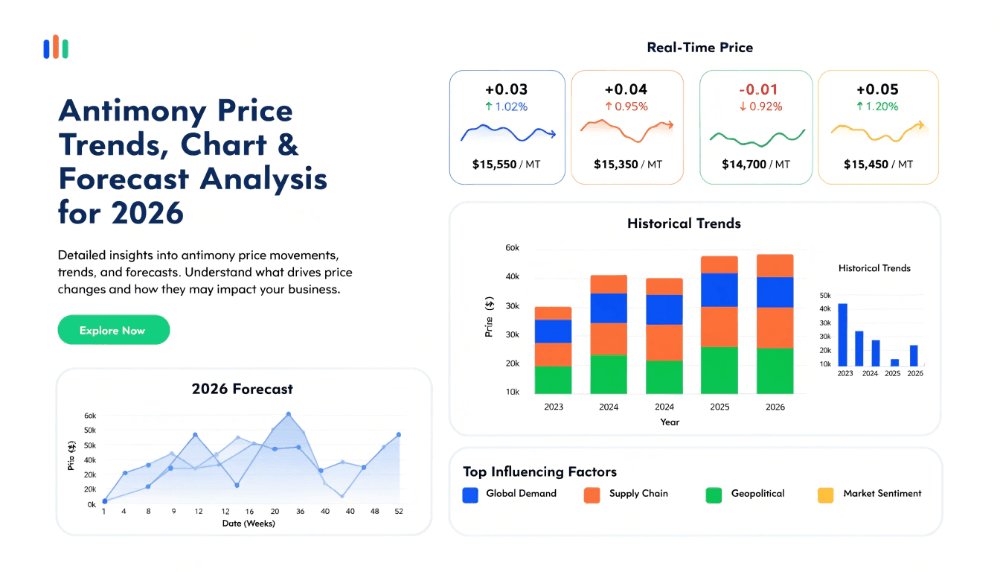
Antimony Price Graph 2026: Trend, History & Forecast Insights
The global antimony price today continues to reflect tight supply conditions and steady industrial demand from flame retardants, alloys, and energy storage applications. As of early 2026, antimony prices are estimated to be in the range of USD 11,000–13,500/MT, depending on purity levels, origin, and contract terms.
The market remains highly sensitive to mining output from key producing countries such as China, Russia, and Bolivia. With ongoing supply constraints and rising downstream consumption, the Antimony Price Graph has shown moderate upward momentum over the past quarters.
Antimony Market Overview and Price Insights
Antimony is a strategic metalloid widely used in flame retardants, lead-acid batteries, and semiconductor applications. Its limited global production base makes it a critical and sometimes volatile commodity.
According to recent market insights, antimony supply is concentrated in a few regions, making pricing highly responsive to mining disruptions, export policies, and environmental regulations. Demand remains stable across construction, automotive, and electronics sectors, supporting a relatively firm pricing structure.
The antimony price index has shown cyclical movement over the past decade, with sharp spikes during supply shortages and moderated corrections during demand slowdowns.
Price Trend Analysis of Antimony (2020–2026)
The antimony price chart over the past several years highlights a clear shift from stability to volatility, followed by a correction phase in 2026. The market has moved through three distinct stages:
2020–2021: Moderate stability, supported by balanced supply-demand conditions, though COVID-19 disrupted industrial consumption in several regions.
2022–2023: Sharp price surge driven by supply chain constraints, mining disruptions, and increased freight costs.
2024–2026: Transition into a correction phase, where prices stabilized initially but started showing downward pressure in 2026 due to weaker short-term demand and inventory adjustments.
In April 2026, regional pricing data reflects a noticeable correction across all major markets, indicating short-term softness despite long-term structural tightness in supply.
Global Antimony Price Comparison (April 2026 – Simple View)
Europe
Price Index: 33.34
Latest Movement: -5.8% ↓ Decrease
Northeast Asia
Price Index: 21.39
Latest Movement: -5.9% ↓ Decrease
North America
Price Index: 38.11
Latest Movement: -26.3% ↓ Sharp Drop
This data shows that the antimony price index declined across all major regions in April 2026. North America recorded the steepest fall due to weak industrial demand and higher inventory levels. Europe and Northeast Asia also saw moderate declines as buyers remained cautious and demand slowed.
Overall, regional price differences are mainly driven by import dependence, industrial consumption trends, and shipping cost variations.
Region-wise Analysis (Updated 2026 Outlook)
North America
North America has experienced the most significant correction in antimony prices in April 2026, with a steep -26.3% decline in the pricing index. This drop is primarily due to weakened industrial procurement, inventory destocking, and temporary slowdown in flame retardant and defense-related demand. Despite limited domestic mining, the region is currently experiencing short-term oversupply from earlier import accumulation, putting downward pressure on prices.
Asia-Pacific (APAC) / Northeast Asia
Northeast Asia, a key sub-region within APAC, recorded a -5.9% decline in the antimony price index. China continues to dominate both production and exports, making it the primary benchmark for global pricing trends. The recent price correction reflects softer downstream demand and seasonal adjustments in industrial consumption. However, APAC still remains the most influential region for setting global Antimony Price Forecast expectations due to its production dominance.
Europe
Europe also witnessed a -5.8% downward movement in antimony prices. The region remains structurally import-dependent, and high procurement costs have slightly eased due to weaker demand from automotive and electronics sectors. While environmental regulations and limited mining output continue to support long-term price firmness, short-term correction reflects cautious purchasing behavior among European buyers.
Antimony Price Index Insights
The antimony price index reflects long-term market behavior and shows that the commodity has entered a structurally firm pricing phase. Over the last five years, the index has gradually increased due to:
Declining ore grades in major mines
Limited new mining investments
Rising demand from energy storage technologies
Strategic importance in defense applications
This trend suggests that antimony is transitioning from a cyclical commodity to a structurally constrained industrial material.
Supply and Demand Dynamics in the Global Market – Overview
The global antimony market is currently shaped by a supply-constrained environment. While demand remains stable, production growth has not kept pace due to environmental restrictions and resource depletion.
On the demand side, the battery sector and flame retardant applications are key growth drivers. Meanwhile, recycling initiatives are gradually emerging but are not yet sufficient to offset primary supply limitations.
Key Factors Influencing Antimony Prices
Several structural and short-term factors influence price movement:
Limited global mining output and reserve concentration
Export regulations from major producing countries
Rising demand from flame retardant and battery industries
Transportation and logistics costs
Environmental restrictions on mining operations
Currency fluctuations affecting import-dependent regions
Substitution trends in industrial applications
These drivers collectively shape the volatility observed in the Antimony Price Graph.
Recent Developments in the Antimony Industry
The antimony industry has witnessed several notable developments:
Increased focus on recycling antimony from industrial waste
Exploration of new deposits in Central Asia and Africa
Strategic stockpiling by industrial consumers
Rising interest in antimony-based energy storage technologies
Tightened export controls in major producing countries
These developments are expected to further tighten supply in the coming years.
Antimony Price Forecast (2026 Outlook)
The Antimony Price Forecast for 2026 suggests a cautiously bullish outlook. Prices are expected to remain firm due to persistent supply constraints and steady industrial demand.
Projected price range:
Low estimate: USD 11,200/MT
High estimate: USD 14,000/MT
Key expectations include:
Gradual upward pressure due to mining limitations
Stable demand from automotive and electronics sectors
Possible short-term volatility due to policy changes in Asia
Overall, the market is likely to maintain a firm pricing structure with occasional spikes driven by supply disruptions.
Applications and End-Use Industries of Antimony
Antimony is widely used across multiple industries:
Flame retardants in plastics, textiles, and electronics
Lead-acid batteries for automotive applications
Alloy production to improve hardness and strength
Semiconductor and electronic components
Glass and ceramics manufacturing
Military and defense applications
These applications ensure consistent baseline demand globally.
Internal Linking Opportunity
For detailed historical and real-time data insights, refer to the full report:
https://www.imarcgroup.com/antimony-pricing-report/requestsample
FAQs About Antimony Prices, Trends, History & Forecast:
What is the current Antimony price today?
The antimony price today is estimated between USD 11,000 and 13,500 per metric ton depending on grade, origin, and contract terms. Prices fluctuate due to supply constraints and regional import dependence, making the market moderately volatile.
What is the Antimony Price Forecast for 2026?
The Antimony Price Forecast suggests a bullish outlook with prices likely ranging between USD 11,200 and 14,000/MT. Limited mining output and stable industrial demand are expected to keep prices firm throughout 2026.
Why is antimony price increasing globally?
Antimony prices are rising due to limited global supply, stricter mining regulations, and increasing demand from flame retardant and battery industries. These structural constraints are pushing the antimony price index upward over time.
Which region dominates antimony production?
Asia-Pacific, particularly China, dominates global antimony production. It significantly influences the Antimony Price Graph due to its export policies and production scale, making it a key pricing benchmark globally.
What industries drive antimony demand?
Key demand drivers include flame retardants, automotive batteries, electronics, and alloys. Growing use in energy storage systems is further strengthening long-term demand trends in the global antimony market.
Contact Us:
IMARC Group
134 N 4th St. Brooklyn, NY 11249, USA
Email: sales[@]imarcgroup.com
Tel No:(D) +91 120 433 0800
United States: +1-201971-6302
Appreciate the creator