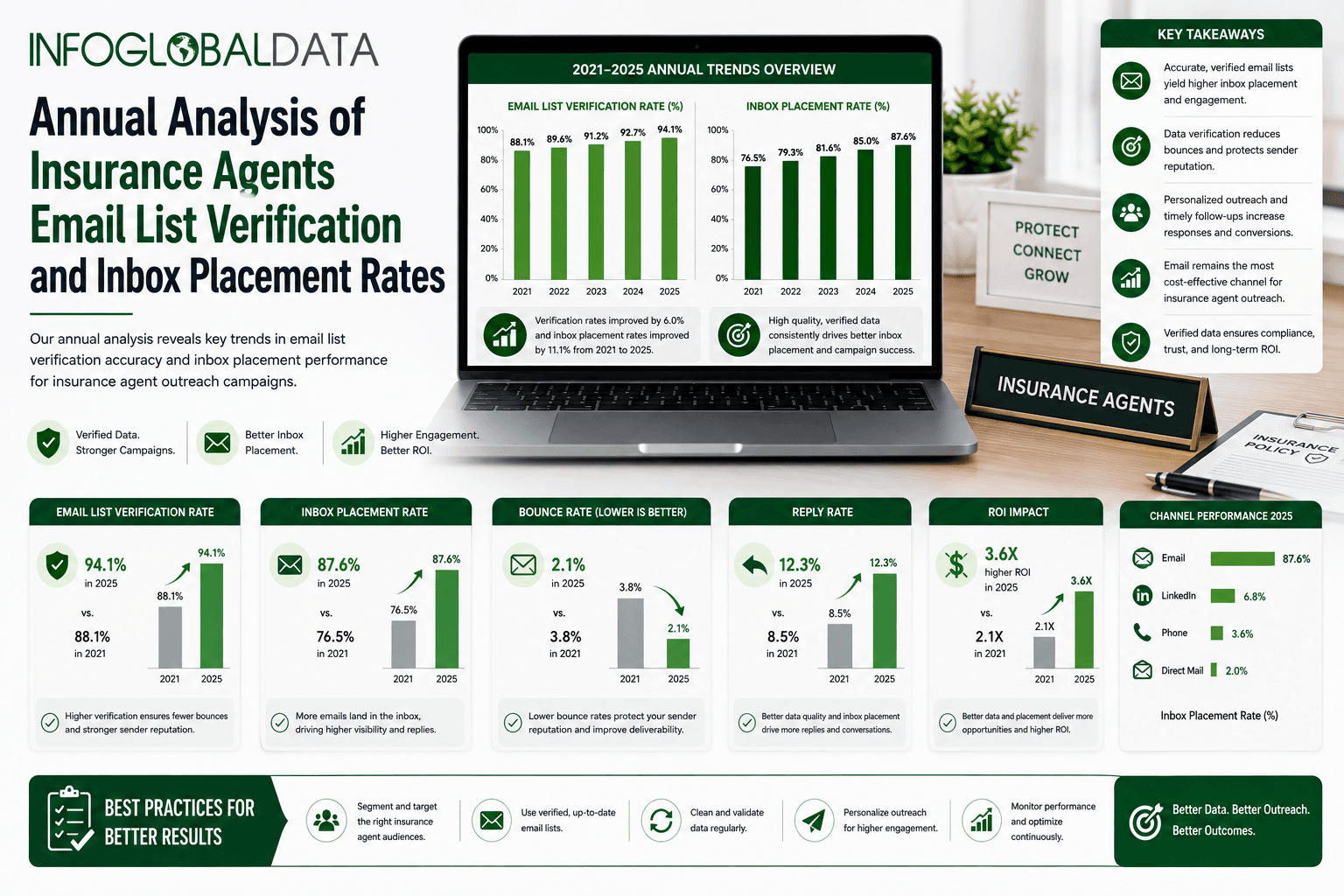
Annual Analysis of Insurance Agents Email List Verification and Inbox Placement Rates | InfoGlobalData
Introduction
Email list quality has become a measurable business issue for insurance marketers. ZeroBounce’s 2026 Email List Decay Report found that at least 23% of email-list data decayed within one year, based on more than 11 billion addresses processed during 2025. At the same time, Validity’s 2026 Email Deliverability Benchmark Report recorded a 90.4% inbox placement rate for the insurance sector, with 3.6% of messages placed in spam and 6.1% classified as missing.
These figures show why verification and inbox placement should be analyzed together. A technically deliverable address is not necessarily an inboxed message, and an accurate Insurance Agents Email List (https://www.infoglobaldata.com/datacard/insurance-agents-brokers-mailing-list) can deteriorate as agents change agencies, roles, or addresses. This annual analysis examines current verification, decay, deliverability, engagement, and compliance data to identify what insurance marketers should measure in 2026—and where list hygiene can directly affect campaign efficiency.
What Is the Current State of Insurance Email Deliverability?
Insurance is performing relatively well on inbox placement compared with the global email ecosystem.
Validity's 2026 Email Deliverability Benchmark Report analyzed trillions of global inbox data points covering 2025. It reported a 90.4% inbox placement rate for insurance, compared with a 87.2% global average. Insurance also recorded a 3.6% spam-placement rate and a 6.1% missing rate.
Deliverability MetricInsurance, 2025Inbox placement90.4%Spam placement3.6%Missing6.1%Global inbox benchmark87.2%
The 90.4% figure is encouraging, but it should not be interpreted as a guarantee for every insurance campaign.
Validity's benchmark reflects sector-level email performance, whereas a campaign sent to a newly acquired or externally sourced Insurance Agents Mailing List (https://www.infoglobaldata.com/datacard/insurance-agents-brokers-mailing-list) may have a different sender reputation, engagement profile, authentication setup, and data quality.
The important takeaway is that insurance marketers have a useful sector benchmark—but should establish their own baseline through inbox-placement testing and campaign monitoring.
Why Verification Matters More in a Rapidly Changing Contact Environment
Email databases do not remain static.
ZeroBounce's 2026 Email List Decay Report analyzed email data verified between January and December 2025 and found that at least 23% of an email list decays within one year. More than 11 billion email addresses were processed in the study, and only 62% of the submitted addresses were classified as valid.
The 23% figure is a cross-industry benchmark—not an insurance-agent-specific decay rate.
Nevertheless, insurance presents several structural reasons why contact maintenance matters. Agents can move between agencies, change positions, leave the industry, consolidate agencies, or adopt different business email addresses.
For marketers, this means a list that was verified 12 months ago should not automatically be considered current today.
A practical verification program should monitor:
Invalid addresses
Role-based addresses
Catch-all domains
Disposable addresses
Recently changed contacts
Duplicate records
Unsubscribed contacts
Agency or employer changes
The objective is not simply to eliminate bounces. It is to maintain a database that accurately represents the current insurance-agent market.
What Does the Insurance Sector's Email Engagement Benchmark Look Like?
MailerLite's latest benchmark report analyzed more than 3.6 million email campaigns from 181,000 approved accounts, covering December 2024 through November 2025. The insurance industry recorded a 44.4% median open rate, 1.36% click rate, 3.19% click-to-open rate, and 0.27% unsubscribe rate.
MetricInsurance BenchmarkOpen rate44.4%Click rate1.36%Click-to-open rate3.19%Unsubscribe rate0.27%
These numbers are useful for insurance email marketing, but they should be interpreted carefully.
MailerLite's benchmark represents email marketing campaigns broadly; it is not specifically a cold-prospecting benchmark for insurance agents.
That distinction is critical for an Insurance Agents Email Database (https://www.infoglobaldata.com/datacard/insurance-agents-brokers-mailing-list) campaign.
A permission-based newsletter sent to an established audience can behave very differently from a cold B2B campaign introducing a product to independent agents.
Why Open Rate Should Not Be the Primary List-Quality Metric
Open rates remain useful as a directional metric, but they should not be treated as definitive evidence that a message was read.
Google explicitly states that it does not track open rates for Gmail and cannot verify the accuracy of open rates reported by third parties. MailerLite similarly recommends focusing more heavily on click rate because Apple Mail Privacy Protection can automatically register messages as opened.
For insurance marketers, this shifts the measurement hierarchy toward observable actions:
Delivered → Clicked → Replied → Qualified → Meeting → Opportunity → Revenue
This is especially important when evaluating a purchased or externally sourced list.
If an Insurance Agents Mailing List produces high opens but almost no clicks or replies, the issue may be message relevance, audience targeting, offer quality, or inflated open tracking—not necessarily a successful campaign.
How Does Cold Email Perform in the Insurance Industry?
Cold outreach requires an entirely different benchmark.
Belkins' 2026 B2B cold-email study analyzed 7,530,489 emails sent across client campaigns during 2025 and tracked 34,393 unique replies. Its overall cold-email reply rate was 0.45%, calculated as unique replies divided by total emails sent.
The study specifically identified Banking and Insurance among the lowest-performing industries for cold-email replies.
Belkins attributes the weaker performance partly to structural factors such as regulation, institutional gatekeeping, lengthy procurement processes, and greater scrutiny of unsolicited communications.
This finding is important because it prevents marketers from applying a generic 2%, 5%, or 10% reply-rate expectation to insurance-agent prospecting.
The correct benchmark depends on:
Whether the audience is permission-based or cold
Contact accuracy
Agency size
Seniority
Offer relevance
Sender reputation
Email authentication
Follow-up sequence
Geographic market
Compliance practices
Insurance marketers should therefore benchmark their own positive reply rate and qualified-conversation rate, not simply total replies.
Does Insurance Agent Technology Adoption Create Better Outreach Opportunities?
The insurance-agent market is becoming increasingly technology-oriented.
Agent for the Future's 2026 Independent Agency Growth Study found that 65% of independent insurance agents had used AI for work during the previous year, up from 37% in 2025. The report also found that 41% used AI weekly, compared with 18% the previous year.
The study found that independent agents primarily use AI today for relatively straightforward tasks such as generating marketing content and summarizing meeting notes. Agencies expect to expand AI use toward areas including data analysis and workflow automation.
This matters for an Insurance Agents Email List because marketers can increasingly frame technology-related outreach around practical business outcomes.
Relevant messaging themes may include:
Reducing administrative work
Improving customer communication
Automating repetitive workflows
Increasing producer productivity
Improving lead follow-up
Data analysis
Marketing automation
Digital policy processes
The strongest campaigns should connect the offer to an existing agent workflow rather than simply announcing that "AI is changing insurance."
What Do Insurance Professionals Say About Technology Priorities?
Independent insurance professionals continue to place strong emphasis on technology that reduces friction.
A 2025 Vertafore survey of nearly 1,300 insurance professionals found that claims, communication, and technology were among the top concerns when independent agents work with carriers. The research also found that 69% considered digital rating and submission in personal lines a must-have capability, while 51% said the same for commercial lines. Digital document and policy delivery was considered a must-have by 59%.
These findings provide a useful messaging framework.
A marketer selling software, data, communication services, or operational technology should connect the product to the specific workflow an agent cares about.
For example, an email about generic "digital transformation" is less actionable than a message explaining how a tool can reduce manual submission work or improve customer communication.
A segmented Insurance Agents Email Database makes this type of role- and workflow-specific messaging easier to execute.
How Poor CRM Data Can Undermine List Verification
Email verification is only one part of data quality.
Validity's 2025 State of CRM Data Management surveyed 602 CRM users and stakeholders and found that 76% said less than half of their organization's CRM data was accurate and complete. Additionally, 37% reported losing revenue because of poor data quality, while 45% said their CRM data was not ready for AI.
This distinction matters.
An email address can technically be valid while the underlying prospect record is commercially inaccurate.
For example:
The email still works, but the agent changed agencies.
The contact is still employed but no longer makes purchasing decisions.
The person remains at the agency but moved from sales to operations.
Multiple records represent the same agency.
An old opt-out status was not synchronized across systems.
Therefore, list verification should include identity and business-context verification, not merely SMTP-level validation.
How Authentication Affects Inbox Placement
List quality cannot compensate for weak sender infrastructure.
Google's current sender guidelines require all senders to Gmail accounts to use SPF or DKIM authentication, valid DNS configuration, TLS, and appropriate message formatting. Senders delivering more than 5,000 messages per day to Gmail accounts also need DMARC, alignment between the From domain and SPF or DKIM domain, and one-click unsubscribe for marketing messages.
Google also recommends keeping the reported spam rate below 0.10% and avoiding 0.30% or higher. For bulk senders, messages that fail authentication or unsubscribe requirements can face delivery problems or spam placement.
For an insurance-focused campaign, this creates a simple equation:
Good data + authentication + relevant messaging + healthy engagement = stronger deliverability
Verification should therefore happen before sending, while sender reputation should be monitored throughout the campaign.
Is Email Still a High-ROI Channel for Insurance Marketers?
Email remains one of the most measurable marketing channels.
Litmus' 2025 State of Email research, based on nearly 500 marketing professionals, found that 35% of companies generated $10–$36 for every $1 spent on email, while 30% generated $36–$50 and 5% generated more than $50. Twenty-one percent of respondents did not measure email ROI.
Litmus also reports an average email ROI of approximately $36 for every $1 spent across its research.
However, marketers should not interpret this as a guaranteed return from an Insurance Agents Email List.
The ROI benchmark encompasses email programs with different audiences, permission models, objectives, and maturity levels. Cold acquisition has additional costs and lower initial response rates.
For insurance prospecting, ROI should be calculated using the actual campaign economics:
ROI = (Attributed Revenue − Total Campaign Cost) ÷ Total Campaign Cost
That should include data acquisition, verification, software, creative, sales labor, follow-up, and conversion costs.
How Should Marketers Build an Annual Verification Program?
An annual list review is better than no review, but the research suggests that waiting exactly 12 months can leave substantial data deterioration unaddressed.
With ZeroBounce reporting at least 23% annual list decay, marketers should consider verification as an ongoing process rather than a once-a-year event.
A practical program can include:
Before Every Major Campaign
Validate new and previously inactive contacts, suppress invalid addresses, and check role and agency information.
Quarterly
Review engagement, bounce rates, unsubscribe activity, role changes, and agency-level duplication.
Annually
Conduct a comprehensive database audit covering contact validity, organizational affiliation, segmentation fields, suppression records, and historical engagement.
After Major Industry Changes
Refresh records following mergers, acquisitions, agency consolidations, or major staffing changes.
The appropriate frequency ultimately depends on list size, acquisition method, send volume, and contact turnover.
Practical Takeaways for Insurance Email Marketers
1. Use 90.4% as a Sector Reference, Not a Promise
Validity's 90.4% insurance inbox-placement figure provides useful context, but individual senders can perform substantially differently depending on infrastructure, reputation, data, and engagement.
2. Verify Before Scaling
ZeroBounce's 23% annual decay finding demonstrates why an old database should not automatically be considered campaign-ready.
3. Measure Positive Replies
Belkins' 0.45% overall cold-email benchmark—and its finding that insurance was among the weaker-performing verticals—shows why gross reply rates alone can create unrealistic expectations.
4. Segment by Agent Context
Separate independent agencies, agency size, role, insurance specialty, and technology needs where the available data supports it.
5. Protect Sender Reputation
Implement SPF, DKIM, DMARC where required, TLS, appropriate unsubscribe mechanisms, and continuous spam-rate monitoring. Google's current requirements make authentication and recipient control central to sustainable sending.
How InfoGlobalData Can Support List-Quality Strategy
For organizations building targeted insurance outreach programs, InfoGlobalData (https://www.infoglobaldata.com) can serve as a data resource when developing an Insurance Agents Email List.
The most effective use of a database is not simply maximizing the number of contacts. Marketers should combine relevant contact data with verification, segmentation, suppression management, sender authentication, and campaign-level performance measurement.
This approach turns a static Insurance Agents Mailing List into a more useful prospecting asset while allowing marketing and sales teams to evaluate whether better data actually improves downstream business results.
Conclusion
The 2026 evidence makes one point clear: insurance email performance depends on much more than the number of contacts in a database. Validity's latest benchmark places insurance inbox placement at 90.4%, above the 87.2% global average, while MailerLite reports a 44.4% insurance open rate and 1.36% click rate for broader email marketing campaigns. Yet ZeroBounce found that at least 23% of email-list data decays within a year, creating a persistent need for verification and maintenance.
For marketers using an Insurance Agents Email List, the forward-looking strategy is therefore continuous rather than annual-only: verify contacts, monitor inbox placement, segment by business context, authenticate sending infrastructure, and measure qualified outcomes. As independent agents increasingly adopt AI and digital workflows, accurate data will become even more important for delivering relevant outreach without sacrificing sender reputation.
Frequently Asked Questions
What is the current inbox placement rate for insurance email?
Validity's 2026 Email Deliverability Benchmark Report recorded a 90.4% inbox placement rate for the insurance sector in 2025, compared with 87.2% globally. The figure is an industry benchmark, not a guaranteed result for an individual Insurance Agents Email List.
How often should an Insurance Agents Email List be verified?
There is no universal verification interval for every insurance database. However, ZeroBounce found that at least 23% of email-list data decayed within one year, supporting verification before major campaigns and periodic ongoing maintenance rather than relying on a single annual check.
What is the insurance email open-rate benchmark?
MailerLite's 2025 benchmark recorded a 44.4% median open rate for insurance. Because privacy technologies can distort open tracking, marketers should also monitor clicks, replies, qualified leads, and revenue.
What is the average cold-email response rate in insurance?
There is no authoritative universal Insurance Agents Email List response rate. Belkins' 2026 study reported a 0.45% overall cold-email reply rate across more than 7.5 million sends and identified Banking and Insurance among the lower-performing industries, so insurance prospecting should be benchmarked separately from general email marketing.
What causes insurance email addresses to become invalid?
Addresses can become obsolete when agents change agencies, leave the industry, abandon accounts, or change professional roles. ZeroBounce's broader 2026 research found that at least 23% of email-list data decayed within one year, although that figure is not specific to insurance agents.
Does email verification improve inbox placement?
Verification can reduce exposure to invalid or risky addresses, but it does not guarantee inbox placement. Sender authentication, complaint rates, engagement, content, sending behavior, and mailbox-provider policies also influence whether a message reaches the inbox. Google's current guidelines emphasize authentication, spam-rate management, and unsubscribe functionality.
What authentication is required for insurance email campaigns?
Google requires senders to Gmail accounts to use SPF or DKIM authentication, valid DNS records, TLS, and appropriate message formatting. Bulk senders sending 5,000 or more messages per day to Gmail accounts must also implement DMARC and meet additional alignment and one-click-unsubscribe requirements.
Is AI changing how insurance agents work?
Yes. Agent for the Future's 2026 Independent Agency Growth Study found that 65% of independent agents had used AI for work during the previous year, compared with 37% in 2025, while 41% reported weekly AI use. Current use is concentrated on tasks such as marketing-content generation and meeting-note summaries, with agencies expecting broader use in data analysis and workflow automation.
What should marketers measure when using an Insurance Agents Email Database?
Track the entire funnel: valid contacts, delivered messages, bounce rate, inbox placement where available, clicks, positive replies, meetings, opportunities, conversions, and revenue. This gives marketers a more accurate picture of whether better data is producing better commercial outcomes.
Appreciate the creator