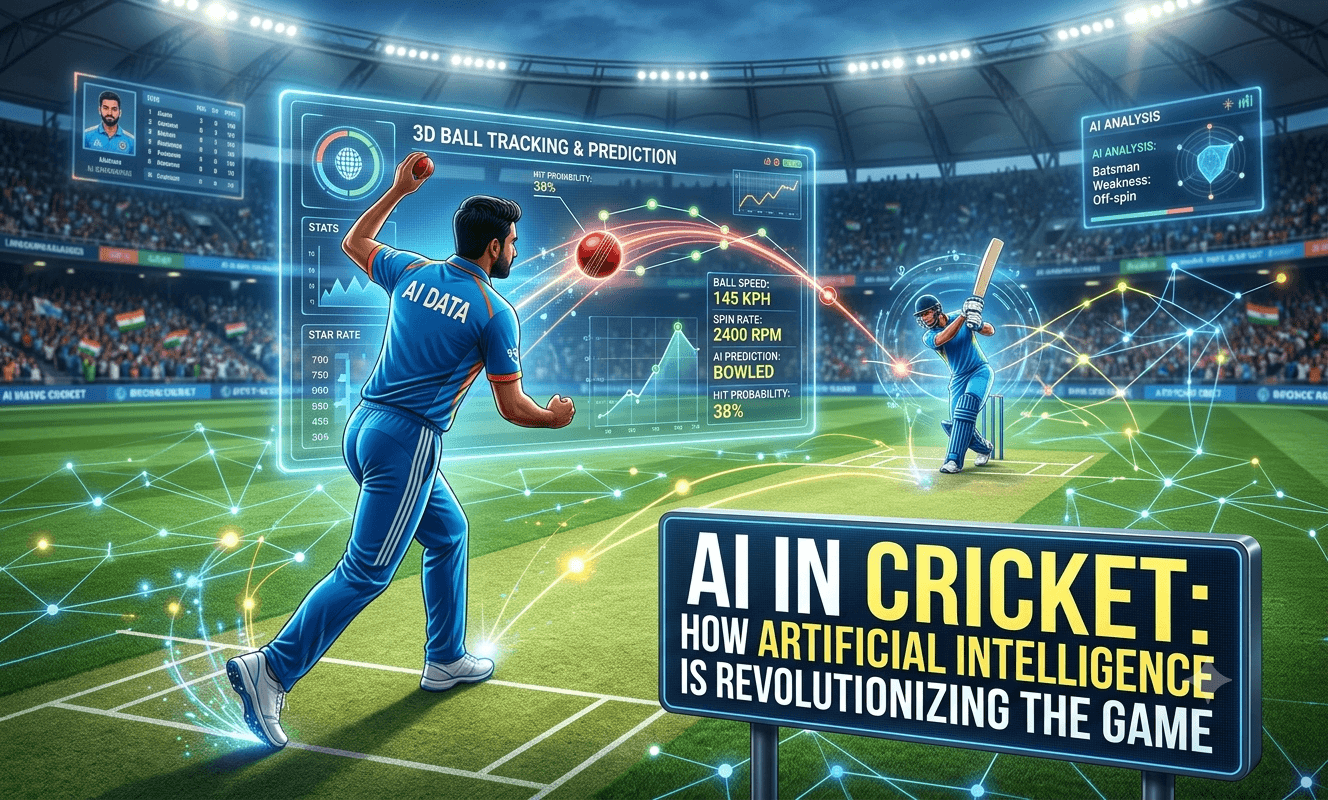
AI in Cricket: How Artificial Intelligence Is Revolutionizing the Game
Cricket has always been a game of strategy, skill, and statistics. Over the past decade, however, a new technology has transformed how the sport is played, analyzed, and enjoyed - Artificial Intelligence (AI). From player performance analysis to injury prevention, match strategy, fan engagement, and broadcasting, AI is changing nearly every aspect of modern cricket.
Today, international teams, domestic franchises, coaches, analysts, broadcasters, and sports scientists rely on AI-powered tools to make smarter decisions. As technology continues to evolve, AI is becoming an essential part of cricket's future rather than just an innovative addition.
At 9wickets, we believe understanding these technological advancements helps fans appreciate the game on a deeper level.
What Is Artificial Intelligence in Cricket?
Artificial Intelligence refers to computer systems capable of processing massive amounts of cricket-related data, identifying patterns, and generating insights that help coaches, players, analysts, and teams make informed decisions.
Unlike traditional statistical analysis, AI continuously learns from new information. It analyzes thousands of deliveries, batting techniques, bowling variations, field placements, weather conditions, pitch reports, and player movements to produce recommendations that would take humans weeks to calculate.
As a result, cricket has become more data-driven than ever before.
AI-Powered Match Analysis
One of AI's biggest contributions to cricket is advanced match analysis.
Every ball bowled in professional cricket generates valuable information, including:
Ball speed
Line and length
Seam position
Swing movement
Spin variation
Shot selection
Field placement
Player positioning
Run-scoring areas
AI software processes this information within seconds and identifies trends that may not be visible to coaches or analysts.
For example, AI may discover that a particular batter struggles against short deliveries outside off stump or that a fast bowler performs significantly better during specific phases of an innings.
These insights allow coaching staff to prepare highly customized match strategies.
Improving Player Performance
Modern cricket training has become increasingly personalized because of Artificial Intelligence.
AI studies every player's strengths and weaknesses by analyzing thousands of previous performances.
For batters, AI evaluates:
Preferred scoring zones
Strike rotation
Boundary percentage
Shot timing
Performance against pace
Performance against spin
Risky scoring areas
For bowlers, AI measures:
Consistency
Release point
Bowling speed
Swing efficiency
Spin rate
Accuracy
Wicket-taking patterns
Instead of relying only on observation, coaches receive objective reports supported by extensive performance data.
This enables players to improve faster and train more effectively.
AI and Injury Prevention
Cricket places enormous physical demands on athletes, especially fast bowlers.
Artificial Intelligence is helping medical teams reduce injuries through workload monitoring and movement analysis.
Wearable devices collect information such as:
Running distance
Sprint intensity
Heart rate
Recovery time
Bowling workload
Body movement
Muscle fatigue
AI identifies early warning signs that may indicate an increased injury risk.
If a bowler exceeds safe workload limits, coaching staff can reduce training intensity before a serious injury occurs.
This proactive approach helps players remain fit throughout long tournaments and international seasons.
Smarter Team Selection
Selecting the best playing XI has always involved experience and intuition.
Today, AI provides additional evidence to support selection decisions.
Machine learning models compare numerous variables, including:
Recent form
Opposition records
Venue history
Pitch conditions
Weather forecasts
Fitness levels
Batting order combinations
Bowling matchups
Rather than replacing selectors, AI assists them by presenting probabilities and performance projections based on historical data.
This creates more informed decision-making before every match.
Better Match Strategies
Captains constantly make tactical decisions throughout a cricket match.
Artificial Intelligence helps coaching teams prepare for situations before the game even begins.
AI simulations can estimate:
Best batting order
Ideal bowling changes
Field placements
Powerplay strategies
Death-over planning
Spin versus pace effectiveness
Chase probabilities
By running thousands of virtual match scenarios, AI recommends strategies that maximize success under different conditions.
Although captains still rely on instinct, AI provides valuable support behind the scenes.
AI in Cricket Broadcasting
Fans now experience cricket differently thanks to Artificial Intelligence.
Modern broadcasts use AI to provide:
Real-time statistics
Win probability graphs
Shot maps
Wagon wheels
Bowling heat maps
Predictive insights
Player comparison graphics
Commentators also benefit from instant statistical information generated by AI systems.
Instead of manually researching historical records, broadcasters receive relevant insights during live matches, making coverage more informative and engaging.
Enhanced Fan Experience
Artificial Intelligence has dramatically improved how fans interact with cricket.
AI-powered platforms now offer:
Personalized highlights
Match summaries
Automatic video clipping
Player recommendations
Interactive statistics
Customized notifications
Multilingual content
Instead of searching through an entire match, fans can instantly watch every boundary, wicket, or milestone involving their favorite players.
This creates a more personalized viewing experience for audiences around the world.
AI and Talent Identification
Finding future cricket stars has become more accurate with Artificial Intelligence.
Young players generate performance data during academy matches, domestic tournaments, and training sessions.
AI analyzes:
Batting technique
Bowling mechanics
Fielding efficiency
Athletic ability
Decision-making
Consistency
Match temperament
Scouts can identify talented players earlier and compare performances objectively across different competitions.
This helps cricket boards build stronger development programs for future generations.
AI in Umpiring Technology
Technology has already transformed cricket officiating.
Artificial Intelligence supports several review systems by improving accuracy and reducing human error.
Examples include:
Ball tracking
Edge detection
Player movement analysis
No-ball detection
Field positioning analysis
Although human umpires remain responsible for final decisions, AI assists officials by providing faster and more reliable information during critical moments.
Challenges of AI in Cricket
Despite its many advantages, Artificial Intelligence also presents challenges.
Data Quality
AI depends on accurate information.
Poor-quality or incomplete data can lead to incorrect recommendations.
High Costs
Advanced AI systems require expensive equipment, software, cloud computing, and specialist analysts.
Smaller cricket boards may struggle to afford these technologies.
Human Judgment Still Matters
Cricket remains unpredictable.
Momentum, pressure, confidence, leadership, and player psychology cannot always be measured by algorithms.
Experienced coaches and captains continue to play the most important role during matches.
Privacy Concerns
Player tracking systems collect enormous amounts of personal performance data.
Teams must ensure that this information is stored securely and used responsibly.
The Future of Artificial Intelligence in Cricket
Artificial Intelligence will continue shaping cricket over the coming years.
Future developments may include:
Fully automated performance reports
AI-assisted coaching sessions
Virtual reality training powered by AI
More advanced injury prediction
Real-time tactical recommendations
Improved player workload management
Smarter broadcast graphics
Enhanced fan personalization
As computing power increases and machine learning models improve, AI will become even more integrated into every level of cricket, from grassroots academies to international competitions.
Conclusion
Artificial Intelligence is revolutionizing cricket by making the sport smarter, safer, and more data-driven. Teams now use AI to analyze player performance, develop match strategies, prevent injuries, improve training, and identify emerging talent. Broadcasters deliver richer insights, while fans enjoy more interactive and personalized experiences than ever before.
Although AI cannot replace the instincts of great players, experienced coaches, or inspirational captains, it provides valuable support that enhances decision-making across the game. As technology continues to evolve, Artificial Intelligence will remain one of the biggest driving forces behind cricket's future, helping the sport become more innovative, competitive, and exciting for players and fans alike.
Appreciate the creator