Agentic AI Frameworks in Action: Comparing LangChain, CrewAI, and AutoGen
Every product team today wants AI to go beyond simple answers. We've moved past chatbots that just reply to prompts. Teams now want systems that take action, handle complexity, and operate like a thinking assistant or, better yet, like a teammate.
But here's the struggle: most traditional AI solutions still operate in a one-question, one-answer loop. They lack initiative. They forget context. They can't plan ahead or work with others.
That's where agentic AI frameworks come in.
These frameworks are designed to build agents that don't just respond; they observe, reason, decide, and act. According to recent studies, 68% of AI-first startups in 2025 are building on agentic architectures, and enterprise adoption is growing fast.
In this blog, we'll explore three of the most talked-about frameworks in the space: LangChain, CrewAI, and AutoGen. You'll see where each one excels, how they differ, and when to choose one over the other.
If your business is considering Generative AI Development Services, or you're leading an AI team building autonomous systems, this comparison will help you choose the right tools to move faster with fewer missteps.
Let's get into the action.
What Are Agentic AI Frameworks?
Before we compare, let's define the basics.
Agentic AI frameworks help developers build AI agents that are proactive, goal-oriented, and capable of working independently or in collaboration with others.
Unlike traditional AI models that require direct input for each action, agents built with these frameworks:
Make their own decisions
Take multiple steps without user prompts
Use tools and APIs to perform real-world tasks
Share information with other agents (when applicable)
Learn and adapt over time
These systems support everything from single-purpose AI assistants to full multi-agent orchestration across apps, workflows, and teams.
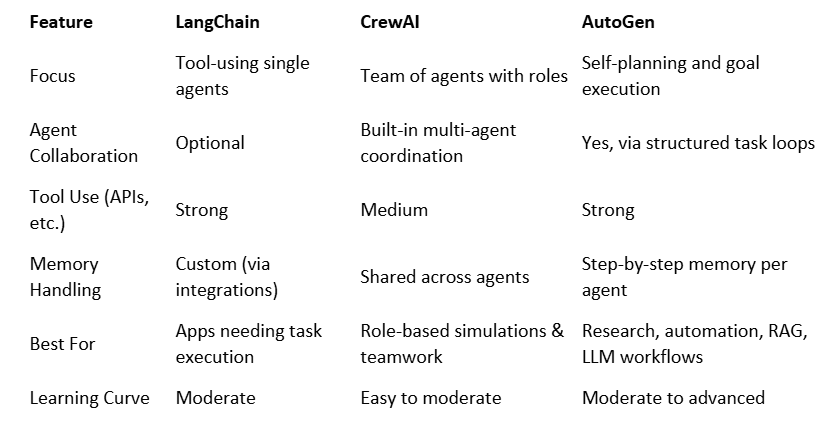
LangChain vs CrewAI vs AutoGen: Quick Snapshot
LangChain: The Go-To for API-Connected AI Agents
Overview
LangChain is the most widely used agentic framework, especially for building agents that interact with APIs, documents, databases, and external tools. It's highly modular, supports various LLMs, and is flexible enough to build pipelines that think and act.
Key Features:
Tool calling (APIs, SQL, webhooks, cloud functions)
Retrieval-Augmented Generation (RAG) for document-based agents
Custom memory integrations for context retention
Chain-of-thought style execution planning
Best Use Cases:
Building AI apps that automate workflows
Document querying agents with long-term memory
Assistants who interact with CRMs, spreadsheets, or customer data
LangChain is ideal when you need an agent to do real work inside your product — especially when APIs and backend systems are part of the flow.
CrewAI: Role-Based Multi-Agent Collaboration
Overview
CrewAI introduces a concept many teams love — giving each agent a clear role, goal, and tools, and letting them work together like a real-world crew. It's built with coordination in mind and is excellent for simulating how teams collaborate.
Key Features:
Agent personas with defined responsibilities
Shared memory across the "crew"
Natural conversations and task planning
Designed for human-in-the-loop validation
Best Use Cases:
Product simulations (e.g., AI PM, AI dev, AI QA working together)
Collaborative workflows like content production or market research
Building decision-making systems where roles matter
CrewAI helps bring the power of multi-agent systems to teams who want logic, structure, and modular control without writing too much coordination logic themselves.
And if you're working with an Ai Development Company, CrewAI is often recommended for prototypes where team simulation is key.
AutoGen: Goal-Driven, Loop-Based Agent Workflows
Overview
AutoGen is focused on agents that plan, execute, and retry if needed. Its strength lies in structured task decomposition, goal management, and autonomous decision-making over multiple rounds.
Key Features:
Agent communication through system messages
Structured multi-step reasoning
Automated retry and review processes
Integration with coding tasks, knowledge retrieval, and research
Best Use Cases:
Building research bots
Workflow automation with minimal human involvement
Data analysis and synthesis agents
Code generation and review systems
AutoGen is also strong in settings where agents need to learn and improve with feedback — ideal for internal tools, research workflows, or high-volume automation.
What Do These Frameworks Have in Common?
Though each has its own strengths, they share some key traits:
Support for LLMs and embeddings
Integration with tools and APIs
The ability to define agent goals and memory
Support for long-form multi-step thinking
A strong developer community behind them
They're all part of the bigger shift seen in AI language models 2025 trends, where static prompts are replaced by dynamic, living agents.
How to Choose the Right Framework for Your Product
1. Know Your Use Case
Need a solo AI that can book meetings, answer emails, and run reports? → Go with LangChain.
Want a virtual team of agents with roles like PM, dev, designer? → CrewAI is your best fit.
Building an agent that can plan, retry, and learn from mistakes? → Try AutoGen.
2. Start Small
Begin with a single agent that handles a basic task
Run it in shadow mode and evaluate results
Add complexity after validating performance
3. Consider Developer Experience
LangChain has deep docs and a large support community
CrewAI is intuitive for role-based tasks
AutoGen requires more setup but offers greater control
Choosing the right AI development tools early can save weeks of trial and error.
What About Integrating with Other AI Systems?
All three frameworks are compatible with popular tools like:
OpenAI, Claude, Cohere (for LLMs)
Pinecone, Weaviate (for vector memory)
Notion, Slack, GitHub, Jira (for tool use)
This means you can plug these agents directly into your existing workflows — whether internal, user-facing, or DevOps related.
Are These Frameworks Ready for Production?
Yes, with a few caveats:
Run in test environments first
Use human-in-the-loop for critical tasks
Log and monitor agent actions closely
Set task limits and retry counts
Agentic frameworks are still evolving. But with the right safeguards, many teams are already shipping real products on top of them.
Need a Recap?
LangChain → Best for solo agents with tool usage
CrewAI → Ideal for role-based collaboration
AutoGen → Top choice for planning and autonomy
All three support real-world workflows, from research to product dev
Start lean, monitor closely, and grow with confidence
If you're ready to ship something smarter, start with one agent — and let it prove itself.
Because agentic AI is no longer an experiment.
It's becoming the standard.
Final Thoughts: From Chatbots to Real AI Teammates
We're no longer asking, "Can AI answer a question?"
Now we're asking, "Can AI handle this task, talk to the right tools, fix mistakes, and report back?"
That's the difference between conversational AI vs generative AI, and agentic frameworks are what make generative systems come alive.
Whether you're building your first agent or scaling a full platform powered by dozens of roles, understanding the strengths of LangChain, CrewAI, and AutoGen will guide your architecture decisions.
Pick the right framework. Build small. Iterate fast. Scale what works.
That's how you build real value with AI in 2025 and beyond.
Appreciate the creator