A Practical Step-by-Step Workflow for Solving Math Problems
When a math problem feels difficult, the hardest part is often not the arithmetic. It is deciding where to begin, translating the question into symbols, and keeping each transformation logically connected. A reliable step-by-step workflow makes that process easier to learn and easier to check.
Start by identifying exactly what the problem asks. Write down the unknown quantity, the information provided, and any constraints. For a word problem, assign a variable to the unknown before writing an equation. For geometry, sketch the figure and label the known lengths or angles. For calculus, note whether the task asks for a derivative, an integral, a limit, or an interpretation of a result.
Next, choose the smallest useful rule. In algebra this might be distributing a factor, combining like terms, or performing the same operation on both sides. In calculus it might be the product rule, substitution, or integration by parts. State the rule before applying it. This habit turns a solution from a string of symbols into an explanation that another learner can follow.
After every major step, perform a quick consistency check. Ask whether equivalent operations were used on both sides of an equation, whether signs changed correctly, and whether units still make sense. These small checks catch errors earlier than waiting until the final answer. They also make it easier to locate the first incorrect step when an answer does not match.
Consider a simple system: 3x + 2y = 16 and x - y = 2. The second equation gives x = y + 2. Substituting into the first equation produces 3(y + 2) + 2y = 16. Expanding and combining like terms gives 5y + 6 = 16, so y = 2. Then x = 4. Substituting both values into the original equations verifies the result. The important lesson is not only the answer; it is the reusable sequence of isolate, substitute, simplify, and verify.
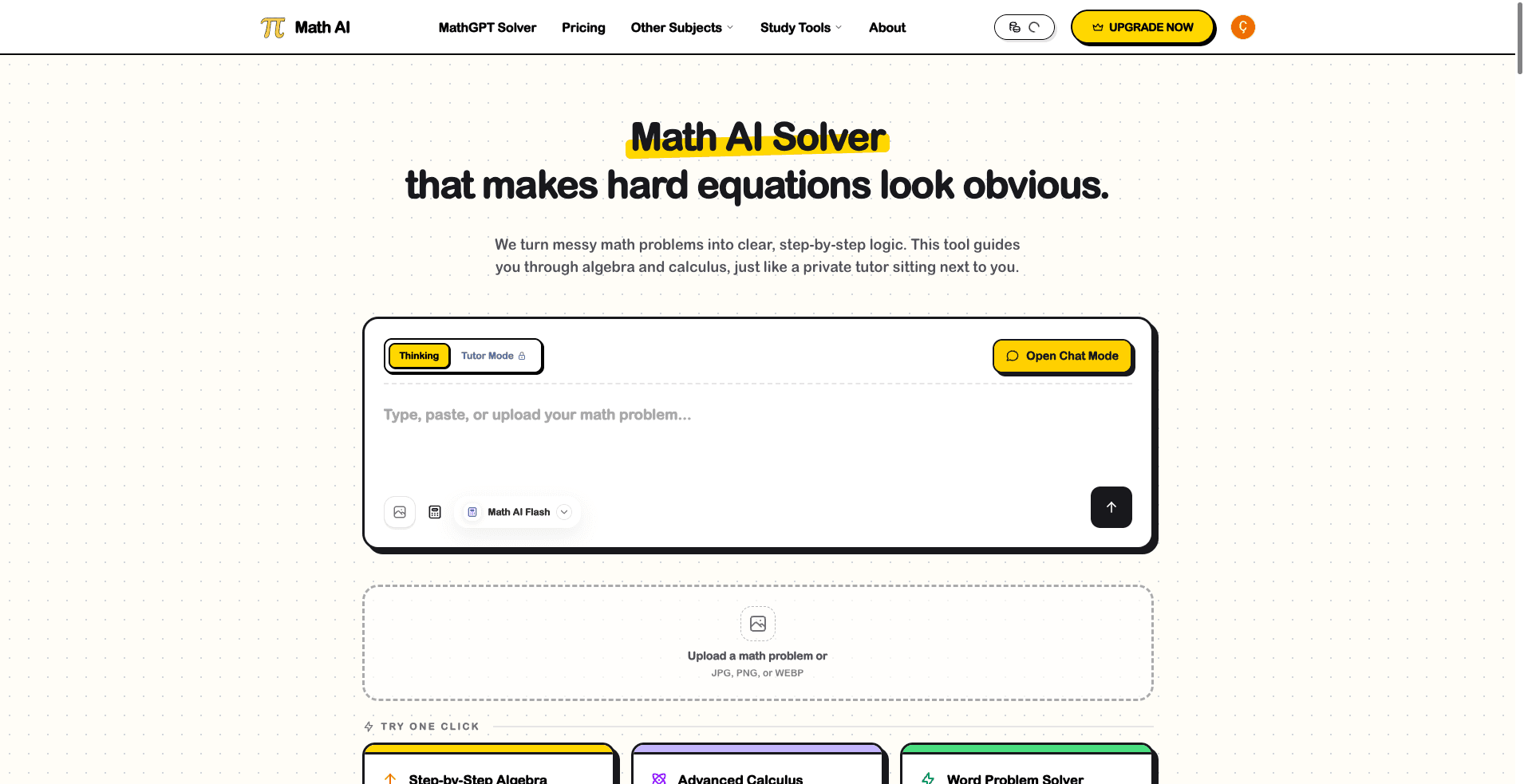
Technology can support this workflow when it explains the reasoning instead of replacing it. Math AI at https://mathai.chat/ is a web-based math solver designed around clear, step-by-step explanations. Learners can type a question or upload a problem image, then review a structured solution across algebra, geometry, calculus, probability, statistics, and mathematical word problems. The goal is to make each transformation understandable rather than present only a final number.
A productive way to use an AI math assistant is to attempt the first step independently, compare that step with the explanation, and then continue. If the methods differ, ask why each method works and which assumptions are being used. For exam review, hide the later steps and reveal them gradually. For homework checking, compare the setup and reasoning before comparing the final answer.
Students should also test the result themselves. Substitute an algebraic solution back into the original equation. Estimate whether a numerical answer is reasonable. Check dimensions in a geometry formula and units in an applied problem. For a derivative, differentiate by another method when possible; for an integral, differentiate the antiderivative. Verification transforms an AI-generated explanation into active practice.
Teachers and tutors can use the same process to create examples at different difficulty levels. A basic problem can focus on one rule, while an advanced version can combine several ideas and ask learners to explain the transitions. Parents supporting students can ask simple questions such as “What are we trying to find?”, “Which rule applies here?”, and “How can we check this step?”
The strongest math learning routine is therefore simple: define the unknown, select a rule, show one justified transformation at a time, and verify the outcome. Tools are most useful when they reinforce that routine. With deliberate practice, a complicated equation becomes a sequence of manageable decisions, and those decisions become transferable problem-solving skills.
Appreciate the creator