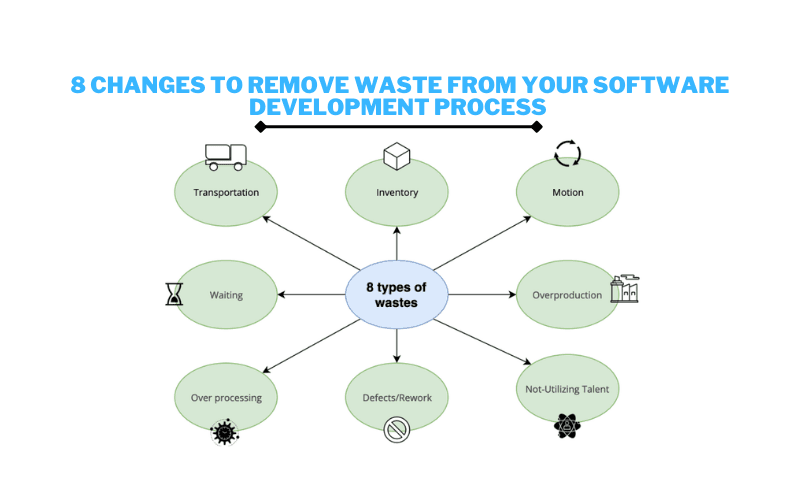
8 Changes to Remove Waste From Your Software Development Process
Even a well-functioning software development process can be a waste due to some bottleneck issues. Inefficient teams, resources and processes can be a hindrance existing in your software development “factory.” For your software to be highly efficient, you need to address waste systematically and sustainably.
In this technology-infused digitization, businesses aim to deliver quality applications successfully effectively, and quickly. To meet this imperative is by rooting latency out of the application delivery pipeline, followed by DevOps methodology that emphasizes automated solutions.
Techsaga is a leading automation software development company, aimed to increase the operational efficiency of business processes
You will learn how a DevOps approach can help you eliminate waste in your software development life cycle (SDLC).
1. Overproduction-
In your SDLC process, software professionals can produce a large set of bug fixes or features in this stage and are not ready to deploy. The team will keep on building the software and working on updates while sitting idle. If the team is deploying every feature in single stages, chances are to overwhelm your users with excessive feature additions and changes.
How to solve overproduction with the best DevOps methodology organization?
Your team needs to be in a position where they need to build a high-speed feature team, review your overall process, and rethink shifting the focus from quantity to quality.. Faster bug fixing leads to better quality software with fewer defects and a better place for delivering features to the customer.
2. Stagnation-
Technically, this doesn’t cost much to store stagnant software “inventory,” but organizations have paid their teams for the unfinished tasks which are not seeing any returns. Partially completed work will cost the organization much higher when trying to address these tickets later on.
Solving software inventory issues with DevOps:
Instruct your team to prioritize tasks If you find, for example, piles of unfinished projects, and none of them gets completed on time, their scope of work is too broad. Devote resources and time to proper backlog refinement and story adjustment.
3. Software Motion through SDLC-
Transferring software from one stage of the software development during the life cycle to another is termed “motion”. Each phase transition is an opportunity for a roadblock to introducing waste into your process.
How to solve motion roadblocks with DevOps:
Identify bottlenecks with mindfulness and how they would affect the flow of software during the life cycle. Prioritize removing those bottlenecks so that developers won’t be waiting for something else to happen before they initiate the task.
4. Preventable defects-
Software product development cycles can never be defective-free. The software continuously evolves due to technological innovation, changing landscapes and more. In a year, your software will not be the same as it is today. But these defects are treatable and rework must be done to decrease customer frustration.
How to address defects in DevOps:
Right process application witnesses improved software flow, with quality and sees fewer defects. Quality can be achieved through automated testing processes. A well-built testing process easily catch-up the defects in a small unit of work and also will require minimal effort to change it later.
5. Feature bloat-
Too many features will make your dashboard complex to navigate. More features will lead to software bloating, and the greater the chances of something going wrong.
How to solve over-processing with DevOps:
Proper backlog of tasks ensuring seamless runaway feature sets from being deployed. The team should not create features the customer doesn’t need, as they will be needing time to work on identifying and preventing defects.
6. Wait time-
Longer waiting time for processes like features integration, testing or deployment leads to bottlenecks in the process, as it will cause delay or slow their work process.
How to decrease wait time in DevOps:
Focus on creating and maintaining your value stream by filing time between the gap in the stages from deploying stage to production. Deploying automation is a great idea to reduce time wastage between those steps, prioritizing the gaps which require the least effort to solve. Most issues with long waiting times can be eliminated with automation or a policy change in a process. For example, any approval process which needed the manual intervention of humans can be replaced by some other checking methods.
7. Transport-
Transportation of software never adds any value to the SDLC cycle. This phase or stage includes making the created product reach its destination. In software, “transport” encompasses the time which is the time consumed while building the software, testing and approval for release and the moment when the customer uses it.
How to solve transportation issues with DevOps:
Transport issues of software can be handled with an integration, where artefacts are in motion. Implementing and integrating automated processes in the software will enable you to push software into an environment for testing and deliver it as soon as it's deemed customer-ready.
8. Environments-
One of the most common wastes of the current software development processes which include Agile methodology is setting up a development and testing atmosphere. Each time a new software developer joins the team, teams in an organization spend a considerable amount of time setting up and configuring Dev/QA environments. Additionally, if any change needs to be done in the configuration of existing applications, then software developers/IT staff get involved in reconfiguring the testing environments accordingly.
The testing environment is created by setting-up dedicated test servers and any changes to application configuration require the dedicated test server’s configurations to be changed relatively. A self-service test environment is a completely automated process. However, software development from self-service DevOps and test environments is completely automated using containers such as Dockers, and CoreOS and configuration management technologies such as Ansible, Chef, Puppet, etc. The human intervention and time involved in these environments are eliminated.
Nowadays, Software development teams utilise DevOps methodology, hence changing the way that software is developed and deployed. Best devops methodology organizations adopting the DevOps settings add value to the software development process and the customers. Thus, being in sync with the changing technology landscape.
Wrap Up!!
Above discussed warning signs can help you to keep a lookout and take action at each stage required. Map your waste against your SDLC process to help you take a structured approach to analyze your software flow. Inefficiencies with purpose can be addressed as they arise. Reducing waste within your process will help you increase velocity, the value you deliver to customers, and your company’s bottom line.
Being a top software design and development companyin Noida, Techsaga can take you forward on your DevOps journey to continuously improve the organization’s performance in terms of profitability, productivity, and customer satisfaction. our software engineers will provide the best end-to-end cloud cost optimization solutions and produce a cloud-based infrastructure to handle on-demand project requirements. Consequently, you can spare time and budget for other business-focused purposes.
Appreciate the creator