7 Smart Mining Dust Suppression Technologies Shaping 2026
Mining is becoming more technology-driven, but mining dust suppression remains a major operational and environmental challenge. Drilling, blasting, crushing, conveying, loading, stockpiling, and haul-road movement can all generate airborne dust.
Modern mines are therefore moving beyond basic water sprinkling toward targeted dust suppression systems for mines, automated monitoring, and application-specificmining dust control solutions. (https://duztec.in/sectors/mining-industry)
India's Ministry of Coal currently lists fog cannons, mist sprayers, wheel washing, mechanized road sweepers, continuous ambient air-quality monitoring, and wet drilling among technologies used for air-quality management in mining areas.
What Are the Latest Mining Dust Suppression Technologies?
The leading mining dust suppression technologies in 2026 include fog cannons, high-pressure misting, automated spray systems, dust suppression nozzles, fog curtains, mobile dust suppression units, and continuous air-quality monitoring. The right combination depends on the dust source, particle size, wind conditions, site layout, and operational requirements
Why Is Mining Dust Suppression Important?
Mining generates dust at multiple stages of operation. Crushing, screening, conveying, loading, unloading, drilling, and vehicle movement can create significant dust emissions in mines.
Fine particulate matter also requires particular attention. WHO identifies PM10 and PM2.5 as important health-related pollutants; PM2.5 can penetrate deep into the lungs and enter the bloodstream.
Effective mining dust suppression can help:
Reduce airborne dust
Control fugitive dust in mining
Improve workplace conditions
Reduce dust around crushers and conveyors
Control haul-road dust
Support environmental management
Improve visibility in operational areas
7 Smart Mining Dust Suppression Technologies
1. Fog Cannon Technology
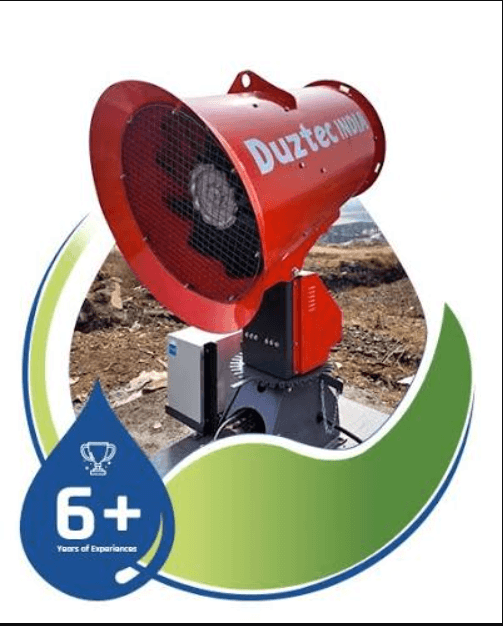
Fog cannon technology (https://duztec.in/product-detail/fog-cannon)uses fine water droplets that interact with airborne dust particles and help bring them down.
Fog cannons are particularly useful for large outdoor areas such as
Open-cast mines
Coal stockyards
Crushers
Material-handling areas
Haul roads
Loading and unloading zones
The Ministry of Coal specifically identifies fog cannons as one of the technologies being deployed for air-pollution control in mining areas.
Best for: Large, open dust-generating areas where wide-area coverage is required.
2. High-Pressure Water Mist Systems
High-pressure water mist technology produces very fine droplets that can target airborne dust more effectively than conventional sprinkling in suitable applications.
These systems can be designed around specific dust sources rather than simply wetting an entire area.
They are particularly relevant around crushers, conveyors, transfer points, and other material-handling locations where dust is continuously generated.
Best for: Fixed dust-generating points requiring targeted suppression.
3. Automated Dust Suppression Systems
Automation is becoming an important part of modern dust control technology for mining. (https://duztec.in/sectors/coal-and-power-industry)
Instead of depending entirely on manual operation, automated systems can be connected to sensors, timers, or site-control systems to activate suppression when required.
This can help avoid unnecessary water consumption while ensuring critical areas receive suppression during operating periods.
Best for: Large mining operations with multiple dust-generating points and variable operating conditions.
4. Advanced Dust Suppression Nozzles
A dust suppression system is only as effective as its application. Dust suppression nozzles determine factors such as droplet size, spray pattern, and coverage.
Incorrect nozzle selection can lead to poor coverage, excessive water use, or insufficient dust capture.
For example, a crusher may require a different spray pattern from a conveyor transfer point or stockpile.
Best for: Crushers, conveyors, transfer points, loading areas, and fixed dust sources.
5. Fog Curtain Systems
A fog curtain (https://duztec.in/product-detail/fog-curtain) creates a controlled mist barrier around specific areas where dust can escape.
This approach is useful when dust needs to be contained around a defined zone rather than treated across an entire mining site.
Potential applications include material-transfer areas, loading zones, and other points where airborne dust can move beyond the immediate source.
Best for: Containing dust around specific operational zones.
6. Mobile Dust Suppression Systems
Mining operations frequently change. Stockpiles move, haul routes change, and temporary work areas are created.
Mobile mine dust suppression equipment can provide flexibility where a permanent installation is not practical.
Truck-mounted or mobile systems can be moved between locations according to operational requirements.
Best for: Temporary work zones, haul roads, stockpiles, and changing mining environments.
7. Air-Quality Monitoring and Data-Driven Control
Modern mining dust management is increasingly moving from “suppress and forget” to measure, analyze, and optimize.
Continuous or periodic monitoring can help identify where particulate levels increase and whether existing mining dust control systems are performing effectively.
The Ministry of Coal reports that Coal/Lignite PSUs deployed or installed 93 continuous ambient air-quality monitoring systems (CAAQMS) along with 431 mist sprayers/fog cannons, 19 wheel-washing systems, and 26 mechanical road sweepers during FY2021–22 to FY2023–24.
Best for: Mines seeking measurable, data-driven environmental management.
How Can Mines Build a Smarter Dust Control Strategy?
A practical approach is
Step 1: Map all dust-generating activities.
Step 2: Identify major sources such as crushers, conveyors, haul roads, and stockpiles.
Step 3: Assess dust characteristics, operating conditions, and wind patterns.
Step 4: Select suitable mine dust suppression equipment for each source.
Step 5: Install suppression as close to the dust source as practical.
Step 6: Maintain pumps, pipes, nozzles, and control systems regularly.
Step 7: Monitor particulate levels and optimize the system based on actual site performance.
This source-based approach can be more effective than relying on one technology across an entire mine.
What Is the Future of Mining Dust Suppression?
The future is not about finding one machine that solves every dust problem. It is about combining technologies.
A large mining operation may use fog cannons for open areas, misting systems around material-transfer points, dust suppression nozzles on fixed equipment, mobile systems for changing locations, and air-quality monitoring to measure results.
This integrated approach is already reflected in India's mining-sector practices, where multiple technologies are deployed across roads, crushers, conveyors, loading points, and stock areas.
Conclusion: Smarter Mines Need Smarter Dust Suppression
Modern mining dust suppression is moving toward targeted, automated, and measurable solutions. From fog cannons and water mist to automated, advanced nozzles, fog curtains, and air-quality monitoring, mines now have multiple options for controlling dust at different sources.
The key is choosing the right combination rather than relying on a single dust suppression system. (https://duztec.in/category/dust-suppression-systems)
Duztec provides engineered mining dust control solutions for applications including crushers, conveyors, stockyards, haul roads, and material-transfer areas.
Frequently Asked Questions
What is mining dust suppression?
Mining dust suppression reduces airborne dust from drilling, crushing, conveying, loading, stockpiling, and vehicle movement using fog cannons, misting systems, sprays, and other technologies.
What is the best dust suppression system for mines?
The right dust suppression system depends on the dust source, site conditions, coverage area, and operating environment. Fog cannons suit open areas, while mist systems and nozzles work well for fixed sources.
How can mines control fugitive dust?
Control fugitive dust in mining from haul roads, stockpiles, crushers, and transfer points using fog cannons, misting systems, water sprays, road cleaning, and wheel washing.
How does fog cannon technology control mining dust?
Fog cannon technology releases fine water droplets that interact with airborne dust particles, helping suppress and settle dust across large outdoor areas such as stockyards, haul roads, and mining zones.
Why are PM10 and PM2.5 important in mining?
PM10 and PM2.5 are fine particulate pollutants that can affect air quality and health. Effective dust suppression helps reduce airborne particulate emissions around mining operations.
How can mining companies improve dust control?
Identify major dust sources, select suitable mining dust control equipment, maintain it regularly, and monitor performance. Combining multiple technologies can provide more effective site-wide dust control.
How often should mine dust suppression equipment be maintained?
Inspect pumps, pipelines, nozzles, and spray patterns regularly. Routine maintenance helps prevent blockages, leaks, and reduced system performance.
Appreciate the creator