7 Industrial Dust Control Mistakes You Need to Fix Now
Industrial dust control is no longer just about keeping floors and machinery clean. In factories, mines, crushers, cement plants, warehouses, and material-handling facilities, airborne dust can affect workplace air quality, equipment performance, productivity, and environmental compliance.
With tighter attention on particulate emissions and air pollution, businesses need to look beyond basic water sprinkling and adopt effective industrial dust suppression strategies. In 2026, CAQM has strengthened particulate-matter requirements for identified industries in Delhi-NCR, with a revised standard of 50 mg/Nm³ scheduled to apply from October 1, 2026. [1]
Quick Answer: What Are the Biggest Industrial Dust Control Mistakes?
The most common industrial dust control mistakes include treating symptoms instead of dust sources, relying only on water sprinklers, using incorrectly selected dust control equipment, ignoring fugitive dust, failing to maintain systems, and not monitoring results. Effective industrial dust control requires source identification, the rightdust suppression system, (https://duztec.in/category/dust-suppression-systems) regular maintenance, and continuous performance checks.
Why Does Industrial Dust Control Matter?
Industrial dust can come from crushing, grinding, loading, unloading, conveying, stockpiling, vehicle movement, drilling, and other material-handling activities.
Fine particulate matter is particularly important. According to the World Health Organization, PM10 can penetrate deep into the lungs, while PM2.5 can penetrate further and enter the bloodstream.
For industrial businesses, effective dust control can help:
Reduce airborne dust around production areas
Improve workplace air quality (https://duztec.in/sectors/mining-industry)
Control fugitive dust emissions
Protect equipment from excessive dust accumulation
Support environmental compliance
Improve visibility and working conditions
Reduce uncontrolled dust pollution
7 Industrial Dust Control Mistakes to Fix
Controlling Dust Without Identifying Its Source
One of the biggest mistakes is installing a dust control system before identifying where dust is actually generated.
A factory may have multiple dust-generating points, including crushers, conveyors, transfer points, loading areas, stockpiles, and vehicle routes.
Better approach: Conduct a dust-source assessment first. Identify where dust is generated, how it travels, and when emissions are highest. Then select the appropriateindustrial dust control solution (https://duztec.in/product-detail/fog-cannon).
Depending Only on Conventional Water Sprinklers
Water sprinkling can help suppress larger dust particles, but it may not be the right solution for every application.
Poorly positioned sprinklers can leave critical dust-generating areas untreated, while excessive water can create drainage, material-handling, and operational issues.
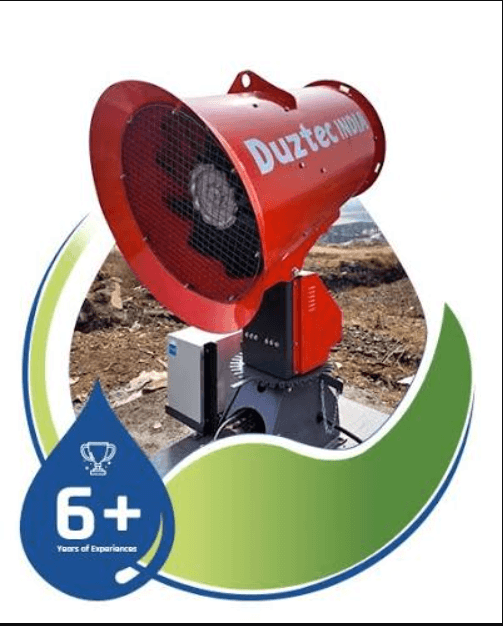
Modern industrial dust suppression can use technologies such as fine mist, fog cannons, high-pressure systems, fixed spray arrangements, and fog curtains depending on the application.
India's Ministry of Coal lists fog cannons, mist sprayers, wheel washing, mechanized road sweepers, and other technologies among the dust-control measures used in mining areas.
Using the Wrong Dust Control Equipment
Not every industrial facility has the same dust problem.
A crusher plant, cement facility, mine, construction site, and stockyard may require different dust control methods.
The wrong equipment may provide limited coverage or consume more water and energy than necessary.
Before selecting dust control equipment, consider:
Dust particle characteristics
Dust generation rate
Source location
Required coverage area
Indoor or outdoor application
Wind conditions
Water availability
Operating hours
Maintenance requirements
The objective should be to match the technology to the dust source rather than choosing equipment based only on price.
Ignoring Fugitive Dust
Not all industrial dust comes from a single visible emission point.
Fugitive dust can escape from stockpiles, haul roads, conveyors, transfer points, open material handling, and vehicle movement.
This makes fugitive dust particularly challenging because it can spread beyond the immediate production area.
The Ministry of Coal specifically identifies fugitive-dust control measures around washeries, crushers, belt conveyors, haul roads, coal stock areas, and other mining operations.
Better approach: Map the complete movement of material through your facility and identify every location where dust can become airborne.
Treating Maintenance as an Afterthought
Even a well-designed dust suppression system can become less effective when nozzles clog, pumps lose performance, pipes leak, or components become damaged.
Regular inspection should be part of the dust control plan.
A practical maintenance checklist should include:
Inspecting spray nozzles
Checking pumps and pipelines
Cleaning clogged components
Checking water pressure
Inspecting coverage patterns
Replacing damaged parts
Monitoring system performance
Preventive maintenance can help keep your dust control system operating consistently instead of waiting for visible dust problems to appear.
Focusing Only on Production Areas
Another common mistake is controlling dust inside the main production area while ignoring surrounding roads and vehicle movement.
Heavy vehicles can carry and redistribute dust across industrial premises. Roads, loading areas, parking zones, and material-transfer routes can therefore become secondary dust sources.
India's Ministry of Coal reports the use of mechanical road sweepers, wheel-washing systems, mist sprays, and fog cannons as part of broader mining-area air-pollution control (https://duztec.in/blog-details/industrial-dust-challenge-india-air-pollution-beyond-cities). During FY2021–22 to FY2023–24, Coal/Lignite PSUs deployed or installed 431 mist sprayers/fog cannons, 19 wheel-washing systems, 26 mechanical road sweepers, and 93 continuous ambient air-quality monitoring systems.
Not Measuring Whether Your Dust Control System Works
Installing equipment is not the final step.
The bigger question is, is it actually reducing dust where it matters?
Factories should monitor dust levels, identify recurring problem areas, inspect equipment performance, and compare conditions before and after implementation.
Depending on the facility, monitoring may include particulate measurements, visual inspections, ambient air-quality monitoring, and operational checks.
This data can help businesses identify underperforming areas and improve their industrial dust control strategy.
How Can You Improve Industrial Dust Control?
A practical approach:
Step 1: Identify all dust-generating activities.
Step 2: Classify the dust sources by severity and frequency.
Step 3: Assess particle size, operating conditions, water availability, and required coverage.
Step 4: Select suitable dust suppression technology and dust control equipment.
Step 5: Install the system at the source rather than treating dust after it has already spread.
Step 6: Regularly inspect and maintain the system.
Step 7: Measure results and optimize the system based on actual site conditions.
What Is the Role of Modern Dust Suppression Technology?
Modern industrial dust suppression is increasingly application-specific. India's mining sector, for example, uses fog cannons, mist sprayers, wheel washing, mechanised road sweepers, continuous air-quality monitoring, and dust suppression systems at multiple operational points.
For facilities dealing with large outdoor dust sources, technologies such as fog cannons and mist-based systems can provide targeted suppression. For enclosed or specific emission points, other engineered solutions may be more appropriate.
Duztec provides industrial dust control solutions designed around different applications, including fog cannon and mist-beam systems, high-pressure dust suppression, single-fluid dust suppression, fog curtain systems, and mobile dust suppression solutions.
Conclusion: Fix the Dust Problem at the Source
Effective industrial dust control is not simply about adding more water or installing a single machine. It requires a systematic approach to identifying dust sources, selecting the right dust control methods, maintaining equipment, and measuring performance.
As regulatory expectations and industrial air-quality requirements continue to evolve, businesses should treat dust management as an ongoing operational priority.
Duztec (https://duztec.in/)helps industries develop application-specific industrial dust control solutions, including fog cannon systems, mist-based technologies, high-pressure dust suppression, fog curtains, and mobile solutions.
The goal is simple: control dust at the source, improve workplace air quality, and build a more reliable industrial operation.
Frequently Asked Questions
What is industrial dust control?
It helps reduce dust from crushers, conveyors, loading areas, and vehicle movement, improving workplace air quality and controlling dust pollution.
How can I control industrial dust?
Identify major dust sources first, then use the right dust suppression system, misting, fogging, or spray technology for targeted control.
What is fugitive dust?
Fugitive dust escapes from open sources such as stockpiles, roads, conveyors, and transfer points. Source-level suppression helps prevent it from spreading.
Which dust control system is best for factories?
The right system depends on the dust source, site size, operating conditions, and required coverage. A site assessment helps select suitable dust control equipment.
How can factories reduce PM10 and PM2.5?
Use source-level dust suppression, control fugitive dust, maintain equipment, and regularly monitor particulate levels.
How often should dust suppression equipment be maintained?
Inspect nozzles, pumps, pipes, and pressure regularly. Routine maintenance helps prevent blockages, leaks, and reduced suppression performance.
Why is workplace air quality important?
Effective dust control reduces airborne dust exposure and helps maintain a cleaner and safer industrial workplace.
Appreciate the creator