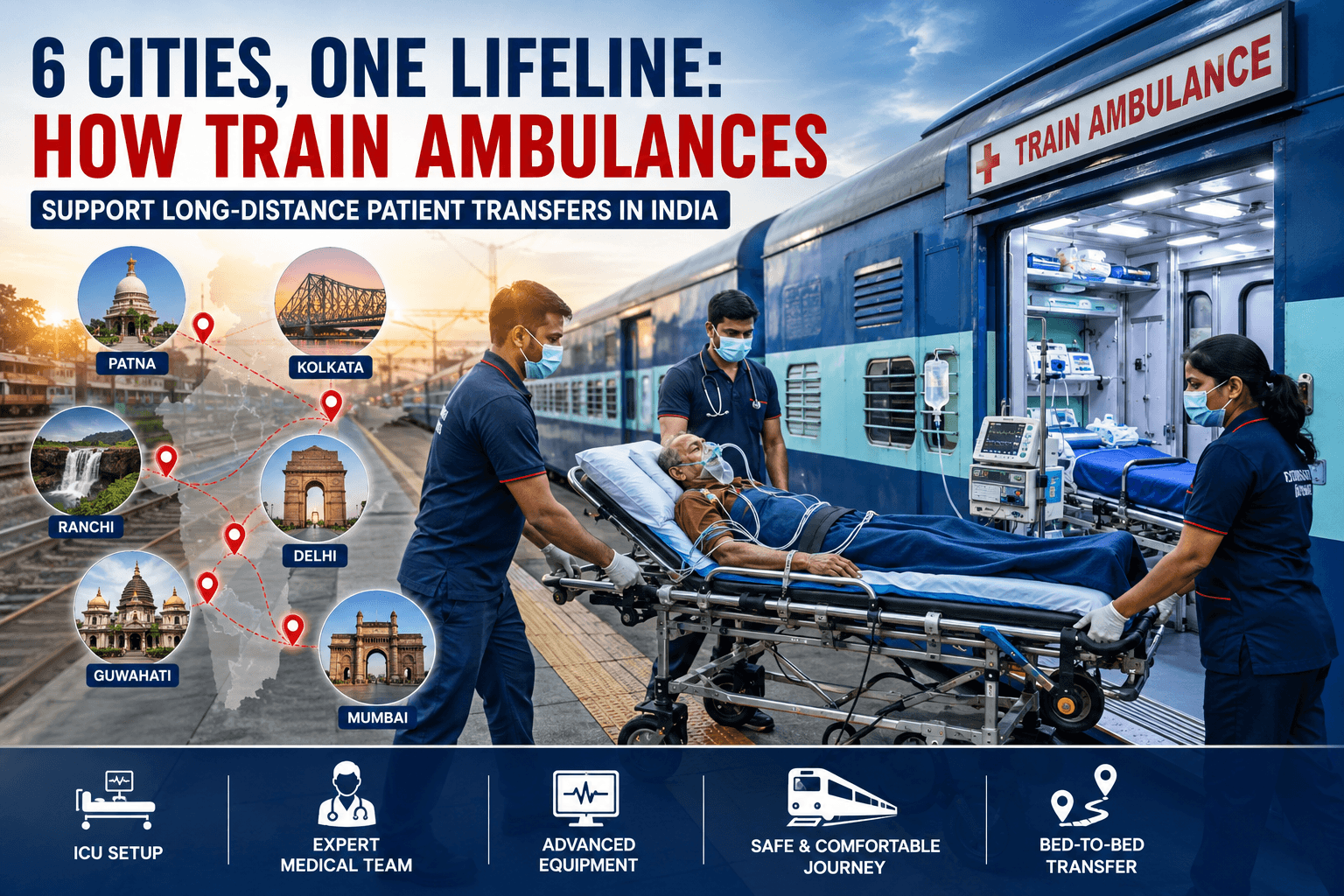
6 Cities, One Lifeline: How Train Ambulances Support Long-Distance Patient Transfers in India
For some patients, the biggest challenge isn't finding the right treatment—it is reaching the hospital where that treatment is available. In India, families often need to move patients hundreds or even thousands of kilometres from one city to another for specialized medical care.
This is where a train ambulance service in India can provide an important solution for long-distance patient transportation. Unlike ordinary train travel, a train ambulance transfer is planned around the patient's medical condition, required equipment, medical supervision, and destination hospital.
From Patna to Delhi, Ranchi to Kolkata, Guwahati to Mumbai, or other long-distance routes, medically supported railway transfers can help patients reach appropriate healthcare facilities while receiving continuous care during the journey.
Why Do Patients Need Long-Distance Medical Transfers?
Healthcare facilities and specialized treatments are not distributed equally across every city. A patient may receive initial treatment at a local hospital but later be referred to another city because a particular specialist, advanced procedure, cancer centre, cardiac facility, neurological unit, or surgical team is available there.
Long-distance transfers may be considered for patients who need:
Specialized cardiac treatment
Cancer care
Neurological treatment
Advanced surgery
Organ-related treatment
Critical care
Post-operative management
Rehabilitation
Specialist consultation
For these patients, transportation is not simply about moving from one location to another. The journey itself may require careful medical planning.
How Train Ambulances Help During Long-Distance Transfers
A train ambulance is designed to support patients who cannot safely travel like ordinary passengers.
Depending on the patient's condition, the medical setup may include:
ICU-style patient monitoring
Oxygen support
Ventilator support when clinically required
Cardiac monitoring
Infusion pumps
Suction equipment
Emergency medicines
Stretcher or medical bed
Trained medical professionals
Continuous observation during the journey
The exact equipment and staffing requirements should be decided according to the patient's medical condition and treating doctor's advice.
The objective is simple: make the journey as medically supported and coordinated as possible.
1. Patna: Connecting Patients to Advanced Treatment Centres
Patna is an important healthcare hub for Bihar, but some patients may still need to travel outside the state when they require highly specialized treatment.
A patient from Patna may be referred to another city because of the availability of a particular specialist, advanced surgical facility, cancer treatment centre, cardiac intervention, or other specialized services.
For patients who are medically stable enough for railway transportation but require assistance throughout a long journey, a train ambulance service in Patna (https://trainambulance.in/patna.html) can be considered.
The transfer may involve coordination between the originating hospital, medical team, railway journey, ground ambulance and destination hospital.
2. Ranchi: When Patients Need Care Beyond the City
Ranchi serves as an important healthcare centre in Jharkhand. However, families may sometimes need to move patients to larger healthcare destinations for specialized or highly advanced treatment.
A medically supported railway transfer can be useful when the distance is considerable and a conventional road ambulance journey may be difficult, particularly when the patient needs continuous monitoring.
A train ambulance in Ranchi (https://trainambulance.in/ranchi.html) can therefore become part of a broader patient-transfer plan involving hospital coordination and medical supervision.
3. Kolkata: A Major Destination for Specialized Healthcare
Kolkata is one of the major healthcare centres in eastern India and receives patients from several surrounding regions.
Patients from neighbouring areas may travel to Kolkata for specialized medical treatment. At the same time, patients who have received treatment in Kolkata may need to return to their home city for further recovery or follow-up care.
A train ambulance service in Kolkata (https://trainambulance.in/kolkata.html) can support these long-distance movements when the patient requires medical assistance during the railway journey.
The advantage is particularly relevant for families dealing with long-distance transfers where maintaining medical support throughout the journey is important.
4. Guwahati: Supporting Patients From Northeast India
For families in Northeast India, geographical distance can make medical transportation especially challenging.
Guwahati is a major healthcare and transportation hub for the region. Patients may sometimes need to travel from Guwahati to another metropolitan city for highly specialized treatment.
In such situations, a train ambulance service in Guwahati (https://trainambulance.in/guwahati.html) can provide an option for medically supported long-distance transportation, subject to the patient's clinical suitability for rail travel.
The journey needs to be planned carefully, especially when the patient requires oxygen, monitoring, or other medical support.
5. Delhi: One of India's Major Healthcare Destinations
Delhi and the surrounding National Capital Region are home to numerous specialized hospitals and medical centres.
Patients from Bihar, Jharkhand, West Bengal, Assam and other parts of India may be referred to Delhi for advanced treatment.
For a patient travelling from a distant city, simply purchasing a railway ticket may not be enough. A critically ill or dependent patient may require a stretcher, medical equipment, trained personnel and coordinated ground transportation.
A train ambulance service in Delhi (https://trainambulance.in/delhi.html) can support patients arriving in the capital as well as those who need medically supervised transportation from Delhi to another location.
6. Mumbai: Long-Distance Transfers for Specialized Care
Mumbai is another major healthcare destination where patients may seek specialized treatment.
For families travelling from eastern or northeastern India, the distance to Mumbai can be substantial. Depending on the patient's condition, a medically supported train transfer may provide an alternative to a long road journey.
A train ambulance service in Mumbai (https://trainambulance.in/mumbai.html) can help coordinate patient transportation involving medical assistance, ground ambulances and the required onboard setup.
The final choice of transportation should always depend on the patient's medical condition, urgency, distance and treating team's recommendation.
From One City to Another: What Does a Train Ambulance Journey Involve?
A long-distance patient transfer is usually more than just arranging transportation.
Step 1: Understanding the Patient's Condition
The patient's diagnosis, current condition, mobility, oxygen requirement and medical history are reviewed.
Step 2: Determining the Medical Requirements
The team determines whether the patient needs oxygen, monitoring, ventilator support, infusion pumps, suction or other medical equipment.
Step 3: Planning the Route
The journey is planned around the patient's condition, railway availability, pickup location and destination.
Step 4: Ground Ambulance Coordination
The patient may require an ambulance to travel from the hospital or home to the railway station.
Step 5: Medical Transfer
The patient is transferred to the medically arranged railway setup with the required medical team and equipment.
Step 6: Continuous Monitoring
During the journey, trained medical personnel monitor the patient according to their clinical needs.
Step 7: Destination Transfer
After reaching the destination, a ground ambulance can transport the patient from the railway station to the receiving hospital.
This bed-to-bed coordination can reduce the burden on families during an already stressful medical situation.
Train Ambulance vs Ordinary Train Travel
One of the most important differences is medical support.
An ordinary train journey is designed for passengers who can travel independently or with routine assistance. A patient requiring medical supervision may have very different needs.
A train ambulance arrangement may provide:
FeatureOrdinary TrainTrain AmbulanceMedical monitoringNo dedicated monitoringAvailable as requiredOxygen supportNot designed as a medical serviceCan be arrangedStretcher/medical bedGenerally unavailableMedical setup can be arrangedMedical personnelNo dedicated teamMedical team may accompany patientICU-level supportNot availableCan be arranged according to needGround ambulance coordinationPassenger's responsibilityCan be coordinatedBed-to-bed transferNoCan be arranged
The exact facilities depend on the patient's condition and the service arrangement.
Who May Need a Train Ambulance?
Train ambulance transportation may be considered for patients who are medically suitable for a long railway journey but cannot travel independently.
Examples may include:
Patients recovering after major surgery
Patients requiring oxygen support
Patients requiring regular monitoring
Bedridden patients
Elderly patients requiring medical assistance
Patients being transferred between hospitals
Patients travelling for specialized treatment
Patients requiring supervised long-distance transportation
However, not every critically ill patient is suitable for train transportation. Patients with unstable or highly time-sensitive conditions may require a different mode of medical transport.
The treating doctor or qualified medical team should assess the patient's suitability before transportation.
What Factors Affect Train Ambulance Cost in India?
There is no single fixed price for every train ambulance journey.
The cost may depend on:
Total travel distance
Origin and destination
Patient's medical condition
Type of medical equipment required
Oxygen or ventilator requirement
Number of medical professionals
Ground ambulance requirements
Number of attendants
Railway-related arrangements
Route and availability
Therefore, families should provide accurate patient details when requesting a quotation.
How to Choose the Right Train Ambulance Service?
Before arranging a long-distance medical transfer, families should ask important questions.
Is the service medically equipped?
Check whether the required equipment is available for the patient's condition.
Is trained medical staff available?
Ask whether doctors, nurses or paramedics accompany the patient when required.
Is ground transportation included?
A train journey is only one part of the transfer. Pickup and destination ambulances may also be necessary.
Can the service handle the patient's specific medical needs?
Ventilator-dependent, oxygen-dependent and critically ill patients may require different levels of support.
Is the journey properly coordinated?
Long-distance transfers require coordination between hospitals, railway arrangements, ground ambulances and medical teams.
Why Bed-to-Bed Coordination Matters
Imagine a patient travelling from Patna to Mumbai.
The journey does not begin when the patient boards the train.
It begins at the hospital.
The patient may first need to be transferred from the hospital bed to a ground ambulance, then from the ambulance to the railway medical setup, monitored during the journey, transferred to another ambulance after arrival, and finally taken to the receiving hospital.
Every transition is important.
That is why bed-to-bed patient transfer can be more useful than arranging railway transportation alone.
Final Thoughts
India's healthcare landscape often requires patients to cross state and city boundaries to access specialized treatment.
From Patna and Ranchi in the east to Kolkata and Guwahati, and from Delhi to Mumbai, long-distance medical transportation can become an important part of a patient's treatment journey.
A properly planned train ambulance service in India (https://trainambulance.in/) can provide medically supported transportation for patients who are suitable for railway travel and require assistance during the journey.
The most important consideration, however, should always be the patient's medical condition. Transportation should be planned with appropriate medical advice, suitable equipment, trained personnel and coordination between the originating and receiving hospitals.
For families facing a long-distance patient transfer, the goal is not simply to reach another city. It is to help the patient reach the right treatment with the right level of care along the way.
Frequently Asked Questions
What is a train ambulance service?
A train ambulance is a medically supported railway transportation arrangement designed for patients who need medical assistance while travelling long distances by train.
Can a patient travel from Patna to Mumbai by train ambulance?
Yes, depending on the patient's medical condition and suitability for railway transportation, a medically supported long-distance transfer may be arranged between Patna and Mumbai.
Can train ambulances operate between different states?
Yes. Long-distance patient transfers can involve multiple states, provided the patient's medical needs, route and railway arrangements are appropriately planned.
Can a ventilator patient travel by train ambulance?
Some ventilator-dependent patients may be transported by medically equipped train ambulance, but suitability depends on the patient's clinical condition and the medical team's assessment.
How is a train ambulance different from a normal train?
A train ambulance arrangement is designed around the patient's medical needs and may include medical equipment, trained personnel, monitoring and coordinated ground transportation.
What determines train ambulance cost?
Cost depends on factors such as distance, medical condition, equipment, medical team, ground transportation and railway arrangements.
How can I arrange a train ambulance?
Families can contact a professional train ambulance provider, share the patient's medical details and travel requirements, and discuss the appropriate medical setup and route.
Appreciate the creator